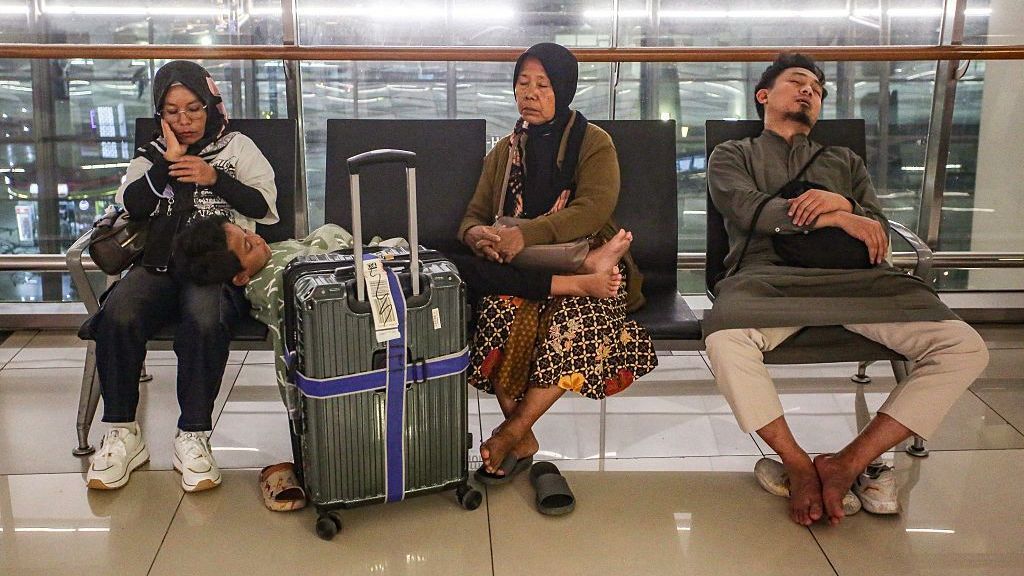
A series of explosive eruptions from Indonesia’s Mount Anak Krakatoa have triggered a major disruption to air travel across the country, forcing authorities to suspend hundreds of flights at the nation’s busiest international airport and leave more than 20,000 passengers stranded over the weekend.
Indonesian aviation officials confirmed that 209 inbound and outbound flights were called off at Jakarta’s Soekarno-Hatta International Airport starting Sunday morning, after dangerous volcanic ash plumes from the active volcano were detected in the airport’s controlled airspace. The operational halt was initially imposed shortly after the ash detection, and was later extended to 13:30 local time (06:30 GMT), extending uncertainty for affected travelers.
The volcanic activity first began late Friday night, when the volcano in the Sunda Strait between Java and Sumatra islands kicked off its latest eruption phase, marked by consistent seismic tremors, visible lava fountains that burst hundreds of meters into the air, and audible booming eruptions that could be heard across nearby coastal communities. Two additional distinct eruptions were recorded early Sunday, amplifying the volume of ash injected into regional air currents.
The flight suspension has impacted over 22,000 passengers traveling through the hub, with most of the affected routes connecting Jakarta to Singapore, as well as other key international destinations including Doha, Sydney and Kuala Lumpur. The disruption has also rippled through connecting flight schedules across Southeast Asia, with many airlines preemptively canceling services to avoid flying through ash-heavy airspace, which can cause catastrophic engine failure in commercial aircraft.
In a public safety update, Indonesian disaster management authorities have ruled out any immediate tsunami risk linked to the volcano’s current activity, easing concerns for coastal populations across the Sunda Strait. Still, Indonesia’s Health Ministry has issued urgent guidance for residents living in ash-prone areas surrounding the volcano, urging people to remain indoors whenever possible and wear properly fitted face masks to avoid health complications from ash exposure, including respiratory irritation, eye damage and skin inflammation.
Geologically, Anak Krakatoa – which translates to “Child of Krakatoa” – emerged from the ocean in the early 1900s, growing within the massive caldera left by the catastrophic 1883 eruption of its parent volcano, Mount Krakatoa. The original 1883 eruption was one of the most powerful volcanic events in recorded history, killing more than 30,000 people and altering global climate patterns for years. Anak Krakatoa has remained sporadically active throughout its existence, with occasional eruption cycles occurring every few years.
Indonesia is located along the Pacific Ring of Fire, a geologically active band that circles the Pacific Ocean and accounts for roughly 90% of the world’s earthquakes and 75% of its active volcanoes. The country is home to more than 120 active volcanoes, and regularly manages volcanic activity and associated disruptions to travel and local communities.