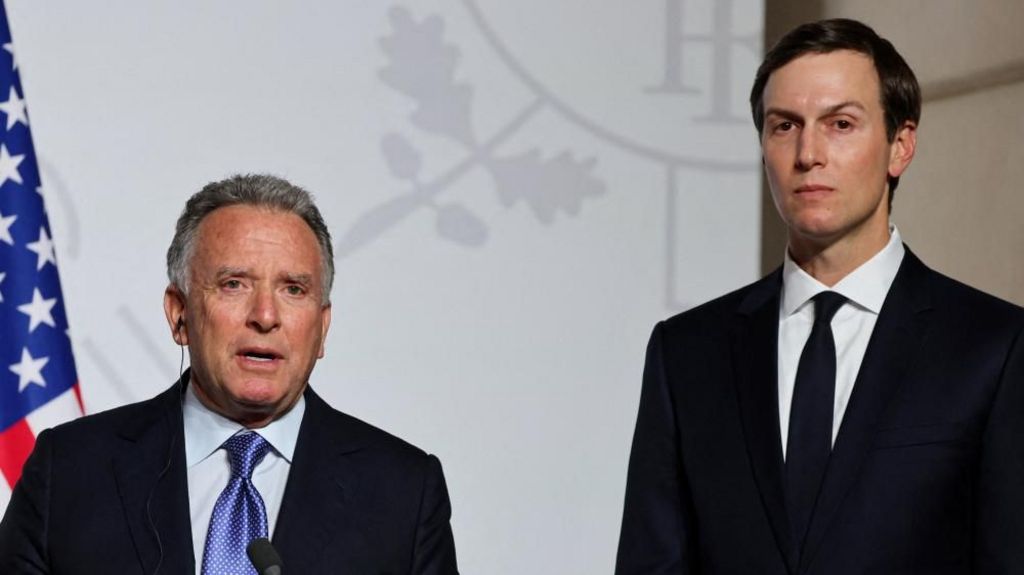
Two senior envoys appointed by U.S. President Donald Trump have touched down in Moscow, launching a high-stakes diplomatic push designed to break years of deadlock and advance negotiations to end the full-scale war in Ukraine.
Real estate developer Steve Witkoff and former White House senior advisor Jared Kushner arrived in the Russian capital on Saturday, following a multi-leg journey that originated in the U.S. and transited through Helsinki, Finland. Flight tracking data confirms a U.S. government aircraft carried the delegation to Moscow’s Vnukovo Airport, where the pair were greeted by Russian diplomat Kirill Dmitriev in photos captured on arrival.
The diplomatic itinerary calls for the envoys to wrap up their discussions in Moscow on Saturday before traveling onward to Kyiv on Sunday, marking their first visit to the Ukrainian capital since Trump returned to the U.S. presidency. This trip is not the first time Witkoff and Kushner have traveled to Moscow for peace negotiations, but their upcoming stop in Kyiv opens a new chapter in Washington’s effort to bring both warring parties to the table. Ukrainian delegations have already traveled to the U.S. for preliminary talks over the past 18 months, laying early groundwork for this weekend’s discussions.
Trump confirmed to reporters on Friday that the pair is carrying a formal draft proposal to end the conflict, a plan that comes after nearly four years of war and multiple failed diplomatic attempts by the U.S. and its European allies to broker a lasting ceasefire. Axios, the U.S. digital news outlet, first reported that the envoys will hold separate one-on-one talks with Russian President Vladimir Putin in Moscow and Ukrainian President Volodymyr Zelensky in Kyiv, a structure designed to address core sticking points between the two sides.
Even as diplomacy gets underway, fresh violence has underscored the fragility of the diplomatic process. Overnight ahead of the envoys’ planned arrival in Kyiv, Russia launched what Zelensky described as “demonstrative” strikes on key civilian airports in Kyiv and the nearby city of Boryspil. In comments to reporters Saturday, Zelensky called the strikes a deliberate show of force timed to disrupt preparations for the U.S. delegation’s visit, noting that Russian forces targeted the airfields that the U.S. delegation was expected to use to enter the country.
Ukraine’s airspace has remained fully closed to commercial and most non-military traffic since Russia launched its full-scale invasion in February 2022, a security restriction that adds logistical complexity to the envoys’ trip. Ahead of the visit, Zelensky announced Friday that Ukraine would guarantee safe passage through Ukrainian airspace for the delegation, and called on Russia to reciprocate with a similar security guarantee for the trip to Kyiv.
The strikes were not limited to air infrastructure: Zelensky also confirmed that an overnight Russian attack on a civilian building in Ukraine’s Dnipro region left four civilians dead and five more injured, a reminder of the ongoing human cost of the conflict as diplomats work toward a resolution.
This weekend’s diplomatic push comes just 10 days after Central Intelligence Agency Director John Ratcliffe made a rare, unannounced visit to Moscow. Officials in Washington and the Kremlin have not released any details of the discussions from that meeting, though Trump described the encounter as “semi-routine” in comments to reporters last week.
Diplomatic momentum for a peace deal built through 2025, when the U.S. brokered a flurry of talks between Moscow and Kyiv, with all three sides separately indicating that an agreement was within reach. European allies held a parallel round of negotiations in Paris later that year, but like prior diplomatic efforts, those talks concluded without any major breakthrough on core issues.
Today, fundamental disagreements continue to divide the two warring nations, most notably over territorial claims and long-term security guarantees for Ukraine. In recent months, fighting has intensified along the front line, and both Russia and Ukraine have ramped up cross-border aerial attacks. Ukraine has publicly warned that it faces critical shortages of air defense interceptor missiles, making it increasingly difficult to repel large-scale Russian strikes. For its part, Kyiv has shifted many of its own aerial attacks to target Russian economic and energy infrastructure deep inside Russian territory.
As the envoys begin their talks, the international community remains watchful for any sign of progress after years of failed diplomacy to end one of the deadliest European conflicts of the 21st century.