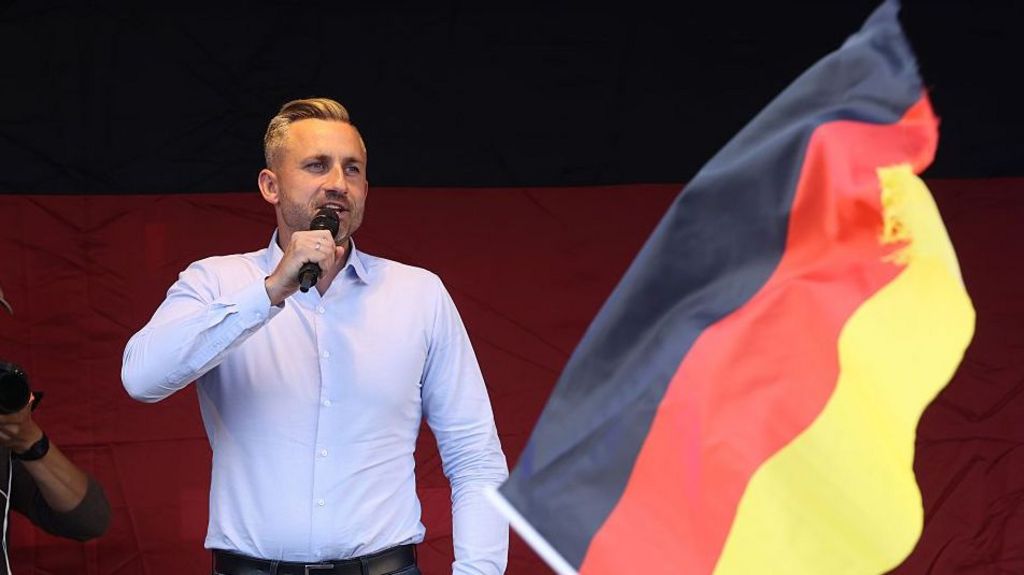
As Germany prepares for this weekend’s critical state election in Saxony-Anhalt, the entire nation is holding its collective breath. Polls currently place the far-right Alternative for Germany (AfD) and its lead candidate Ulrich Siegmund on track to win an outright parliamentary majority – a result that would mark the first time a far-right party has claimed full state-level power in post-war German history, a shift that could reshape the country’s political trajectory for decades to come.\n\nFor AfD leadership, a decisive victory in this eastern German state would be far more than a regional win: it would act as a critical stepping stone toward their long-held goal of gaining national power. For the party’s opponents, however, an AfD majority represents an existential threat to Germany’s post-war democratic order.\n\nThe election also casts fresh uncertainty over the future of embattled conservative Chancellor Friedrich Merz, leader of the Christian Democratic Union (CDU). Plagued by poor public approval and booing at recent public appearances, Merz is widely seen as a liability for center-right candidates on the campaign trail. Many political observers note he may already regret his public pledge to halt the far-right’s rise, a promise that has been undermined by the AfD’s growing momentum across the country.\n\nAt the center of the election campaign is 35-year-old Siegmund, a charismatic AfD figure who has dominated media coverage and energized grassroots support in the state. Labeled “Germany’s Most Dangerous Man” by leading German magazine Der Spiegel, Siegmund has pushed back against widespread reports that neo-Nazi affiliates hold influential positions in his inner circle, often presenting a populist, relatable public image across social media – sharing content of himself interacting with adoring supporters and riding a retro East German scooter.\n\nThe AfD’s surging popularity in eastern Germany, its long-standing stronghold, has been fueled by two overlapping forces: lingering nostalgia for the pre-reunification East German era and widespread public anger at the status quo. Voters across the state have voiced deep frustration over a range of issues, including unmanaged immigration, perceived public safety failures, Germany’s stagnant national economy, skyrocketing energy costs, and billions in aid sent to Ukraine. For many committed supporters, the AfD represents the only party offering meaningful, radical change, with Siegmund framed as a leader who has restored hope for disillusioned voters. Even more hesitant backers say they have abandoned decades of support for mainstream parties, which they see as unresponsive to working-class needs. As one AfD legislator put it, a turn to regional governance would prove to voters that “the sky won’t fall in” if the party takes power.\n\nDetractors argue that the AfD’s policy platform for Saxony-Anhalt is deeply controversial and incompatible with Germany’s democratic and social values. Key planks include segregating child refugees into separate schooling, on the grounds that their stay in Germany is temporary; the party’s manifesto also condemns what it calls the aggressive promotion of “sexual deviations and non-reproductive lifestyles” over “normal family structures,” calling for a ban on LGBT rainbow flags in public schools and a curriculum that reduces focus on Nazi history and emphasizes more “positive” elements of German national history. On immigration, the party has proposed creating a dedicated task force to detain and deport migrants who lack legal residency, while calling for an immediate end to what it labels “illegal, culturally alien” mass migration.\n\nThe AfD has also faced repeated scrutiny over its well-documented pro-Russia sympathies, leading to warnings that the party cannot be trusted with sensitive state intelligence. Just this week, Berlin publicly blamed Moscow for a failed drone attack on Leipzig/Halle Airport, a claim the Kremlin has denied. The controversy comes amid reports of a Russian military mug displayed in the office of senior AfD state figure Hans-Thomas Tillschneider, who dismissed the item as a simple souvenir, adding “it’s not our war.” German security officials have also warned of escalating Russian-backed disinformation campaigns targeting AfD’s political rivals, a charge Moscow dismisses as “anti-Russian hysteria.”\n\nWidespread concerns over extremism within the party are not limited to foreign policy. Saxony-Anhalt’s AfD branch is officially classified as a right-wing extremist movement by German domestic intelligence, which accuses the local organization of being rooted in “racist ideology” and holding anti-constitutional goals. During a recent AfD rally covered by the BBC, an attendee was spotted wearing a t-shirt emblazoned with “Arisch” – the German term for Aryan, the white supremacist racial category weaponized by the Nazis to promote their ideology of a master race. While it remains unclear whether the man was a party member, supporter, or casual attendee, the incident has reinforced long-standing concerns about extremist influence within the movement. The AfD, which frames itself as a conservative libertarian movement, rejects all extremism claims as politically motivated smears and rejects any comparison to National Socialism. If elected to a majority, Siegmund has even refused to rule out dissolving the state branch of Germany’s domestic intelligence agency (BfV), the body that monitors the party’s extremist activities.\n\nGermany’s mainstream parties have maintained a long-standing “Brandmauer” (firewall) policy, ruling out any formal or informal coalition with the AfD. This political blockade means the party must win an outright parliamentary majority to take power, rather than forming a coalition with smaller parties. Its path to victory therefore depends heavily on whether smaller competing parties manage to clear the 5% vote threshold required to gain seats in the state parliament – a mathematical reality that could work heavily in the AfD’s favor if smaller rivals fail to qualify.\n\nUnlike past regional elections where the AfD has only managed to crack the mainstream firewall, this vote could see the party bypass it entirely. If the AfD secures a majority, it will face an unprecedented test: for years, the party has built its support on anti-establishment rhetoric, blaming Berlin for all of Germany’s problems. Once in power, it will no longer be able to solely rail against incumbents – it will have to deliver on its promises, facing the same governing pressures that have frustrated mainstream parties for decades.\n\nState governments in Germany wield significant authority over key policy areas including local education, policing, and cultural policy, and their delegates hold seats in the Bundesrat, the federal government’s upper legislative chamber. An AfD-led state government would therefore be able to implement its controversial policy agenda at the regional level while gaining a far louder voice in national politics. Currently, the AfD not only leads polls in most eastern states but also holds a lead in national polling, making this regional election a critical bellwether for the country’s future.\n\nThough Saxony-Anhalt is a small state by population, its upcoming election is one of the most consequential political moments in modern German history, with outcomes that will ripple across the entire nation and European politics as a whole.