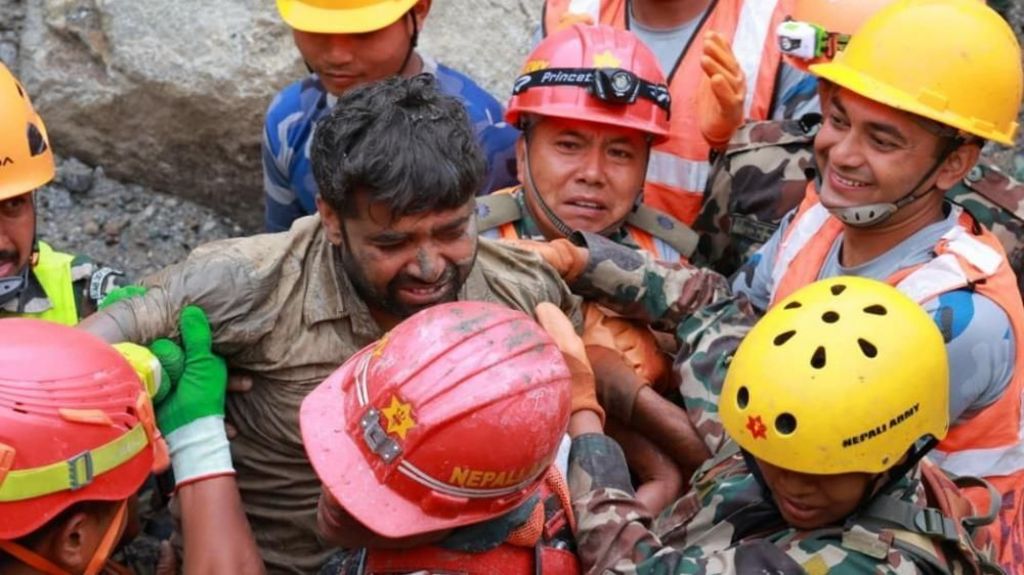
Nine days after catastrophic glacial-triggered flash floods swept through a Himalayan valley straddling the Nepal-China Tibet border, Nepalese rescue teams are continuing frantic operations to locate dozens of workers trapped inside hydropower construction tunnels, with renewed optimism sparked by two successful live extractions on Friday.
The disaster, which unfolded on August 26, is one of the deadliest mountain hazard events in the region in recent decades. Preliminary investigations point to a sudden glacial collapse as the root cause, with climate scientists warning that rising global temperatures have increasingly increased glacial instability across the Himalayan region. The collapse unleashed a massive surging wall of water and debris that roared downstream, flattening entire villages, destroying critical infrastructure, and sweeping away roads, bridges, and heavy construction equipment. As of the latest update, the combined confirmed death toll across Nepal and Tibet stands at 1,311, with another 5,330 people still listed as missing. Hundreds of these missing individuals are foreign citizens hailing from at least 34 different nations.
On Friday, rescuers working at the Trishuli 3A hydropower project, one of seven active tunnel sites where more than 150 people are feared trapped, detected faint sounds from deep inside the blocked tunnel. After calling out to potential survivors, crews received a quiet response of “okay,” prompting an urgent extraction effort. Two workers, Sanjaya Shah and Kabir Maharjan, were pulled from the tunnel alive, though both sustained hand and leg injuries consistent with crawling through debris-choked passageways. The two men were immediately airlifted to Kathmandu’s Army Hospital for urgent care: Maharjan remains in critical condition, while Shah is undergoing ongoing medical assessment. Hours after the successful rescue, teams recovered the body of a third victim from the same tunnel, which was too swollen to be immediately identified. Officials estimate that another 39 people may still be trapped in the Trishuli 3A tunnel, though there is no confirmation that any additional survivors remain alive.
Across the affected region in Nepal, more than 400 Nepali citizens and 270 foreign nationals have been pulled from flood-hit areas by rescue teams, according to Colonel Jhabindra Reshmi. Progress reaching trapped tunnel workers has been severely hampered by massive accumulations of mud and rock that block existing entrances, forcing crews to dig new access holes by hand and with limited heavy equipment. Engineers have been pumping oxygen into the blocked tunnels to sustain any potential survivors, but much of the construction machinery needed to clear debris was washed away in the initial flood, slowing rescue work significantly.
Despite the immense challenges, the successful rescue of the two workers has lifted morale among response teams. Uttam Bhlon Lama, vice president of the Independent Power Producers of Nepal, told the BBC that the extraction would motivate crews to redouble their efforts. Still, major hazards remain: flood levels across the region remain high, and Nepalese authorities have issued new warnings forecasting additional rainfall that could trigger secondary flash floods.
Across the border in Tibet, the full scale of the disaster remains unclear. Chinese state media has released footage showing widespread devastation, but has released limited details on victims and local impact. As of Friday, official reports from China confirm 31 deaths and 531 people missing, and emergency response teams in Tibet have shifted their focus to assisting displaced survivors rather than continuing search operations for additional survivors.
While the exact sequence of the glacial collapse is still under scientific investigation, experts from the Asian Mountain Academic Alliance, the Stimson Centre, and China’s Institute of Mountain Hazards and Environment note that growing glacial instability was detected in the days leading up to the event. The group has argued that more robust early warning systems could have reduced the death toll, highlighting gaps in hazard preparedness across a region increasingly vulnerable to climate change-driven glacial disasters.