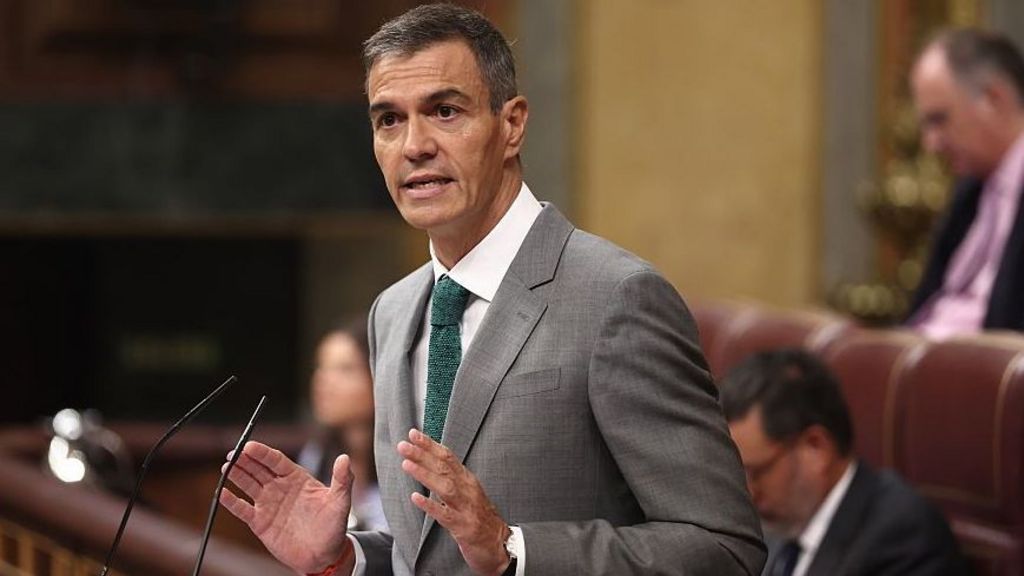
As widespread protests backed by Spain’s main opposition movement swept across the country, Spanish Prime Minister Pedro Sánchez stood before the national parliament Thursday to push back against growing criticism of his administration’s response to an unprecedented mass migrant influx into the North African Spanish exclave of Ceuta.
In late May, more than 72,000 migrants crossed the border from Morocco into Ceuta, one of the only two European Union land border outposts on the North African mainland. When addressing lawmakers, Sánchez rejected widespread claims that his government had advance knowledge of the surge and intentionally failed to act, calling such accusations “absurd”. He also doubled down on previous claims that there was no concrete proof the Moroccan government orchestrated the mass crossing, emphasizing that Madrid and Rabat had maintained “close coordination” on migration management throughout the incident.
Sánchez’s stance conflicts with a recent internal Spanish police report that noted the “total permissiveness” shown by Moroccan security forces towards migrants attempting the crossing, though senior Spanish officials have moved quickly to clarify the document does not officially accuse the Moroccan government of direct involvement. To date, more than 90% of the arriving migrants have been repatriated to Morocco, but roughly 5,000 people, including an estimated 1,400 unaccompanied minors, remain stranded on Ceuta’s public streets and beaches, creating a strained humanitarian and administrative situation for the small exclave.
Multiple independent reports have confirmed that Spanish officials received advance warnings of an expected surge in border crossings after a Spanish court ruling was widely misinterpreted by migrants as a guarantee that they would not be pushed back if they successfully crossed into Ceuta. Though Sánchez has long avoided public criticism of Morocco, he broke his silence to denounce what he called “unacceptable” comments made by two Moroccan ministers regarding both Ceuta and its sister Spanish exclave Melilla.
The Spanish government’s handling of the crisis has already sparked friction with other European Union member states. Italy, which has long struggled with its own migrant arrivals, moved quickly to implement new border restrictions for travelers coming from Spain in response to the Ceuta incident.
During his parliamentary address, Sánchez defended the actions of Ceuta’s local police force, praising officers for prioritizing “the defense of human life” over rigid border enforcement when the mass crossing began. He also reiterated that close bilateral cooperation with Moroccan authorities allowed for the repatriation of more than 90% of migrants within just 72 hours of the crisis beginning.
Acknowledging the severe disruption the influx has caused for Ceuta’s local residents, Sánchez framed the events of late May as a complex incident shaped by multiple overlapping actors and interests. He repeated his earlier claims that hoaxes and false rumors spread across social media platforms were a key trigger for the mass migration, a position that has already drawn significant criticism. Previously, Sánchez drew condemnation from both Russia and Israel after he blamed trafficking gangs and suggested social media accounts linked to both countries, alongside an international far-right movement, had fueled the crisis. He told lawmakers Thursday that while there is no evidence of direct state involvement from any country, he stood by his claims that linked social media accounts tied to Russia and Israel helped spread destabilizing misinformation.
Sánchez closed his address by describing the situation in Ceuta as both a pressing humanitarian crisis and a major administrative challenge for the Spanish state, as authorities work to find long-term solutions for the thousands of migrants still remaining in the exclave.