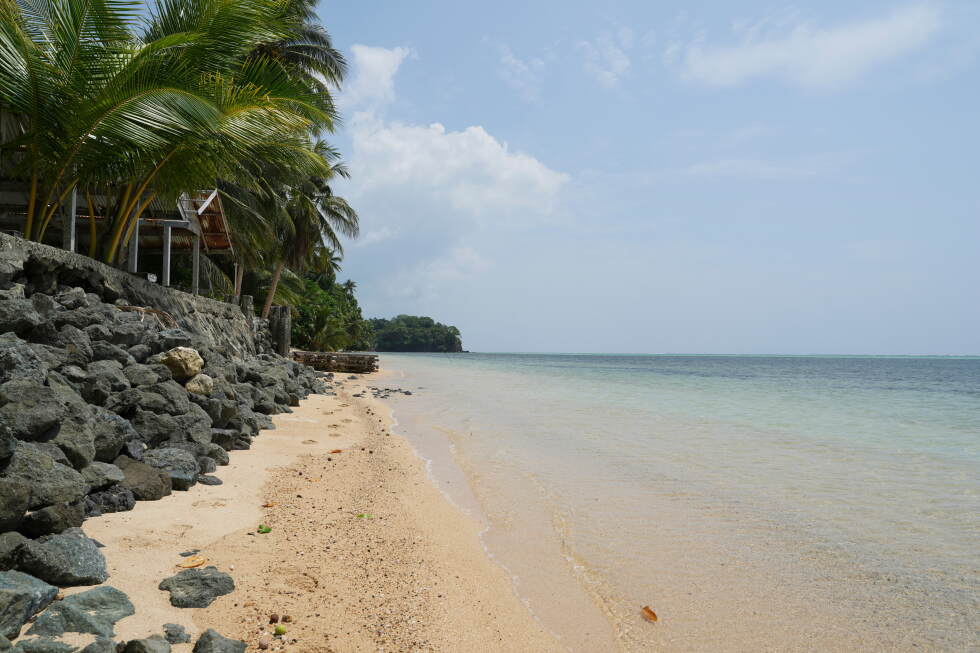
In the low-lying coastal community of Melekeok, a 300-person chiefdom on Palau’s largest island, storm surges driven by rising sea levels now routinely flood residential properties, forcing residents to plead for government support to relocate inland. For 43-year-old Bol Sebalt, a lifelong Melekeok resident who works as a legislative clerk and trained disaster response volunteer, the need for relocation could not be clearer — but chronic underfunding has left the community trapped.
Sebalt already moved to a newly platted inland subdivision designated for Melekeok’s displaced population, but she remains the only resident months after relocation preparations began. Funding for critical infrastructure including plumbing, sewage systems, and street lighting has trickled in in small, fragmented batches, moving far too slow to match the accelerating pace of climate change. “We cannot move faster than climate change,” Sebalt told the Associated Press, summing up the existential crisis shared by dozens of low-lying Pacific island nations facing encroaching oceans.
This collective crisis took center stage this week at the annual Pacific Islands Forum summit hosted in Palau, where leaders from the region’s most climate-vulnerable nations issued renewed dire warnings just days after the United Nations released a groundbreaking report confirming that global temperatures will exceed the 1.5°C safe threshold set by the 2015 Paris Climate Agreement within the next decade, driven by fossil fuel emissions from the world’s largest economies.
“Loss and damage is a reality that currently exists in my country,” said Vanuatu Climate Adaptation Minister Ralph Regenvanu Wednesday, speaking to reporters from the sweltering outdoor summit venue. “It will only accelerate with any overshoot, encompassing economic and non-economic losses that no finance can fully restore. This includes our ancestral lands, our heritage, our identity.”
For decades, Pacific island leaders have pressured major global greenhouse gas emitters to cut emissions enough to keep warming below 1.5°C, the threshold scientists identify as the line that would avoid the most catastrophic, irreversible impacts of climate change projected to occur if warming hits 2°C. The UN’s latest confirmation that the world will cross the 1.5°C mark in the coming years, even with temporary overshoot and efforts to cool the planet afterward, comes as too little, too late for these at-risk nations.
Beyond the immediate threat of submerged coastlines and displaced communities, regional scientific body the Secretariat of the Pacific Community (SPC) warns that warmer ocean temperatures will devastate the Pacific’s $multi-billion tuna fishing industry, which supplies 30% of the world’s global tuna catch, as well as the mangrove ecosystems that support juvenile fish populations. Already, the 2024 El Niño event has triggered extreme drought in some parts of the Pacific and catastrophic flooding in others, a pattern scientists project will only intensify as the planet warms.
“There is no other way out,” said Maina Talia, Tuvalu’s Minister for Climate Change. “The only way out for us is to ensure that we continue to push for 1.5, to stay alive, to stay in our countries.”
Palau’s President Surangel Whipps Jr., this year’s summit host, used his opening address to push back against the pattern of major global powers prioritizing geopolitical influence over climate action in the strategically vital Pacific region. Whipps argued that major powers seeking a foothold in the region should redirect their efforts toward funding climate adaptation and mitigation projects, backing his call with a goal to make Palau the world’s first nation powered entirely by renewable energy.
Despite Whipps’ appeal, longstanding geopolitical tensions quickly overshadowed opening proceedings, when diplomatic envoys from Beijing and Taipei were seated in the same row during the opening ceremony, rekindling the cross-strait rivalry that frequently distracts from climate action at regional summits. Geopolitical jostling is far from the only obstacle, however: a region-managed climate fund, the Pacific Resilience Facility (PRF), designed to deliver fast, direct funding for grassroots adaptation projects across the Pacific, has failed to secure the pledged funding from major global donors.
While some donors have cited governance concerns about the PRF, which will be headquartered in Tonga, regional leaders note the fund was intentionally designed to bypass the slow, rigid approval processes of traditional international financial institutions, which often delay critical aid for years while donors retain control over how funding is spent. For aid-dependent Pacific communities facing immediate climate threats, that delay is fatal. “International financial institutions have very lengthy, long processes to deliver the direct access funding that we require in the Pacific,” Tonga Prime Minister Fatafehi Fakafanua told the AP. “The PRF was purposefully designed to work immediately for the urgent needs of the Pacific Island people. That is something that differentiates the PRF from the existing financial models that we are using here in the Pacific.”
Tensions have also flared between the forum’s small island member states and its two largest, most powerful donor nations: Australia and New Zealand. Australian Prime Minister Anthony Albanese told reporters in Palau Wednesday that his country’s transition away from fossil fuels could not happen overnight, and required expanded renewable energy capacity to be feasible. “Australia is highly regarded when it comes to climate change and the talking down of Australia doesn’t happen from outside Australia, I make that point,” Albanese said.
Just an hour later, Regenvanu pushed back on that claim, noting that as one of the world’s top fossil fuel exporters, Australia is still approving new fossil fuel expansion — a step that directly contradicts the needs of climate-vulnerable Pacific nations. “Australia is a major producer of fossil fuels,” Regenvanu said. “The very least a country like Australia should be doing is stopping future expansion and it’s not doing that.”