As the United States prepares to mark the 25th anniversary of the devastating September 11, 2001 terrorist attacks, a new national poll has laid bare deep partisan divisions over the decades-long legacy of the post-9/11 “war on terror” and the domestic surveillance and security infrastructure it spawned.
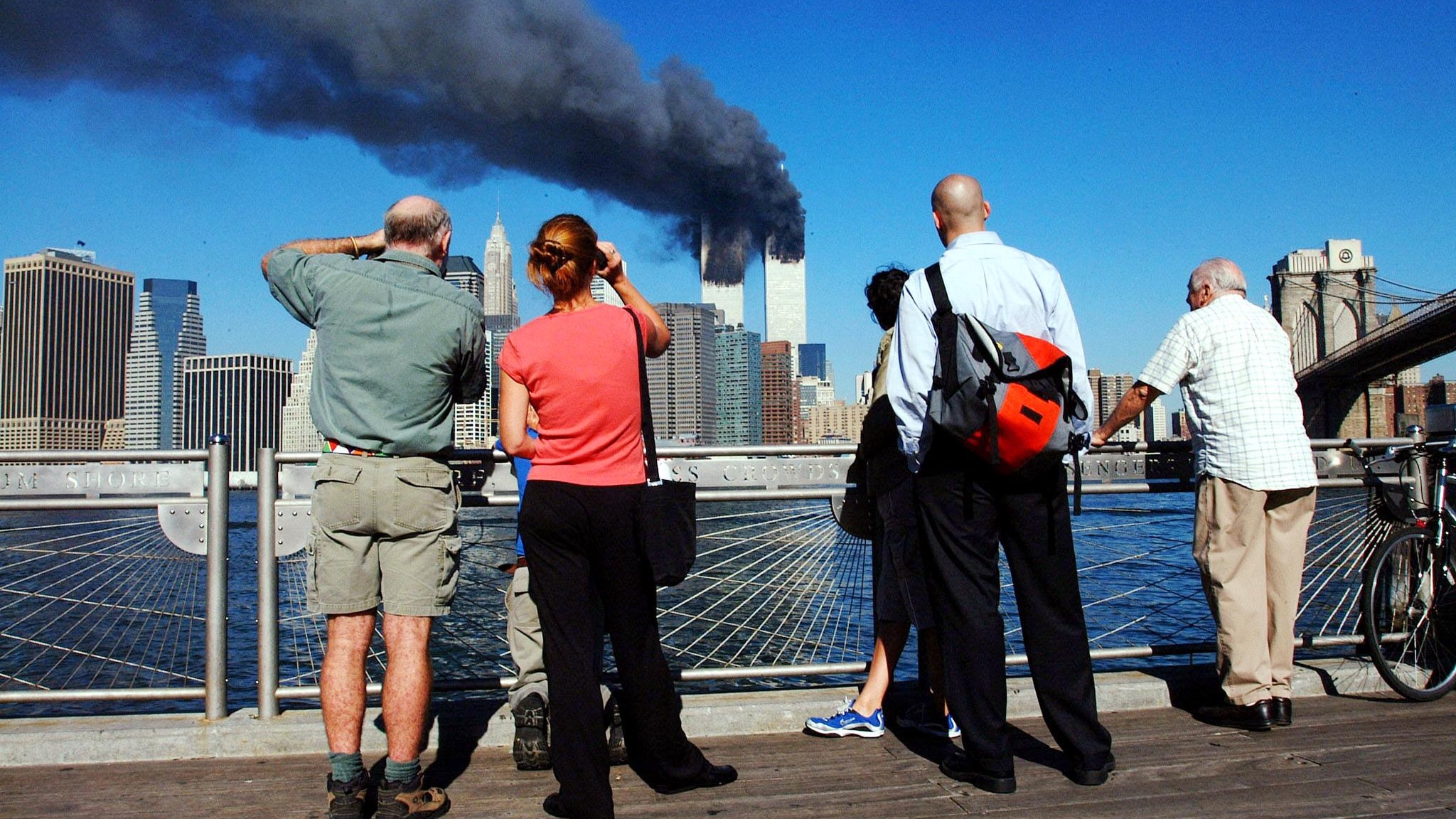
On September 11, 2001, 19 al-Qaeda hijackers seized control of four commercial airliners, launching coordinated attacks that killed nearly 3,000 people. Two planes crashed into the Twin Towers of the World Trade Center in New York City, destroying the iconic complex; a third struck the Pentagon outside Washington, D.C.; the fourth crashed into a rural field in Pennsylvania after passengers fought back against the hijackers.
In response to the attacks, then-President George W. Bush launched sweeping changes to U.S. national security architecture that reshaped American life for generations. The administration created the new Department of Homeland Security, established the Transportation Security Administration (TSA) which introduced widespread airport screening protocols still used today, signed the Patriot Act granting law enforcement broad authority to surveil citizen communications, and secured congressional passage of the 2001 Authorization for Use of Military Force (AUMF). That open-ended military authorization remains in effect 23 years later, and has been invoked by every subsequent administration to launch military operations across at least seven sovereign nations, including Afghanistan, Iraq, Syria, Somalia, Pakistan, Libya and Yemen.
The new YouGov poll, published Wednesday, surveyed 1,098 U.S. adults aged 18 and older between August 20 and 23, with a margin of error of plus or minus 4.1 percentage points. When asked whether post-9/11 counterterrorism measures—including overseas military operations and expanded domestic security and surveillance—have been “worth the cost”, 48 percent of respondents answered yes, 25 percent said no, and 27 percent reported being unsure.
Partisan affiliation drove starkly different views: 71 percent of Republican respondents said the measures were worth the cost, nearly double the 36 percent of Democrats who agreed with that assessment. That partisan divide extends to perceptions of national safety: just under half of all respondents (49 percent) said the U.S. is safer today than it was before the 9/11 attacks, but that number jumps to 60 percent among Republicans, while only 20 percent of Republicans say the country is less safe now.
Maha Hilal, author of *Innocent Until Proven Muslim*, a book documenting the human costs of the war on terror, attributed widespread acceptance of the “safer now” narrative to decades of sustained government propaganda and little visible disruption to daily life for most Americans. “It’s pretty easy to convince people that they’re safer now because their ability to maintain the same sort of lifestyle has been relatively unchanged, especially as Americans tend to be quite apathetic anyway,” Hilal told Middle East Eye.
The poll also found that a narrow majority of Americans—52 percent—recognize that Muslim Americans have faced worse treatment than followers of other faiths in the post-9/11 era. That finding also splits sharply along partisan lines: 71 percent of Democrats agree that Muslim Americans have been mistreated, compared to just 28 percent of Republicans. This gap comes as Muslim community leaders and experts report that current anti-Muslim rhetoric from leading Republican figures is more extreme today than it was in the immediate aftermath of the 9/11 attacks.
When asked which ideological group has carried out the most violent attacks within U.S. borders, 25 percent of respondents correctly identified right-wing extremists, while 19 percent blamed Islamic extremists, 17 percent pointed to unaffiliated lone wolves, and 13 percent named left-wing extremists.
Hilal noted that the decades-long success of the war on terror narrative has made it difficult even for progressive critics to center the harms of Islamophobia, which is often framed as an accidental side effect of counterterrorism rather than a core, intentional feature of the policy. “It has been to reiterate over and over again how this war has been a success, and how it has stopped numerous acts of terrorism,” Hilal said. “Even among leftists and liberals, it has been difficult to communicate the idea that Islamophobia has been a part and parcel to the war.”
The ongoing resonance of post-9/11 biases has been highlighted by a recent controversy at CBS News, which faced internal backlash from current and former staffers over its coverage of Abdul El-Sayed, the first Muslim Democratic nominee for U.S. Senate in Michigan, who is running in the 2024 November election. Critics accused the network of overt racism and poor journalism for publishing a pre-anniversary story highlighting old, deleted social media posts from El-Sayed. In the posts, El-Sayed compared the more than 1 million U.S. deaths from COVID-19 to the nearly 3,000 deaths from 9/11, and called for the same level of national mobilization to address poverty and the pandemic that the country deployed after the attacks. He also mourned both the victims of 9/11 and the hundreds of thousands of people killed in the post-9/11 wars that followed.
New research from Brown University’s Costs of War project has underscored the staggering human toll of those post-9/11 conflicts. A 2023 report from the project estimated that at least 4.5 million people have died as a direct or indirect consequence of post-9/11 wars across the Middle East, North Africa and Asia. Of those fatalities, between 3.6 and 3.7 million are classified as indirect deaths, caused by collapsed economies, widespread food insecurity, destroyed public health infrastructure, environmental contamination, and ongoing intergenerational violence and trauma that follow armed conflict. Even after the U.S. withdrew its formal military presence from Afghanistan in 2021, Afghans continue to suffer and die from war-related causes at higher rates than at any point during the conflict, the report found. Many of these indirect deaths could have been prevented if not for the collapse of basic services brought by war, researchers noted.
While casualty counts for post-9/11 conflicts remain a topic of heated political debate, independent estimates have consistently pointed to massive death tolls: a 2015 report from Nobel Prize-winning organization Physicians for Social Responsibility estimated that more than 1 million people had been killed in Iraq, Afghanistan and Pakistan alone by that point.