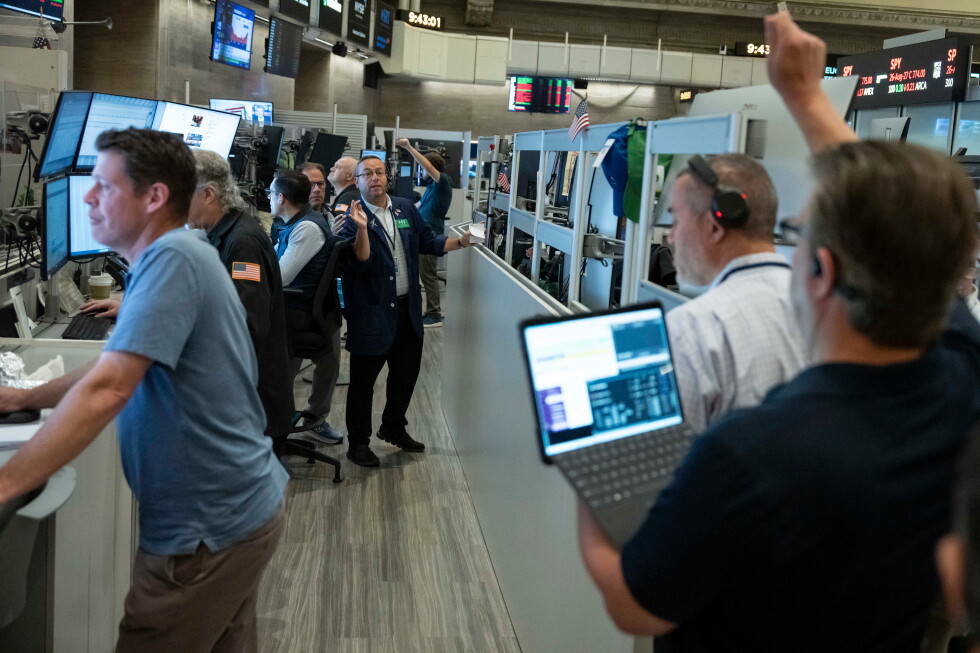
Global financial markets swung sharply on Monday after U.S. forces carried out the first direct military action against Iranian rocket launchers in the Strait of Hormuz in a month, ending a weeks-long lull in regional tensions and stoking new fears of broader conflict in the oil-rich Middle East.
The targeted strike, which came on Sunday, has upended recent market calm that had begun to reduce the geopolitical risk premium baked into global crude prices. As of early Monday trading, U.S. stock futures pointed to clear downward momentum: futures tied to the S&P 500 and the Dow Jones Industrial Average each dropped 0.2%, while Nasdaq 100 futures slipped a more modest 0.1%. European markets followed the negative trend, with Germany’s DAX index falling 0.8% to 26,364.99 and France’s CAC 40 edging slightly lower to 8,399.55. British markets were closed for a national bank holiday, and Asian markets finished the trading day mixed. The U.S. dollar edged down slightly against the Japanese yen, falling to 159.72 yen from 160.10 yen, while the euro ticked up modestly to $1.1602 from $1.1580.
The most dramatic market movement came in the energy sector, where crude prices surged in response to renewed geopolitical risk near the Strait of Hormuz, a critical chokepoint through which roughly a fifth of global oil supplies pass daily. International benchmark Brent crude jumped 3.4% to reach $91.10 per barrel, while U.S. domestic benchmark West Texas Intermediate crude rose 3.6% to trade at $86.40 per barrel. Stephen Innes, a strategist at SPI Asset Management, noted that the strike shattered the quiet that had allowed traders to start rolling back geopolitical risk pricing. “The Middle East had finally gone quiet enough for oil traders to start sanding some of the war premium out of crude,” Innes wrote in a market note. “Then Sunday arrived, with a reminder that quiet in the Strait of Hormuz is not the same as peace.”
Along with the geopolitical shock, the Trump administration has rolled out new economic measures targeting Iran, amplifying market concerns over the potential for further escalation of hostilities that could disrupt global energy supplies. For U.S. consumers, the price jump has already translated to record-high fuel costs this month: AAA data shows the national average gasoline price has stayed above $4 per gallon every single day in August, marking the most expensive August for gasoline on record. This milestone outpaces even the severe supply chain disruptions that pushed fuel prices higher during the COVID-19 pandemic in August 2022, creating additional widespread economic pressure on households both in the U.S. and around the globe.
Not all equities moved downward on Monday. GameStop, the video game retail chain, saw its shares surge more than 5% in pre-market trading after the company released preliminary second-quarter earnings results that outperformed its year-ago performance. On the other hand, professional services firm Aon saw its share price dip slightly after the company announced it would acquire insurance broker USI Insurance Services from private equity firm KKR in a $17 billion deal that includes assumed debt.
Beyond the immediate geopolitical shock, markets are also bracing for two key coming events: the release of U.S. August jobs data later this week, and a potential interest rate hike from the U.S. Federal Reserve. July’s jobs report delivered an unexpected slowdown, with employers cutting 23,000 jobs, and revised Labor Department data later slashed an additional 103,000 jobs from May and June payrolls. The Fed, meanwhile, signaled its continued commitment to lowering inflation in a high-profile speech Friday by Fed Chairman Kevin Warsh at the annual Jackson Hole economic symposium in Wyoming, even acknowledging that the policy would likely bring short-term economic pain. Following Warsh’s remarks, the yield on the two-year Treasury note, which closely tracks investor expectations for Fed policy, jumped to 4.35% from 4.22% before the speech.
The Fed’s potential rate hike sets up a new clash with President Donald Trump, who appointed Warsh and has repeatedly pushed publicly for lower interest rates to boost economic growth. Warsh reaffirmed Friday that the central bank will move away from giving explicit forward guidance to markets about future policy moves, while emphasizing that short-term interest rates remain the Fed’s primary tool to pursue its dual mandates of stable low inflation and a strong labor market.
In alternative asset trading, Bitcoin extended its monthly rally on Monday, climbing roughly 1% to $78,625. The leading cryptocurrency has already gained roughly 25% so far this month, outperforming many traditional asset classes amid ongoing market volatility.