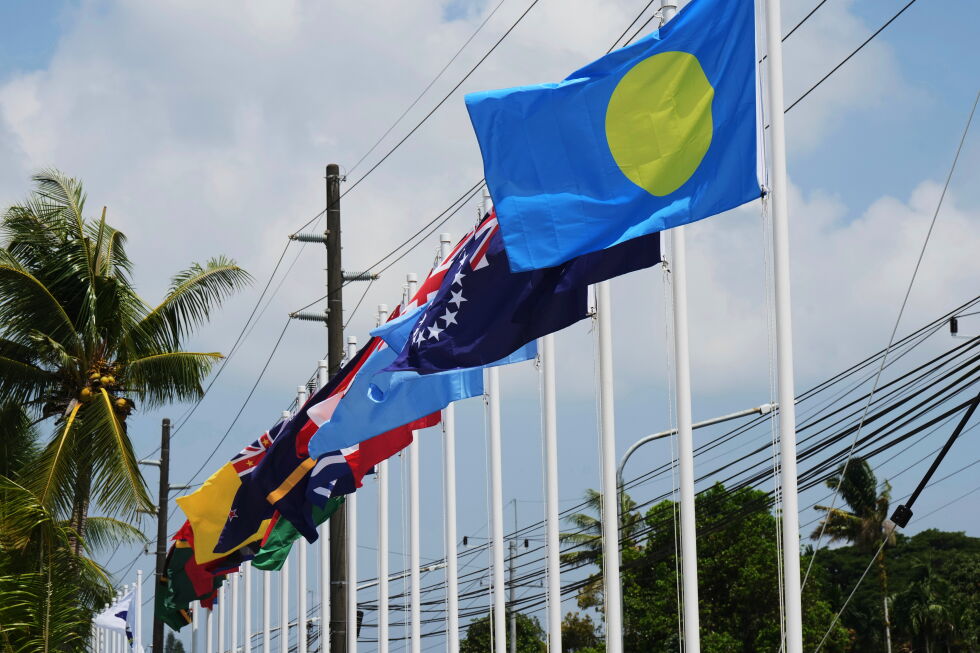
KOROR, Palau — Against the backdrop of a calm tropical archipelago with no traffic lights, far from the global diplomatic hubs of New York and Davos, leaders from some of the world’s smallest sovereign states have gathered for the annual Pacific Islands Forum Leaders Meeting. For this year’s gathering, the tiny host nation Palau, which has a permanent population of just 18,000, has seen its population jump to 20,000 with the arrival of delegates from dozens of participating nations and territories.
In the lead-up to the summit’s official opening on Monday, local communities mobilized to welcome guests: Palauan President Surangel Whipps Jr. joined senior government officials in cleaning litter along the island’s main coastal road, while local barbers and tattoo artists stepped in to volunteer as drivers for delegates, and student groups prepared to guide visiting dignitaries. But beyond this distinctly warm, unhurried Pacific welcome, a tense, escalating geopolitical dispute simmers beneath the surface, centered on which global powers will shape the future of this vast ocean region.
Over the past several years, major global powers have raced to cement strategic alliances among Pacific island nations, intensifying a high-stakes contest for regional influence that pits China against the United States, Taiwan, Australia and New Zealand. These competing overtures have drawn deep dividing lines among the Forum’s 18 member states and territories, threatening to derail the annual gathering that has long served as the region’s premier diplomatic body.
“The Pacific is our home, not a theater for geopolitical competition,” President Whipps told reporters on Sunday. He urged major global powers closely monitoring the week’s talks to stay out of internal discussions, which he said should center on the existential threats facing small Pacific island nations: accelerating climate change and collapsing local economies. “Let’s not use this as a place that we should be threatening or making people feel uncomfortable,” he added. But observers warn the reality of the summit will be far from simple.
Many Pacific Islands Forum members, some of which count their populations in the low thousands or tens of thousands, were long known primarily as idyllic tropical tourist destinations. Today, however, these nations hold outsized strategic and economic importance: most control sprawling, resource-rich exclusive economic zones brimming with commercial fisheries and untapped seabed minerals, and their positions across the breadth of the Pacific have made them key strategic nodes amid rising global tensions, turning small island states into sought-after international allies.
While Forum members often refer to themselves as a “Pacific family,” they encompass diverse cultures and political systems, and their geographic isolation means leaders rarely have the chance to meet in person. For decades, the annual leaders’ summit was a relaxed, informal affair, where small states with little global clout sought to amplify their collective voice by agreeing to unified positions — most notably, pushing wealthy major emitters to cut greenhouse gas emissions as rising sea levels began to threaten low-lying atoll nations with complete submersion.
But over the past decade, as major powers have ramped up efforts to secure access to Pacific waters and port infrastructure by signing security agreements, offering large-scale funding, expanded immigration access and other incentives, the Forum’s longstanding ability to speak with one unified voice has fractured. The body’s traditional “Pacific Way” of decision-making — which requires consensus rather than a majority vote to move forward — has increasingly struggled to overcome these divides.
“We see examples of this where that consensus-based model, which is referred to as the Pacific Way, can sometimes lead to a bit of paralysis in taking action,” explained Oliver Nobetau, Pacific Islands program director at the Australian think tank the Lowy Institute. A recent high-profile example underscored this weakness: when Forum foreign ministers gathered earlier this year, they failed to reach a consensus on a statement criticizing China’s July launch of a ballistic missile into the South Pacific. While most members strongly opposed the launch, the refusal of just two states to endorse the statement meant no official statement could be released at all.
“At this point in time when Pacific Islands are facing a lot of acute security issues, decision-making is paramount for this summit,” Nobetau said. “We’ll be looking to see if President Whipps can sort of steer the forum to take tangible action.”
Beyond geopolitical rivalry, Pacific nations are grappling with a cascade of immediate, urgent crises. The current El Niño event has triggered extreme weather across the region, bringing severe droughts and destructive floods that threaten already fragile food security and clean water access. Most island nations rely heavily on imported goods and depend on foreign aid to balance their budgets, leaving them extremely vulnerable to these shocks. Compounding this, global fuel volatility stemming from ongoing Middle East tensions has triggered severe economic disruption across the region, which is almost entirely dependent on imported diesel and gasoline delivered through a fragile global supply chain — several nations have already declared national emergencies in response.
President Whipps has proposed a path forward for wealthy powers seeking regional involvement: opening their coffers to fund the widespread installation of solar energy infrastructure across the Pacific, helping the region transition away from fossil fuels. “What are they doing together with us to partner to get a 100% renewable Pacific?” he asked this week.
Geopolitical tensions are set to dominate much of the summit’s discourse, however. Palau is one of only 12 countries worldwide that maintains formal diplomatic recognition of Taiwan, a stance that has drawn consistent pushback from Beijing, which claims Taiwan as an inalienable part of its territory. The island nation also sits at the center of other great power competition: located in the western Pacific adjacent to the Philippines, Palau draws significant tourism from Asian markets and maintains closer ties to the United States than most Forum members, under a Compact of Free Association that grants U.S. defense and security access to Palauan territory in exchange for tens of millions of dollars in annual U.S. funding.
This year’s summit also finds leaders once again attempting to finalize rules governing the participation of non-member states in Forum meetings. Approved participating nations such as the U.S. and China hold formal “dialogue partner” status, while Taiwan holds separate standing as a development partner. Beijing has increasingly pressured Forum hosts to bar Taiwanese envoys from the annual summit; this dispute grew so acrimonious ahead of the 2025 summit set to be hosted by the Solomon Islands that all non-member delegates were ultimately barred from attending entirely. This year, Palau’s close diplomatic ties to Taipei have allowed Taiwanese Foreign Minister Lin Chia-lung to attend the summit, drawing a formal warning from Beijing that it opposes Taiwanese participation.
The prospect of another summit overshadowed by non-member great power rivalry has sparked frustration among Pacific officials and regional analysts. Over the weekend, the gathering was already hit by unexpected upheaval: newly elected Solomon Islands Prime Minister Matthew Wale, who is seen as more aligned with Australia than his Beijing-leaning predecessor, flew home just hours after arriving in Koror after a domestic political opponent launched a leadership challenge. It remains unclear how much his sudden departure, alongside the absence of other leaders including Kiribati President Taneti Maamau, whose administration has warmed ties with Beijing, stems from unease over the summit’s geopolitical dynamics.
“You’d be defying gravity and logic if you said it wasn’t a big problem,” New Zealand Foreign Minister Winston Peters told reporters in Koror on Sunday, referring to repeated attempts at foreign interference in the Forum’s work. The absence of key leaders was “seriously disappointing” and did not help the summit’s work, Peters added, but noted “in the main the delegations are of the highest standard. So let’s see how we go.”