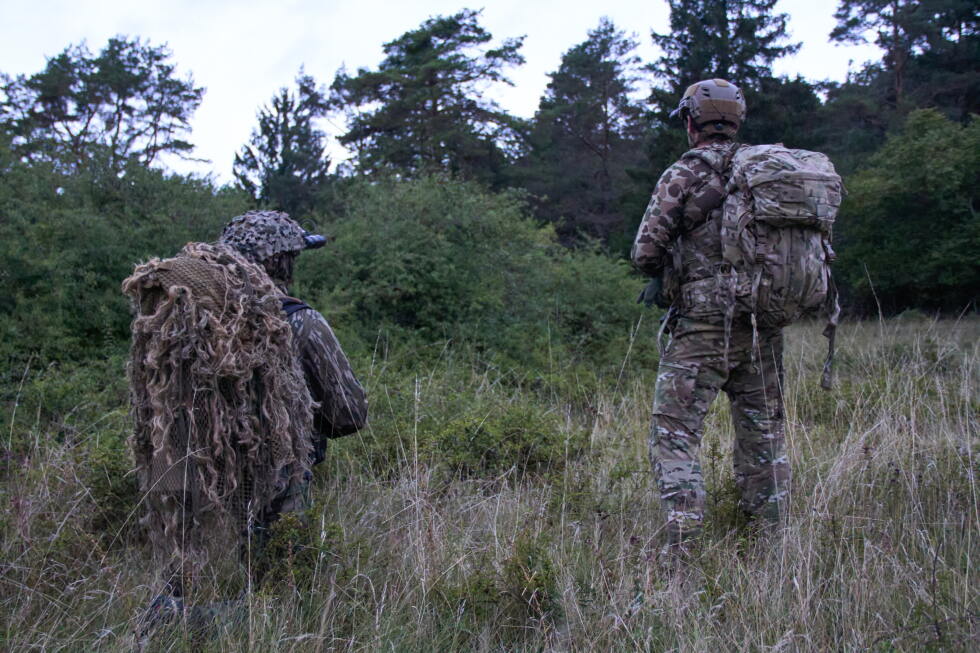
Deep in the Bavarian alpine countryside of southern Germany, under a rain-soaked, moonless sky, a team of Polish special forces slipped out of a dilapidated mock church structure on Friday. Silently advancing toward the distant tree line, with rugged hills rising behind them, the unit began the first ever Ukraine-inspired special operations exercise hosted by U.S. Army Green Berets for a NATO ally.
Developed just months ago and modeled directly on the real-world combat challenges Ukrainian forces have faced in their 4.5-year war against Russian invasion, the drill is designed to test elite troops’ ability to infiltrate enemy lines, cross hundreds of kilometers of contested territory, and execute a precision drone strike on a high-value enemy target. Originally created for U.S. special operations units, this exercise has only been run twice before in 2025, both times by separate Green Beret teams, making Poland’s participation a landmark step for NATO collective military training.
The Associated Press was granted rare, unrestricted access to the 3,000-square-kilometer training complex at the Joint Multinational Readiness Center Hohenfels, located roughly an hour southeast of Nuremberg. The multi-day scenario places Polish special forces against a U.S. Army airborne infantry unit cast in the role of enemy forces, which parachuted into the restricted training area to establish a fortified front line. If Polish troops successfully slip past the defensive line, they must traverse 100 kilometers of mixed terrain—including working German farms, populated villages, private and government surveillance cameras, and a mid-sized civilian town—to reach a second training site in Grafenwoehr, where they will destroy a simulated strategic target.
Every element of the drill is designed to replicate the risks of operating behind enemy lines, just as Ukrainian forces do in Russian-occupied territory. Unaware local German civilians act as an unscripted test of the special forces’ ability to blend into civilian populations: if troops are spotted and residents report suspicious activity to police, that intelligence is passed to opposing forces to track down the infiltrating team. “This is supposed to be Russia, and you’re going to stand out in Russia,” a senior enlisted special operations instructor told the AP, speaking on condition of anonymity per U.S. military policy that prohibits public identification of special forces personnel. In prior iterations of the exercise, Green Beret trainees removed their military uniforms specifically to practice blending into civilian areas without being spotted.
Opposing forces also deploy a fleet of more than 100 surveillance drones to hunt for the infiltrating team. If the Polish unit is detected, the scenario assumes that the full “Russian arsenal” would target their position, and opposing forces can dispatch canine-trained military police patrols or redirect additional drones to intercept the team, with troops marked as captured or killed if caught, just as in live combat.
U.S. instructors emphasize that every aspect of the exercise draws directly on combat lessons emerging from the war in Ukraine. “We’re using lessons learned from Ukraine,” a Green Beret officer assigned to the training complex explained. “All of those effects that we’re seeing either Russia or Ukraine having to overcome — we’re doing our best to replicate.”
The drill shines a spotlight on a growing push across U.S. and NATO military circles to adapt to modern drone warfare tactics, which have been pioneered and refined by Ukrainian forces throughout their defense against Russia. It also underscores the deepening military collaboration between the U.S., NATO allies, and Ukraine to prepare for potential future Russian aggression, even as the Trump administration’s ongoing force review for European deployments has created uncertainty around future U.S. troop levels, with repeated signals of potential drawdowns. Just this week, CIA Director John Ratcliffe traveled to Moscow to issue a formal warning to Russian leadership against any direct military attack on NATO territory, The Wall Street Journal reported.
Three Western officials, speaking anonymously Friday to discuss sensitive intelligence, confirmed that while Russian leadership seeks to avoid open direct confrontation with NATO, Moscow maintains the capability and intent to carry out large-scale sabotage and cyberattacks against NATO member states. This heightened tension has spurred growing interest across the alliance in Ukraine’s battlefield expertise. Training organizers told the AP they expect to run the exercise several times annually, and anticipate that most, if not all, of NATO’s 32 member states will request to send special forces units to train.
Interest in Ukraine’s drone warfare knowledge extends far beyond NATO: In March, Ukrainian President Volodymyr Zelenskyy confirmed that his country was already assisting five nations in the Middle East and Gulf region countering Iranian drone attacks, while multiple U.S. and European countries have also requested Ukrainian support for modernizing their own military tactics. The need for this updated training has been underscored by a recent rise in mysterious drone incursions across Europe: earlier this month, two unidentified drones were spotted over a German military base, and an explosive-laden drone was recovered at a major German cargo airport.
Despite broad consensus on the value of modern drone warfare training, the message around alliance collaboration has been muddled in recent weeks. President Trump’s repeated shifts on plans for drawing down U.S. troops in Europe have sown confusion among NATO allies, and last week the U.S. Army’s top leadership disbanded a specialized elite drone warfare unit, a move that has sparked debate among military planners.