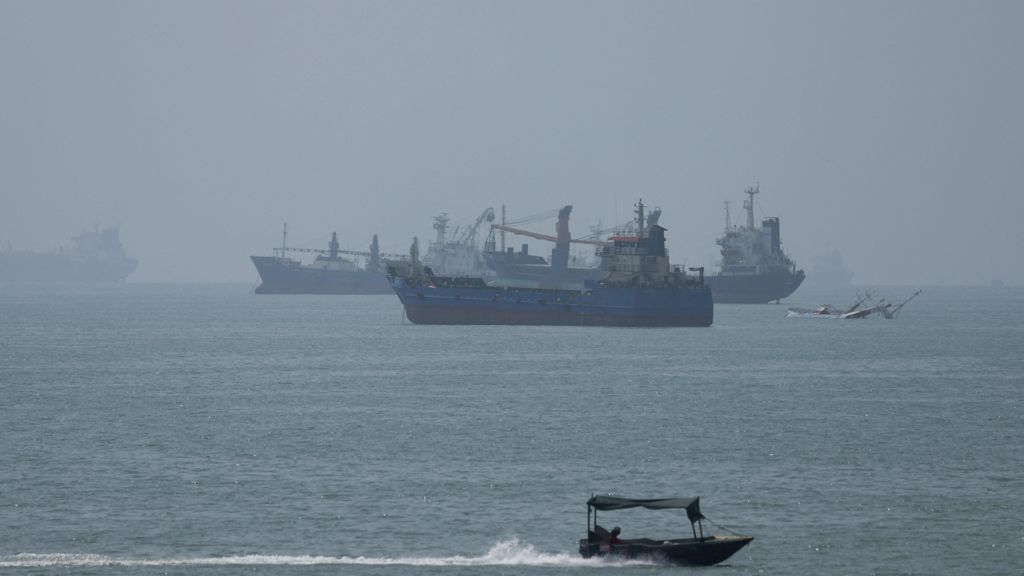
Six months into the escalating Iran-US conflict that has upended global energy security, the United States has carried out its first known strike on Iranian territory since late July, targeting two missile launchers operated by the Islamic Revolutionary Guard Corps (IRGC) on Iran’s strategically critical Larak Island.
Located just off the coast of the major Iranian port of Bandar Abbas, Larak Island sits directly adjacent to the Strait of Hormuz — the chokepoint that once carried 20% of the world’s total oil and liquefied natural gas supplies before the conflict shut down most commercial traffic through the waterway. In recent weeks, Iran has rerouted all commercial tanker traffic past the island for mandatory inspections, with reports indicating Tehran forces vessel operators to pay a $2 million fee to gain passage through the strait.
US Central Command (Centcom) spokesman Commander Tim Hawkins, quoted by CBS News, confirmed the strike, saying US forces spotted IRGC personnel preparing to launch rockets fitted with sea mines into the Strait of Hormuz. This operation marks the first American military action on Iranian soil since former President Donald Trump halted a expanded US military campaign in late July.
Within hours of the US attack, IRGC officials confirmed the strike left multiple Iranians killed and injured, and issued a stark vow of retaliation. Iran’s Tasnim News Agency, an outlet aligned with the IRGC, reported the assault was carried out by drone, putting the casualty count at two dead and two wounded. IRGC spokesman Hossein Mohebbi condemned the strike as a “strategic and fatal mistake by the Trump regime,” warning that “the enemy will pay the consequences of this miscalculation in both the economic and military fields.”
True to its threat, the IRGC announced hours later it had launched a retaliatory ballistic missile attack against two US military bases in Jordan: King Hussein Air Base and Al-Azraq Air Base. Iranian state media quoted the IRGC as saying the strike caused “heavy damage” to US technical infrastructure, aircraft maintenance facilities and fighter jet positions. The BBC has reached out to Centcom for additional comment on the Iranian retaliatory attack.
Jordan’s armed forces quickly confirmed the incursion, announcing that its air defense systems intercepted eight of the incoming missiles that breached Jordanian airspace early Monday. “Air defense systems intercepted eight missiles that breached the Kingdom’s airspace at dawn today, Monday,” the Jordanian military said in a statement carried by the country’s state-run Petra News Agency.
The latest exchange of fire comes amid steadily escalating tensions between Washington and Tehran, just weeks after Trump warned Iran that any vessel caught laying new mines in the Strait of Hormuz would be destroyed. Last week, Trump claimed all mines previously laid by Iran as part of its blockade of the waterway had already been detonated or removed — a claim Iranian Deputy Foreign Minister Kazem Gharibabadi dismissed as “propaganda” deception.
The escalation also follows a fresh round of US economic sanctions announced on August 24, designed to further isolate Tehran and expand secondary sanctions on countries and entities that maintain economic ties with Iran. Iranian officials have dismissed the new sanctions as a predictable continuation of previous US economic pressure, arguing the measures come in response to Washington’s failed military objectives in the six-month-long conflict.
The current cycle of violence traces back to February 28, when the US and Israel launched a wide-ranging series of strikes on Iranian targets. Iran responded with attacks on Israeli positions, US military bases across the Middle East and US-allied Gulf states, before effectively closing the Strait of Hormuz to all commercial marine traffic — a move that has sent global energy prices soaring and disrupted supply chains worldwide.