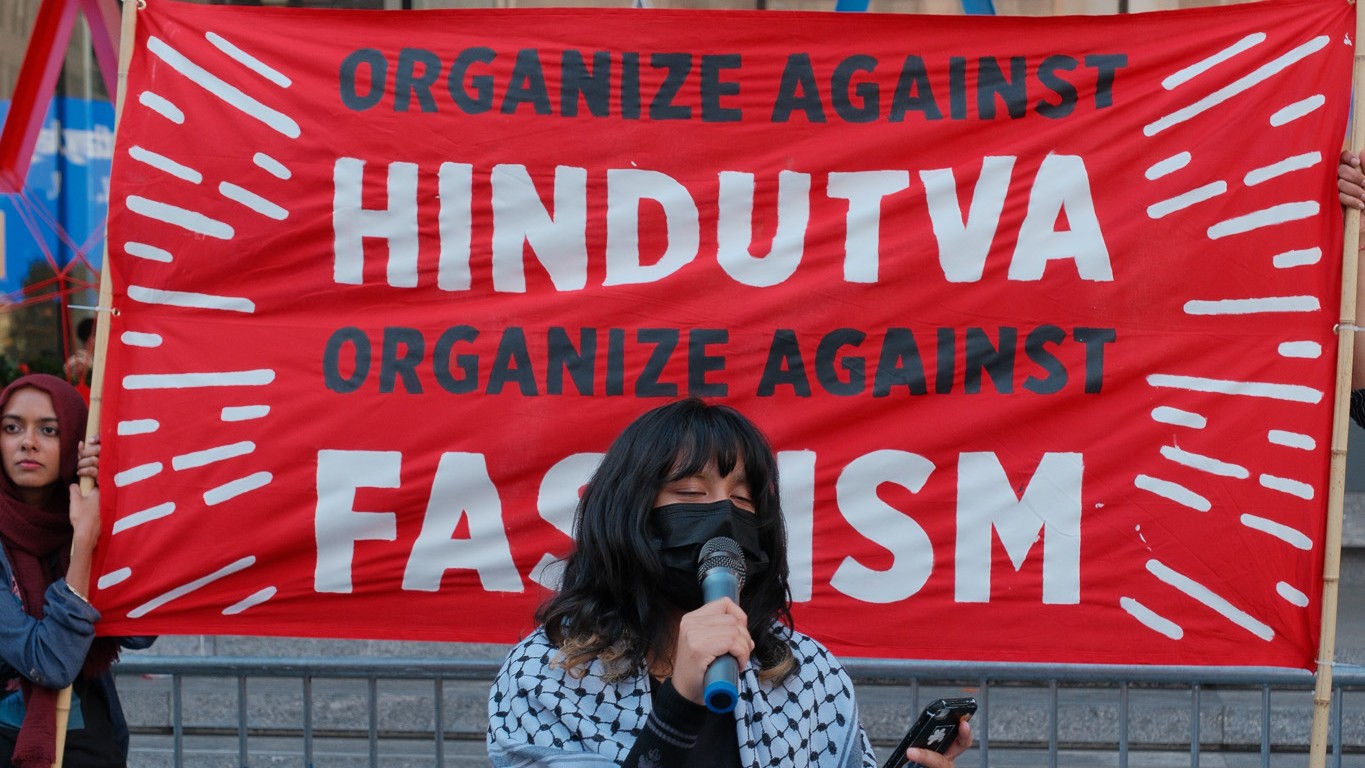
Thousands of activists gathered outside New York City’s iconic Madison Square Garden on Saturday to demonstrate against a high-profile public event headlined by Mohan Bhagwat, the leader of the Rashtriya Swayamsevak Sangh (RSS), a Hindu nationalist paramilitary organisation based in India. The event welcoming Bhagwat, branded “Universal Oneness”, was organised by the group American Hindus for Engagement and Dialogue, and drew an estimated 5,000 attendees representing more than 200 Hindu and Indian community organisations from across the United States. The protest brought together a broad coalition of local and national advocacy groups, including the South Asian Left (SALAM), Indian American Muslim Council (IAMC), Hindus for Human Rights (HfHR), and Anti Imperialist South Asian Alliance Philadelphia (AISA Philly). A separate, independently organised demonstration by the pro-Khalistan group Sikhs for Justice (SFJ) was also held adjacent to the main protest, where activists decried Bhagwat’s visit and renewed calls for a sovereignty referendum for an independent Sikh state in India’s Punjab region. Safa Ahmed, a board member of the IAMC, told independent news outlet Middle East Eye that protesters took to the streets because the RSS has spent a century normalising the fascist ideology of Hindutva, or Hindu supremacy, that targets minority communities across India. “This ideology declares that people like me, Indian Muslims—200 million of us—do not deserve to be called Indians and that we deserve to wiped out of India,” Ahmed explained. Founded in 1925, the RSS now counts more than five million members globally and operates over 250 affiliated chapters across the United States. The organisation’s core ideological goal is the establishment of a Hindu Rashtra, an ethnonationalist Hindu state in India, and it serves as the ideological founding force behind India’s ruling national party, the Bharatiya Janata Party (BJP). Historical records show that early RSS leadership drew explicit ideological inspiration from 20th century European fascism and Nazism, framing their project of a homogenous Hindu state as aligned with the ethnic nationalist logic that shaped the creation of Israel in historic Palestine. In his 1930s text *We or Our Nationhood Defined*, prominent early RSS ideologue M.S. Golwalkar directly compared the group’s push for a Hindu Rashtra to Adolf Hitler’s anti-Semitic policies, arguing that minorities in India must face either total cultural assimilation or ethnic subjugation. “To keep up the purity of the Race and its culture, Germany shocked the world by her purging the country of the Semitic Races—the Jews,” Golwalkar wrote. “Germany has also shown how well-neigh impossible it is for races and cultures, having differences going to the root, to be assimilated into one united whole, a good lesson for us in Hindusthan to learn and profit by.” Beyond its ideological origins, the RSS has long been tied to violent and polarizing actions across India, including being widely blamed for the 1948 assassination of Mahatma Gandhi, India’s independence leader. On its official website, the organisation frames the Muslim-majority region of Kashmir as a “thorn in the flesh” and rejects its distinct demographic and political character. Ahmed stressed that the RSS’ agenda poses ongoing harm not only to minorities in India, but also to political discourse in the United States. “Not only does the RSS and its support base not care about minorities in India, but they’re also fine with the wanted bloodshed of Indian minorities and Kashmiris,” Ahmed said. “They’re also comfortable with normalising the far right in the United States.” New York City Mayor Zohran Mamdani, a Muslim Indian-American elected to office in 2025, publicly weighed in on the controversy earlier that week, describing the RSS’ core vision as inherently exclusionary. While he made clear he opposed the event, Mamdani noted that city government lacked the legal jurisdiction to cancel a privately organised gathering. Shree Baphna, a member of New York-based South Asian advocacy group SALAM, highlighted why the location of the event at Madison Square Garden, one of the most high-profile public venues in the world, made the protest a critical priority. “Madison Square Garden represents a world stage; fascism has no place on a world stage like this,” Baphna said. “This is not just a one-off event; this is a symptom of a much larger systemic ideology and destructive thought process that exists here in our diaspora. So the fact that it’s here and so visible means that we have to show up out here in numbers and do our part.” Just days before the event, the independent U.S. Commission on International Religious Freedom made an official recommendation that the U.S. federal government impose sanctions on the RSS over its documented role in “violent attacks against religious minorities, including Christians, Dalits, Muslims, and Sikhs”. The commission also called for U.S. officials to revoke Bhagwat’s visa ahead of his New York appearance. The original reporting on this event was published by Middle East Eye, an independent media outlet that provides on-the-ground coverage of the Middle East, North Africa, and surrounding global issues.
Hundreds protest Hindu nationalist paramilitary leader Mohan Bhagwat’s visit to New York