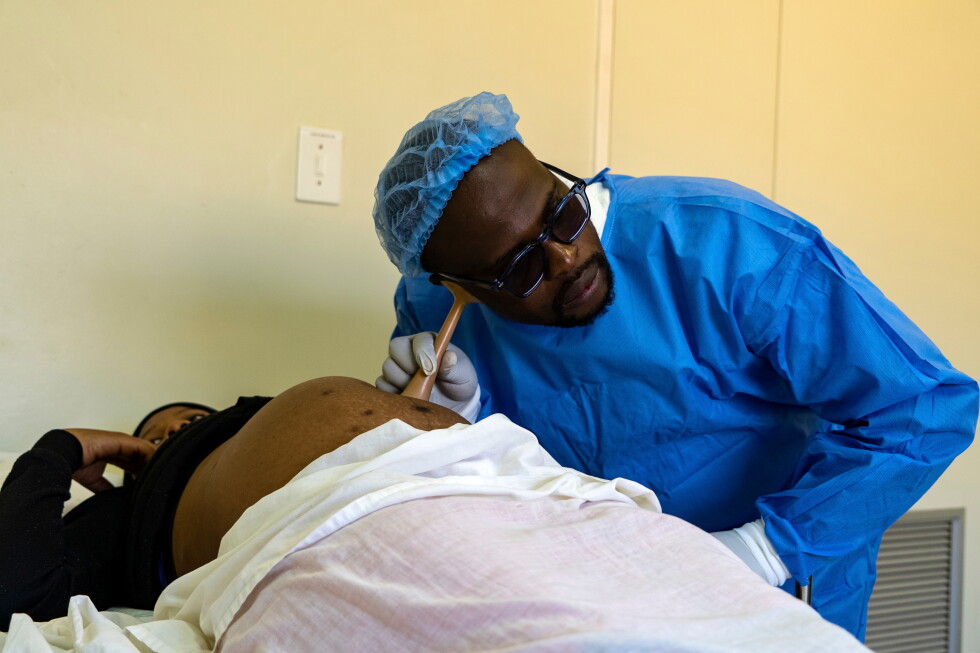
On a crisp, cold morning in the mountainous Southern African kingdom of Lesotho, Ntlhane Sehloho slung his backpack stuffed with critical medical gear over his shoulders and set off on a three-hour trek along winding, unpaved gravel roads. His destination: Mpharane Health Center, a small clinic tucked into a remote valley that serves scattered rural communities with limited access to advanced care.
Sehloho occupies a role once almost unheard of in this part of the world: he is a male midwife. When he stepped through the clinic’s doors on this particular morning, a group of waiting women exhaled in relief — some expecting their first child, others balancing fussy infants on their backs, all seeking the routine prenatal and postnatal care Sehloho has provided for 20 years.
For generations, midwifery has been strictly regarded as women’s work in Lesotho’s largely conservative society. But facing one of the world’s worst maternal mortality crises, the country has launched an urgent push to recruit more men into the profession, upending long-held cultural norms to save lives. According to United Nations data, Lesotho records roughly 530 maternal deaths for every 100,000 live births — a rate more than two and a half times the global average of 200.
This crisis is not unique to Lesotho. Sub-Saharan Africa, the world’s fastest-growing region, accounts for 70% of all global maternal deaths, with roughly 180,000 pregnancy-related fatalities recorded across the continent each year. Severe staffing shortages in remote rural clinics, where most of Lesotho’s population lives, have only worsened the crisis. With just over 2 million people nationwide, the country’s rural health posts are chronically understaffed, leaving thousands of pregnant women without access to skilled care during childbirth.
Global health bodies have sounded the alarm for years over this shortage. World Health Organization data estimates that men make up less than 1% of the global midwifery workforce. Both the WHO and UNICEF have called for expanding recruitment to all qualified candidates, regardless of gender, to close gaping gaps in emergency obstetric care.
Sehloho is one of an estimated 300 male midwives now practicing across Lesotho — a milestone that would have been unthinkable a generation ago. The Lesotho government does not track midwifery data by gender, so an exact count is not available, but recruitment efforts over the past two decades have steadily grown the share of men in the field. Sehloho never set out to become a midwife: as a high-achieving student, he originally planned to work as a nurse, driven by childhood memories of preventable tragedy in his rural home village.
“Our village was far away from the health facility, so most pregnant women delivered at home. We were still young, we were not supposed to see that, as some were dying,” he recalled. “I didn’t understand how far they had to travel just to get care.”
After he finished his nursing training, Lesotho’s health authorities encouraged Sehloho and other male nursing graduates to pursue additional midwifery training, part of a targeted strategy to expand care access to underserved rural areas. The strategy has already delivered measurable results: UNICEF data shows that 92% of births in Lesotho now are attended by a trained health provider, up from a far lower share just two decades ago.
Lesotho’s government says the core goal is saving lives, and that gender should never stand in the way of that mission. “I think the system and the community is starting to slowly accept that gender should not matter when it comes to this issue of delivery,” explained Dr. Llang Maama, acting director of health services at Lesotho’s Ministry of Health. She acknowledged that a small number of patients still report discomfort with male midwives, and the health system formally accommodates those requests when possible. “But in the urgency of childbirth, there isn’t always time to choose,” Maama added.
For Sehloho, acceptance comes down to building trust, one patient at a time. A talkative, quick-witted provider, he makes a point of putting pregnant women at ease from their very first prenatal visit, often sharing his own background growing up in a rural Lesotho community and highlighting his 20 years of experience delivering babies. “We are a very cultural and traditional African society,” he said.
Blandina Motaung, a representative for the United Nations Population Fund, which partners closely with Lesotho’s midwifery community, said public reactions to male midwives remain mixed, but many patients are surprised by the unique strengths men bring to the role. Many patients report that male midwives tend to be more gentle and less strict than their female counterparts during consultations, she said. During prenatal checks, Sehloho routinely pauses after taking blood pressure or measuring fetal progress to ask patients if they are comfortable, a small habit that has won him loyalty among the community he serves.
Motaung noted that while most female midwives have personal experience with childbirth, men’s lack of that firsthand experience often makes them more attentive to small changes and warning signs that can signal complications. “For the men, because they have not been through the process, they become more vigilant and more attentive to the nitty gritties, and that in itself improves the quality of care that they provide,” she explained.
Patients across the country are slowly adapting to the new norm. Mpolokeng Mafereka, a 21-year-old patient at Mpharane Health Center, said she still prefers care from a female provider, but has grown accustomed to seeing Sehloho when he is the only clinician available. “I’m used to being treated by women,” she said.
But 21-year-old Bonolo Tebello, another patient at the clinic, said she has never had concerns about seeing a male midwife. “I’m happy to be treated by a male because they still provide the same level of care,” she said. “Even when one arrives late for a check-up, they just treat you like any other person who arrived on time.”
This reporting is part of AP News’ Africa Pulse series, supported by a grant from the Gates Foundation. The Associated Press maintains full editorial control over all funded content.