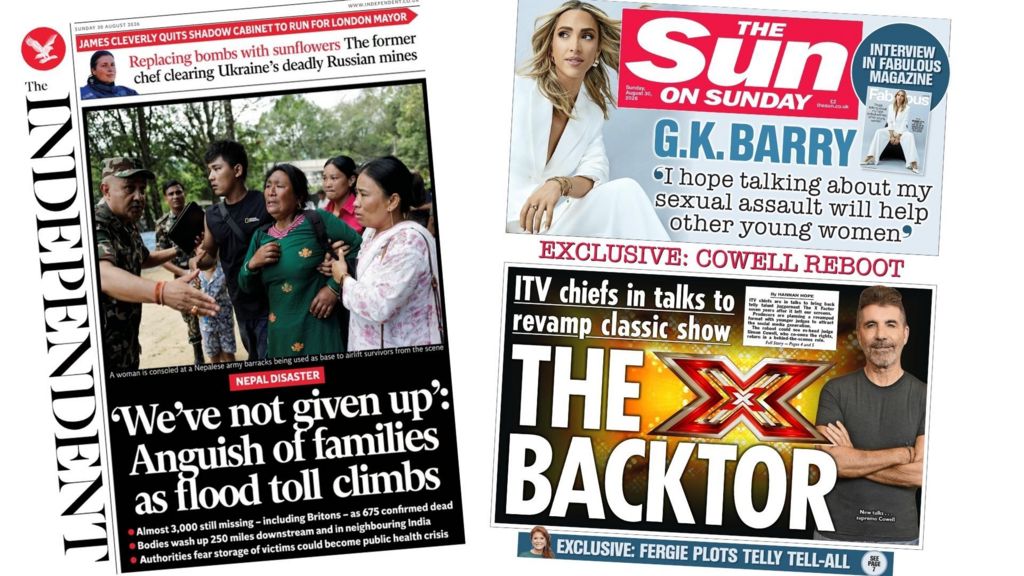
Five days after catastrophic flash floods swept through the Nepal-Tibet border region, British Sunday newspapers have turned their focus to the growing human cost of the disaster, alongside coverage of shifting geopolitical tensions, domestic political negotiations, and a range of other headline-making stories.
Leading the international coverage, The Observer confirms the official death toll has climbed to at least 675, with more than 3,000 people still unaccounted for across a 60-mile stretch of landscape left devastated by mud and floodwater. The newspaper’s front page features an image of distraught family members gathering to support one another as they wait for news of missing relatives. The Independent, meanwhile, centers its coverage on the agonizing uncertainty facing these waiting families, highlighting the widespread anguish that has spread through affected communities as rescue operations stretch into their fifth day.
Turning to European geopolitics, the Mail on Sunday reveals that a senior advisor to Russian President Vladimir Putin has issued an explicit warning that Russia could launch a hybrid attack against a drone manufacturing facility located in the United Kingdom. The warning comes as tensions continue to escalate between Moscow and London over the UK’s consistent military and political support for Ukraine in its ongoing conflict with Russia.
On the domestic political front, the Sunday Times reports that Prime Minister Andy Burnham has approved a generous pay increase for train drivers operating on the high-speed London-Manchester route, a deal negotiated to head off a planned major strike. The agreement, struck with Avanti West Coast, preserves service on a line connecting London to Burnham’s former political base, where he served as mayor before taking office as prime minister.
As Chancellor John Healey prepares to unveil his first national budget, the Sunday Telegraph understands Healey is actively considering implementing a new windfall tax targeting profitable banks and oil and gas companies. The policy is being explored to close a growing gap in the UK’s public finances, with the goal of avoiding direct tax increases for ordinary individual taxpayers.
In entertainment news, The Sun on Sunday has broken the news that British commercial broadcaster ITV is in early discussions to revive the iconic singing competition show *The X Factor*, seven years after the conclusion of the last original UK series. The outlet adds that Simon Cowell, the show’s creator and long-time judge, is expected to return to the program if the reboot moves forward.
Climate and health coverage from the Daily Star links this summer’s record-breaking UK heatwaves to at least 3,000 excess deaths across the country, adding a stark warning that such deadly heat events will only become more frequent and severe in coming years as climate change accelerates.
The Sunday Express leads a story on asylum policy, reporting that migrants housed in taxpayer-funded hotels are receiving free condoms through the UK’s National Health Service (NHS). In response to the coverage, NHS England clarified that the provision is part of standard public health services offered to all people residing in the UK, including asylum seekers supported by the state.
The Sunday Mirror publishes an investigation into a long-running maternity care scandal at Nottingham NHS Trust, where an official review found 520 mothers and infants experienced avoidable harm or death. Grieving parents have spoken out to the paper to express outrage that the trust’s former chief executive Peter Homa, who led the organization during the period of failures, now co-owns a private company that provides maternity training services to the NHS, and has earned substantial income from the business.
Finally, the Sunday People shares positive medical news: research indicates common cholesterol-lowering medications known as statins can dramatically reduce a patient’s risk of developing dementia, a finding that offers new hope to the more than 10 million people currently taking the drug across the UK.