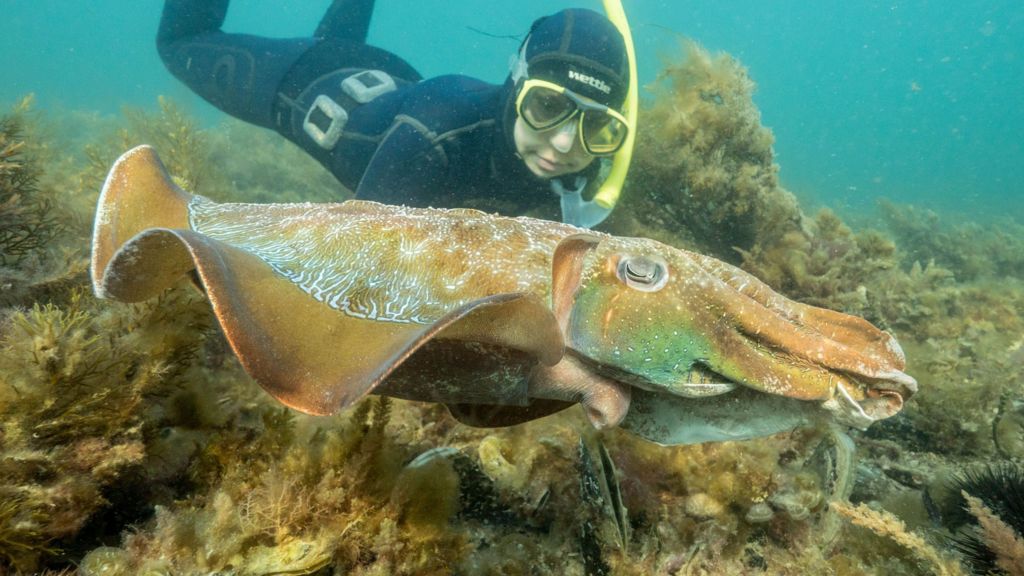
Each winter, a narrow stretch of South Australia’s iconic Cuttlefish Coast becomes the global stage for the world’s largest aggregation of breeding Australian giant cuttlefish, a one-of-a-kind marine species found nowhere else on Earth. In abundant years, hundreds of thousands of these color-changing, shape-shifting cephalopods gather in the area’s shallow coastal waters to mate, drawing thousands of enthusiastic recreational and scientific divers eager to witness the spectacular natural event. This year, however, that yearly gathering has hit an unprecedented historical low, triggering urgent warnings of a potential catastrophic collapse of the local population.
Official population data published this month puts the total number of breeding cuttlefish at just 1,811, marking a staggering 97% drop from the 63,000 counted during last year’s mating season. State environmental officials point to a persistent toxic algal bloom that has ravaged South Australia’s coastline for more than 18 months as the most likely driver of this sharp decline. The plummeting numbers have also reignited calls for the species to be formally listed as endangered under Australian conservation legislation.
Unlike many marine species, adult giant cuttlefish have an extremely short lifespan of just 12 to 18 months, and die immediately after breeding. This means every annual mating season is make-or-break for the next generation of the population. This year, survey teams only counted 440 cuttlefish eggs across the entire breeding grounds, a stark contrast to the millions of eggs that are typically laid during a healthy season.
Manny Katz, a 28-year-old diver commissioned by South Australia’s Department of Environment and Water (DEW) to conduct the underwater egg survey, explained the urgency of the work. “Because there have been so few cuttlefish, DEW thought it would be worth going out and trying to do an assessment of how many eggs there currently are around the coastline to understand what the population is going to be next year,” he said. Over two days in July, Katz and three other divers completed eight hour-long dives, combing the undersides of rocky reefs across 8 kilometers of coastline to count every egg. “Along the eight kilometers of coastline, there would normally be millions of eggs, because each female can lay dozens of eggs and tens of thousands usually turn up to breed,” Katz noted. “We pretty much looked under every single rock that we could have and we only found about 440 eggs.”
With the species’ one-year lifespan, the outcome of this breeding season will directly determine the size of next year’s population, leaving the future of the aggregation uncertain. “Under our current circumstances, with there being so few eggs along the coastline, we don’t know if the population is ever going to be able to recover,” Katz said. While it will take 12 to 24 months to confirm the long-term impact of this year’s low numbers, Katz said the result aligns with expectations, given the ongoing damage from the toxic algal bloom first detected in South Australian waters in March 2024.
During his survey, Katz also observed unusual behavior in the small number of adult cuttlefish his team encountered. Where tens of thousands would normally be visible, the team spotted only around a dozen individuals, all of which were far more skittish than usual, spending most of their time hiding under rocks. “Because there’s so few cuttlefish hanging out at the moment, they don’t have strength in numbers,” he explained.
While toxic algal blooms are a naturally occurring phenomenon, the current prolonged event is driven by a combination of ocean warming, marine heatwaves, and nutrient runoff, all of which are being amplified by human-caused climate change. For conservation advocates, the plummeting cuttlefish numbers are a warning sign of broader systemic damage to Australia’s coastal marine ecosystems. “Our marine habitats have been getting wiped out for the past year and a half now… this is an indicator that our marine ecosystems are in real big trouble – the canary in the coal mine, so to speak,” Katz said.
Last year’s breeding season was largely unaffected, as the algal bloom had not yet reached Cuttlefish Coast by winter 2024, but low concentrations of the toxic algae have been recorded in the area since late last year. Cuttlefish, along with other cephalopods including octopus and squid, are uniquely sensitive to the toxins produced by the bloom, making the spread especially concerning for the species.
Stefan Andrews, co-founder of the Great Southern Reef Foundation, has formally called for the Australian giant cuttlefish to be listed as a threatened species in response to what his organization describes as a catastrophic decline. Andrews acknowledges that while the algal bloom is the most plausible explanation for the collapse, current data does not yet confirm it is the sole cause. Even so, he warned that the lack of breeding activity this year will almost certainly lead to a very small cohort of young cuttlefish entering the population next year. “That will make the next breeding season especially challenging,” he said.
In response to the findings, a spokesperson for South Australia’s Department of Primary Industries and Regions noted that giant cuttlefish populations have naturally fluctuated significantly in response to changing environmental conditions in the past. Previous surveys have recorded population lows of 13,500 in 2013, and highs of 247,000 just seven years later in 2020. “The cuttlefish population estimate rebounded to more than 100,000 just two years following the low numbers in 2013,” the spokesperson said. “While it appears likely the algal bloom has impacted cuttlefish numbers, researchers are working to determine whether this contributed to the reduced population or was just one of the potential impacts.”
Professor Mike Steer, executive director of the South Australian Research and Development Institute, which assisted with the 2025 underwater surveys, called the unprecedented low count “disheartening.” But he echoed the government’s cautious optimism, pointing to the species’ history of rapid recovery when environmental conditions improve. “We know from the past that this population has the capacity to recover when conditions are favourable,” Steer said, adding that there are early positive signs: adult cuttlefish are still successfully laying eggs, meaning the population could rebound over the next several years if conditions improve.