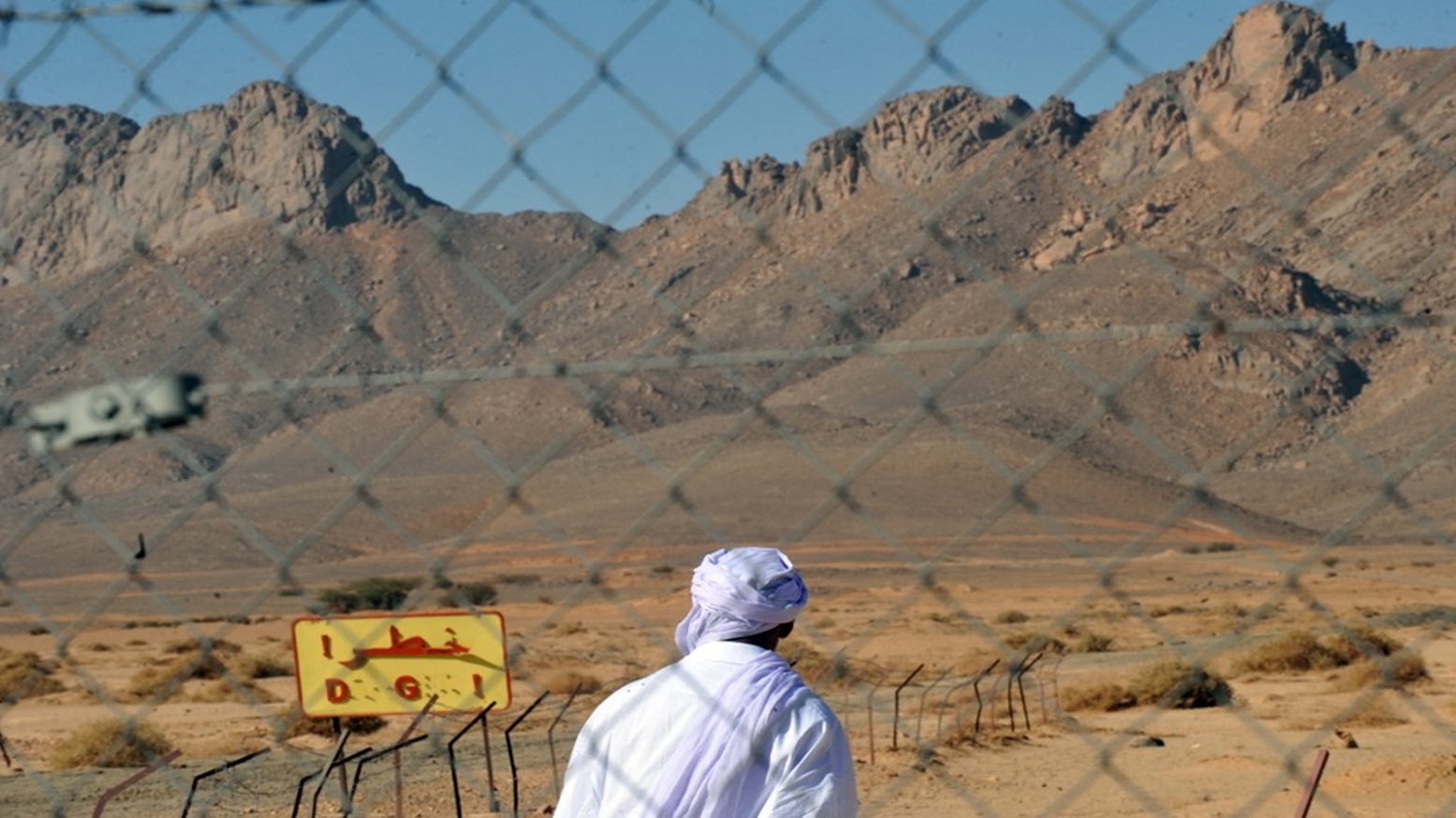
For 30-year-old Algerian engineer Mokhtar Benabdelkader, childhood stories of his grandfather Mohamed have never faded—nor has the shadow of France’s first nuclear test in the Algerian Sahara. What Mohamed described to his grandson was no small desert rodent, but the 70-kiloton plutonium bomb codenamed *Gerboise Bleue* (Blue Jerboa), detonated on February 13, 1960, in Reggane, deep in the arid heart of the North African territory. At the time, Algeria was still under French colonial rule, and Paris had selected the remote Sahara as its testing ground to advance its nuclear ambitions.
Mohamed, who resided with his family in the small hamlet of Bahou, just dozens of kilometers from the blast site, woke that morning to an event that would shape the rest of his life and the lives of generations that followed. As Benabdelkader recounts his grandfather’s memory: A searing, blinding light seared across the sky, followed by a low, rumbling roar that tore through the ground like a violent earthquake. Mohamed survived the immediate blast, but the 70-kiloton device—four times more powerful than the U.S. nuclear bomb dropped on Hiroshima in 1945—left a trail of destruction that stretched across a radioactive fallout zone spanning 200 kilometers wide and 100 kilometers long. Plants, wildlife, and human communities alike were killed by the invisible toxic radiation. Mohamed ultimately died of liver cancer in 1992, a disease that had already felled dozens of other residents in his village.
After Algeria gained independence from France in 1962, Mohamed moved his entire family 1,500 kilometers away to Adrar, convinced that relocating would let them escape the threat of radiation. But the danger had already spread. *Gerboise Bleue* was only the first of 17 French nuclear tests—both atmospheric and underground—conducted across two Saharan sites, Reggane and In Ekker, that continued through 1966. To this day, France has refused to formally acknowledge the full scope of the public health and environmental damage caused by these tests, and has repeatedly declined to share detailed maps marking the locations of buried radioactive waste, ranging from small hand tools to decommissioned military vehicles contaminated with radiation.
In her work *Colonial Toxicity*, Algerian historian Samia Henni has documented how the remnants of these tests continue to poison the Sahara today. “Vast areas are littered with abandoned objects and materials… The waste scattered across them is likely to be contaminated and radioactive,” Henni writes. “Not only does it pollute the desert and the many forms of life it shelters, but it also infringes upon the dignity of the Saharan people, who are denied the right to live in uncontaminated territory.” Henni emphasizes that France’s ongoing refusal to address the geological and ecological harm of its nuclear tests is not an oversight—it is a core part of the enduring colonial project that deliberately erases the violence of colonial extraction and its long-term intergenerational harm.
Henni’s research lays bare the catastrophic demographic toll of the testing program. In the Reggane region alone, the total population has dropped by half, falling from 40,000 to just 20,000 residents. Exact casualty numbers remain impossible to calculate, because France keeps all documents related to the tests sealed under military secrecy. Paris argues that releasing the archives would expose sensitive nuclear technology and set a precedent for opening other classified military nuclear records.
Patrick Bouveret, a member of the International Campaign to Abolish Nuclear Weapons (ICAN) and co-founder of the independent Arms Observatory in Lyon, describes France’s nuclear archives as being under “double lock.” A 2008 French heritage law created a permanent category of unreleasable archives covering weapons of mass destruction, including all nuclear materials. A 2021 anti-terrorism and intelligence law further tightened restrictions, granting French military authorities an absolute veto over the release of any documents related to radioactive fallout or waste burial at the Algerian test sites. Bouveret notes that leftover surface and underground waste can remain toxic for tens of thousands of years, contaminating groundwater and the regional food chain, and many of the bombs tested were 10 to 20 times more powerful than the weapons the U.S. dropped on Hiroshima and Nagasaki.
In 2020, Bouveret and ICAN president Jean-Marie Collin compiled a partial inventory of radioactive waste sites in the Algerian Sahara, drawing on limited declassified records and accounts from former civilian and military personnel who participated in the tests. Today, Algerian authorities use this study to formalize their demands for France to take accountability for the legacy of nuclear testing. Algerian President Abdelmadjid Tebboune and army chief of staff Said Chengriha have repeatedly called on Paris to support Algiers in rehabilitating contaminated territories, but France has consistently ignored these requests, offering no official or unofficial information to Algerian authorities.
Collin outlines three core reasons for France’s persistent refusal to cooperate. First, the history of French colonial rule in Algeria remains a deeply divisive issue that fuels tensions within the French political class. Second, the French Ministries of the Armed Forces and Foreign Affairs fear that releasing information about the tests would open the door to demands for massive financial and moral reparations. Third, acknowledging the full human and environmental damage caused by the tests would undermine France’s long-held doctrine of nuclear deterrence, casting public doubt on the legitimacy of the country’s nuclear program.
Local communities in affected regions have already documented clear signs of growing public health crises. In 2021, El Geith El Kadem, a charity that supports vulnerable patients in Adrar, warned of a worrying surge in all types of cancer, congenital birth defects, and infertility linked to radiation exposure from the historic tests. “Diseases linked to radioactivity are passed down through generations,” says the NGO’s founder Abderahmane Toumi. He adds that the health and environmental risks will persist indefinitely until all contaminated sites are properly remediated.
Last year, Algeria’s parliament passed a formal law requiring France to decontaminate the test sites used between 1960 and 1966, compel cleanup of the polluted regions of Reggane and In Ekker, and hand over full topographic maps of all radioactive waste burial sites. But under current international and French legal frameworks, Paris faces no binding obligation to comply with these demands.
The 1962 Evian Accords, which ended the Algerian War of Independence and granted France permission to continue nuclear testing in the Sahara through 1966 (Paris conducted 11 tests after Algeria gained independence), included no provisions requiring France to rehabilitate contaminated sites. France has also refused to ratify the 2017 amendment to the Comprehensive Nuclear Test Ban Treaty that requires signatory states to clean up affected test territories.
While France agreed to open preliminary discussions with Algeria and establish a joint expert committee to assess hazards and draft a decontamination plan in 2008, the committee never made meaningful progress. Decades of inconsistent, roller-coaster diplomatic relations between Algiers and Paris have blocked all movement on the issue. Though French President Emmanuel Macron has made small symbolic gestures to ease historical tensions between the two countries during his two terms in office, he has taken no substantive action to meet Algeria’s demands.
Notably, in 2021 Macron formally acknowledged “France’s debt” to French Polynesia for the 193 nuclear tests Paris conducted in the Pacific between 1966 and 1996. That same year, France established a commission to open archives related to Pacific nuclear tests, created a monitoring service for cleanup operations, and expanded victim compensation under the 2010 Morin Law. The Morin Law established a compensation process for people suffering from radiation-linked illnesses caused by French nuclear tests, covering both French Polynesia and Algeria. To date, however, only one Algerian victim has received compensation out of just over 1,000 total claimants globally.
Collin explains that the Morin Law includes a requirement that makes compensation nearly impossible for most Algerian victims: To qualify, claimants must prove they resided near the test sites at the time of the explosions. But most Saharan residents at the time were nomadic, with no fixed address to document their presence. Under pressure from Polynesian activists, the French parliament passed a new bill in May this year that eliminated the requirement to prove a direct causal link between a victim’s illness and the tests—extending this exemption to Algerian claimants—but the residency requirement remains in place.
For Algeria, financial compensation is no longer the primary demand anyway. In 2024, President Tebboune made clear Algeria’s position in an interview with French weekly *Le Point*: “We respect our dead so deeply that financial compensation would be a humiliation. We are not a begging people.”
With France continuing to refuse to hand over maps of waste sites, Algeria launched its own independent decontamination operations in February 2025, relying on domestic investigations and research. The current strategy involves collecting contaminated waste and sealing it in specially prepared reinforced concrete containers for long-term storage. Military-led decontamination work began at the Taourirt Tan Afella site near In Ekker, the location of France’s second underground nuclear test, codenamed Operation Beryl. The test suffered a catastrophic containment failure, producing an explosion equivalent to 30 to 40 kilotons of TNT. Cracks in the underground test chamber allowed radioactive gas to escape, forming a toxic radioactive cloud and releasing molten radioactive material that destroyed the region’s entire ecosystem. A recent French parliamentary report confirmed that four of the 13 underground tests conducted in the Algerian Sahara were never fully contained, and the region still has dangerous levels of cesium-137 and plutonium contamination to this day.