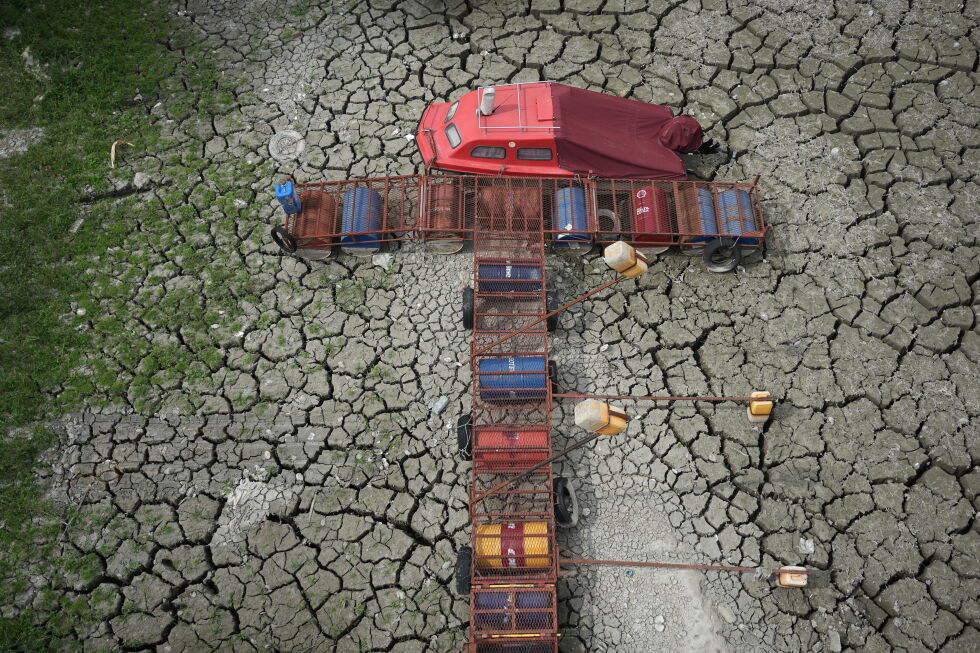
Across Central and Southeastern Europe, this summer’s record-breaking persistent drought and searing heat have triggered an ecological and economic crisis that has hit the region’s aquaculture and fishing sectors harder than most other industries. From the shrinking tributaries of the Danube in northern Serbia to fish farms spanning Hungary, Romania, Bosnia, the Czech Republic and Slovenia, water levels have plummeted to historic lows, leaving aquatic life teetering on the edge of mass mortality.
In Novi Sad, Serbia, the once-navigable side channel of the Danube now lies cracked and dry, with only two small, shrinking ponds holding the remaining fish. Fisherman Dusan Jovanovic, pointing to juvenile fish circling in the shallow, 30-degree-Celsius (86-degree-Fahrenheit) water, warned that a mass die-off could happen suddenly if conditions do not improve. “If they start to die, they will all die at once,” Jovanovic said.
The crisis extends far beyond Serbia’s riverbanks. Hungary’s national meteorological service reports that nearly 99% of the country’s territory is currently grappling with severe or extreme drought, pushing large swathes of the Great Hungarian Plain toward accelerating desertification. Of Hungary’s roughly 27,000 hectares (67,000 acres of commercial fish ponds, more than 1,588 hectares (3,924 acres) have completely dried out. The national Agriculture and Food Economy Ministry confirmed that nearly 280 metric tons of fish have already died across 20 affected farms, causing an estimated $4.2 million (1.3 billion forints) in direct revenue losses. Industry representatives note that restocking to replace lost fish could take multiple years, and in some cases, operators have been forced to drain smaller ponds to divert water to larger stocks in a last-ditch effort to save what they can.
For Romanian fish farmers, the 2025 crisis compounds the cumulative damage of consecutive severe droughts in 2023 and 2024. Catalin Platon, president of the ROMFISH National Association of Fish Producers, explained that the three-to-four-year production cycle for carp, the country’s most commonly farmed fish, means losses from past droughts continue to ripple through the industry year after year. “So what we lost in 2023 has had an impact every year since,” Platon said. He also criticized water allocation policies that prioritized agricultural irrigation during previous dry spells, leaving aquaculture producers with no viable water reserves to draw from.
Czech fish farmers have rolled out a suite of emergency measures to slow losses: they have reduced or halted fish feeding to cut oxygen demand, deployed aeration systems to oxygenate shrinking ponds, and drained vulnerable marginal ponds early to harvest what stock they can. Jan Sokolik, a technician at the Rybarstvi Trebon fishery, noted that producers are now bracing for impacts to the region’s large, core production ponds. “Now we’re just starting to plan what to do with the big ponds,” Sokolik said. Czech fishing industry officials stress that while sustained rainfall would ease the immediate emergency, long-term structural changes to retain more water in the landscape are required to adapt to repeated extreme weather.
In mountainous Bosnia, where cold-water trout farming is a key commercial and culinary staple, producers are fighting just to stay operational. “Trout is a cold water fish, which requires cold water with a lot of oxygen,” said Veljko Budjen, who owns a trout farm near Trebinje in southeast Bosnia. “So during the summer you are forced to reduce trout production and feeding so the business can just barely survive.” Many producers are forced to invest in costly liquid oxygen additives to keep water oxygen levels high, while others have no option but to wait for rain to cool and replenish their water supplies.
In eastern Slovenia, emergency crews have been working around the clock to save a popular recreational fishing lake, Lake Pristava, from a total mass fish die-off. Low water and rising temperatures have fueled explosive overgrowth of water chestnut, which covers the lake surface and depletes oxygen levels critical for fish survival. Firefighters have already pumped 8 million liters (2 million gallons) of additional water into the lake, but local fishing association official Danijel Fras told public broadcaster RTV Slovenia that even that massive intervention may not be enough. “We are surprised that any fish has survived at all,” Fras said.
Back in Serbia, fishermen say the only viable solution to save the remaining fish in the Novi Sad Danube side channel is to relocate them to deeper, cooler water bodies. Jovanovic noted that this summer’s temperatures are unprecedented. “No one can remember anything like this,” he said.
Across the region, total damage to the fishing industry already runs into millions of euros, adding to broader economic losses from disrupted river transport, decimated crop yields, and strained energy and drinking water supplies. The crisis has exposed widespread lack of preparedness for recurring extreme weather events, which climate scientists have repeatedly linked to human-caused climate change. Governments and industry stakeholders are now scrambling to develop long-term adaptation strategies to reduce the impact of future drought and heat events on regional ecosystems and livelihoods.