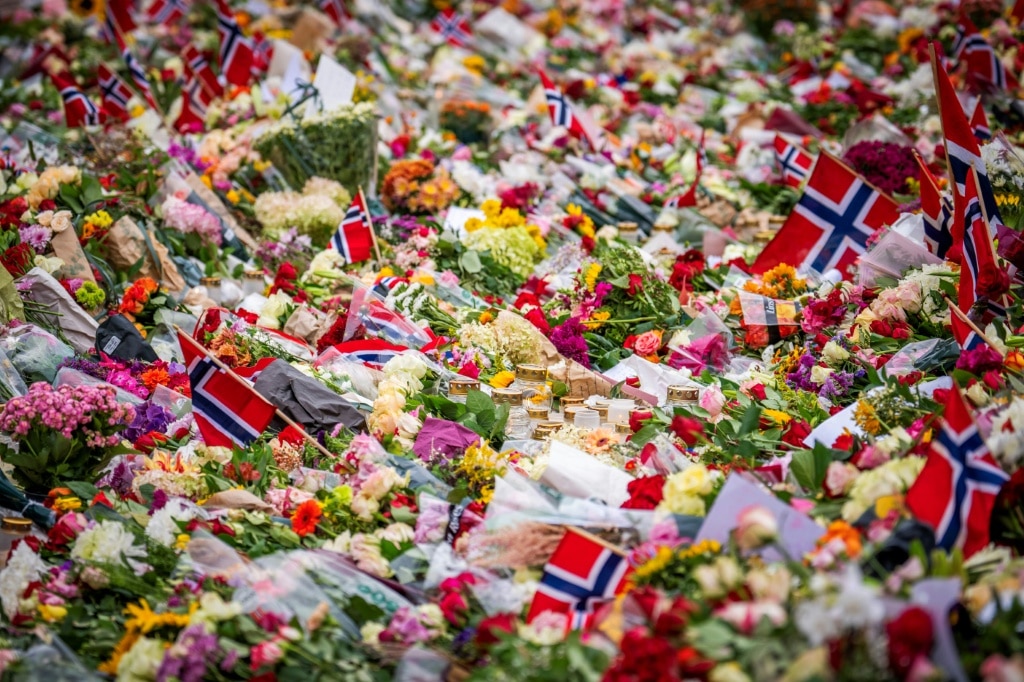
Norway has formally entered an unprecedented new chapter in its centuries-long royal history this weekend, as 53-year-old King Haakon VIII ascended to the throne following the passing of his father, King Harald V, who died Friday morning at Oslo University Hospital at the age of 89. After 35 years on the Norwegian throne, Harald’s death triggered an immediate national period of mourning that will remain in place until his funeral, the date of which has not yet been announced by the royal household.
Thousands of grieving Norwegians flocked to the capital Oslo within hours of the announcement, braving heavy evening rain to gather outside the Royal Palace and near Oslo University Hospital to lay flowers, share embraces, and pay their final respects to the monarch who was widely described as a unifying figurehead for the nation. On Friday evening, a motorcade carrying Harald’s casket traveled from the hospital to the Royal Palace, with crowds of well-wishers lining the route to honor the late king. Haakon, accompanied by his 22-year-old daughter Ingrid Alexandra, who is now the new crown princess, arrived at the palace earlier Friday to formally notify the Norwegian government of his father’s passing, fulfilling constitutional formalities.
In the hours after the succession, Prime Minister Jonas Gahr Store addressed the nation, marking the quiet turning point in Norwegian history with the iconic words: “An era has ended. A new begins. The king is dead. Long live the king.” Store praised Harald for his deep devotion to the Norwegian people, his signature good humor and quiet warmth, and his unshakable faith in the nation he led for decades. The new king released a statement thanking the government and public for their outpouring of support and sympathy for the royal family during this difficult period. Per Norway’s constitutional rules, Haakon will be sworn in with an oath of allegiance before parliament on Tuesday. Unlike many European monarchies, a formal coronation ceremony was abolished in Norway in 1908, so Haakon will not be crowned. However, following a tradition set by his father and grandfather, he may opt for a ceremonial blessing of his reign at Trondheim Cathedral, the historic coronation site for Norwegian monarchs between 1814 and 1906.
Harald, who was the oldest reigning monarch in Europe prior to his death, had been hospitalized since mid-August while being treated for haemolytic anaemia, a blood disorder that causes rapid breakdown of red blood cells and leads to fatigue and breathing difficulties. He ascended to the throne in 1991, and during his three-and-a-half decade reign, he guided Norway through a period of dramatic transformation, as the country grew economically, expanded its population, and became far more socially diverse. For many Norwegians, he was more than just a monarch — he was a beloved national grandfather figure, who embodied the country’s values of openness and tolerance.
Members of the public who spoke to AFP repeatedly highlighted Harald’s unifying leadership after the 2011 terror attacks carried out by neo-Nazi Anders Behring Breivik, which left 77 people dead in Norway’s deadliest attack since World War II. Many recalled that Harald always found the right words to unite the country and give people a sense of security in times of crisis. “He has meant a great deal, he has been a unifying king, he has been a king of the people,” 49-year-old Line Stousland told AFP as she prepared to lay a bouquet for the late king. She added, “he has been like a grandfather to the whole nation.” Caroline Vagle, a reporter for Norwegian magazine Se og Hor, echoed that sentiment, noting that “he was someone who always seemed to find the words that brought us together and gave us a sense of security.”
Tributes to Harald have poured in from across the globe, with messages of condolence coming from other European royal houses and world leaders alike. Former U.S. President Donald Trump was among those who paid tribute, remembering Harald as “a strong, proud, and greatly respected man.”
While Haakon inherits a Norwegian monarchy long celebrated for its modern, approachable style that aligns with 21st century Norwegian values, the new king also takes the throne at a turbulent moment for the royal household. The past 12 months have brought a string of scandals and health crises that have tested the family: Harald’s wife Queen Sonja, also 89, was briefly hospitalized for heart concerns in May; Haakon’s wife Crown Princess Mette-Marit has faced intense public scrutiny over her past connections to deceased American sex offender Jeffrey Epstein; in June, Mette-Marit’s son from her first relationship, Marius Borg Hoiby, was sentenced to four years in prison on two rape convictions; and Mette-Marit, who lives with a chronic serious lung disease, underwent a life-saving lung transplant in July. Despite these challenges, the nation has united in mourning this weekend, as the country says goodbye to one of its most beloved modern leaders and welcomes its new monarch.