Global equity markets mostly climbed through Friday’s early trading sessions, building on a tech-driven rally from Wall Street triggered by blowout quarterly results from AI powerhouse Nvidia. The upward momentum carried across most major European and Asian benchmarks, even as some individual markets bucked the trend and investors braced for upcoming commentary from the U.S. Federal Reserve.
In early European trading, Germany’s benchmark DAX index gained 0.6% to close the early session at 26,523.10, while France’s CAC 40 notched a stronger 1.1% increase to 8,408.72. The UK’s FTSE 100 posted a more modest 0.2% uptick, reaching 10,815.07. Futures for U.S. indexes signaled a muted opening ahead: S&P 500 futures slipped 0.1%, while Dow Jones Industrial Average futures edged 0.2% higher.
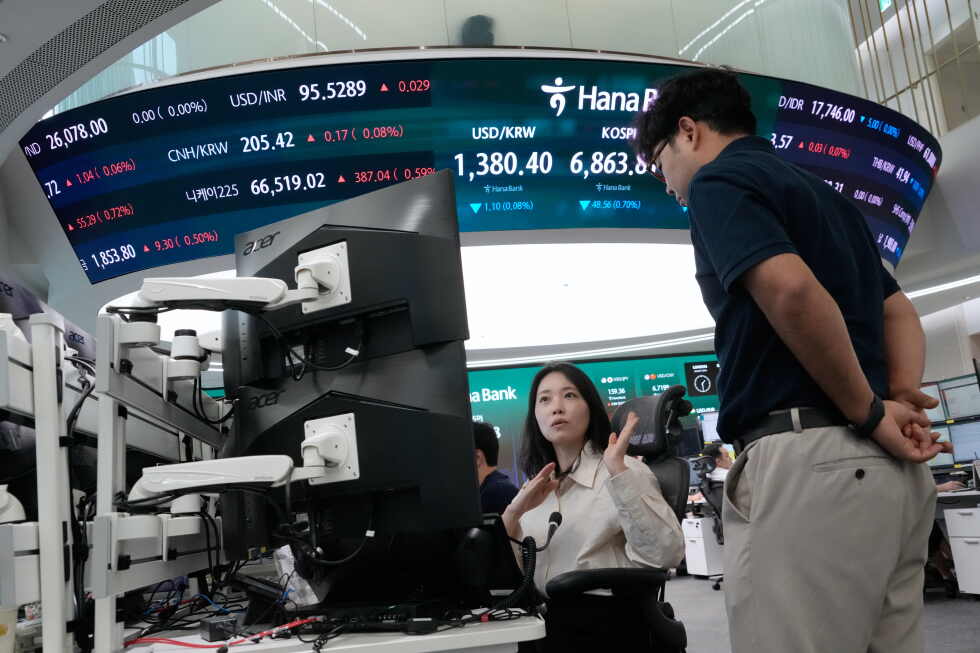
Across Asian markets, the picture was mixed. South Korea’s Kospi emerged as the region’s sharpest decliner, dropping 1.8% to 6,788.88. Mainland China’s Shanghai Composite also fell slightly, shedding 0.1% to 3,952.18. By contrast, Japan’s Nikkei 225 added 0.4% to hit 66,405.56, Hong Kong’s Hang Seng gained 0.2% to 25,584.79, and Australia’s S&P/ASX 200 rose 0.6% to 9,092.30. Taiwan’s Taiex index surged 0.8%, while India’s Sensex posted a 0.2% gain.
The market uptick originated on Wall Street Thursday, when the S&P 500 climbed 0.7% to move within striking distance of its all-time high set earlier in August. The Dow added 0.2% on the day, while the Nasdaq composite jumped 1.6% — gains driven almost entirely by a surge in technology stocks fueled by AI demand.
Nvidia, the global leader in AI-optimized semiconductors, led the charge with an 8.7% rally after the firm reported second-quarter profit and revenue that far outpaced Wall Street analyst forecasts. The company also released upcoming revenue projections that topped consensus estimates, confirming that robust demand for chips powering AI development projects shows no signs of slowing. “AI has reached its inflection point,” Nvidia CEO Jensen Huang said in commentary following the release. “It’s doing useful work. Its tokens are productive and profitable.”
The strong results helped ease mounting investor anxiety that AI stocks had become overvalued after years of rapid gains fueled by AI hype. In recent weeks, the sector has faced growing skepticism that valuations have outpaced actual profit potential, and that demand for AI chips could cool if the AI revolution fails to deliver on outsized growth promises. Nvidia’s strong performance helped allay those fears for the moment.
Another major tech firm, enterprise software leader Salesforce, also posted a historic gain, jumping 22.6% — its best single-day performance in six years. The company reported one of its strongest quarters in history, driven by AI-driven growth, raised its full-year revenue forecast, and announced an expanded partnership to integrate AI startup Anthropic’s Claude chatbot into its customer data management platform. The results eased prior concerns that AI-native competitors could siphon customers away from established enterprise software providers like Salesforce.
Not all U.S. stocks joined the rally, however: a majority of S&P 500 constituents ended the trading day lower. Big box retailer Best Buy dropped 4.4%, even though the company beat analyst forecasts for both profit and revenue in its latest quarter, as persistent worries about consumer spending power amid ongoing high inflation kept investor sentiment muted. Discounters turned in a mixed performance: Dollar General gained 2.5% after beating profit estimates, as analysts predict dollar chains could gain market share from cash-strapped higher-income households seeking more affordable shopping options. By contrast, rival Dollar Tree fell 3.9% despite topping profit expectations.
In the bond market, Treasury yields moved slightly higher after a new report on weekly unemployment benefit applications confirmed the U.S. labor market remains resilient, a key factor the Federal Reserve considers when setting monetary policy. In currency markets, the U.S. dollar edged up to 159.56 Japanese yen from 159.39 yen, while the euro slipped marginally to $1.1648 from $1.1652.
Oil prices, a key wild card for global inflation forecasts, have see-sawed in recent sessions amid ongoing uncertainty over conflict in Iran and the resumption of unimpeded commercial shipping through the Strait of Hormuz, a critical chokepoint for global oil supplies. On Friday, international benchmark Brent crude fell 0.4% to $88.13 per barrel, a pullback after the price rose 1.8% in the prior session. U.S. benchmark West Texas Intermediate crude fell 0.6% to $83.08 per barrel.
All eyes are now turning to a highly anticipated speech scheduled for later Friday from Federal Reserve Chairman Kevin Warsh. Despite growing market pressure for clearer guidance on future U.S. monetary policy, Warsh has signaled he will continue the Fed’s recent approach of providing limited clues to markets about the central bank’s plans for managing inflation.