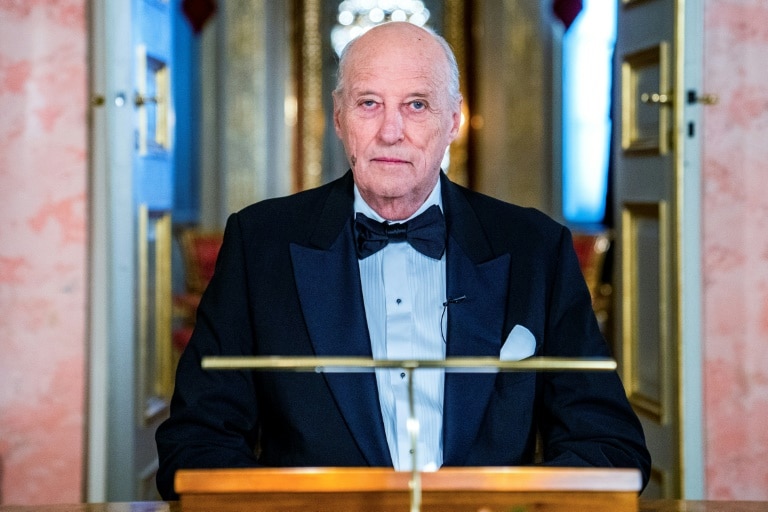
Norway is marking the passing of its longest-serving modern monarch, King Harald V, who died Friday at the age of 89, leaving behind a legacy of national unity that endured even as family scandals rocked the final years of his 35-year reign.
Ascending to the Norwegian throne on January 17, 1991, following the death of his father King Olav V, Harald spent more than three decades on the throne, making him Europe’s oldest sitting monarch by the end of his life. Plagued by worsening chronic health issues in his final years, he repeatedly rejected calls to abdicate, insisting his parliamentary oath bound him to serve for the entirety of his lifetime. He was admitted to an Oslo hospital on August 17 for complications related to hemolytic anemia, a blood disorder, and the Royal Palace confirmed his death earlier this week.
Though Norway’s constitutional monarchy grants the head of state limited formal political power, Harald earned a reputation as a steady, unifying force for the nation, consistently finding words that resonated with the public during moments of national crisis. One of his most iconic moments came in the wake of the 2011 twin terror attacks carried out by far-right extremist Anders Behring Breivik, which killed 77 people in the deadliest attack on Norwegian soil since World War II. Standing before a grieving nation, Harald affirmed: “I firmly believe that freedom is stronger than fear. I firmly believe in an open Norwegian democracy and society.”
A lifelong champion of Norway’s progressive social values, Harald made his stance on inclusivity clear in a 2016 speech marking the 25th anniversary of his reign. “Norwegians are girls who love girls, boys who love boys, and girls and boys who love each other,” he said. “Norwegians believe in God, Allah, the Universe and nothing.”
Unlike many of his European royal peers—including Spain’s Juan Carlos, Belgium’s Albert II, the Netherlands’ Beatrix, and Denmark’s Margrethe II, all of whom abdicated during their lifetimes—Harald held firm to his commitment to reign until death. “The oath I’ve sworn before parliament lasts as long as my life, that’s how simple it is,” he stated repeatedly throughout his later years.
Born in 1937, Harald’s early life was shaped by World War II. Just three years after his birth, Nazi forces invaded Norway, forcing the young prince into evacuation: he first fled to neighboring Sweden, then to the United States, where he lived in Washington D.C. with his mother Princess Martha for the remainder of the war, while his father and grandfather remained in London in exile. He returned to Norway after the war ended, growing up with as normal a life as possible for a royal heir.
An accomplished athlete, Harald competed for Norway in sailing at three Olympic Games, and shared his countrymen’s deep love of outdoor recreation, including fishing, hunting, and skiing. Standing tall and solidly built, he was known for his dry, sharp sense of humor hidden beneath a reserved public demeanor. His health began declining decades ago: he underwent bladder cancer surgery in 2003, heart surgery two years later, received a pacemaker in 2024, and relied on crutches for mobility in his final years, with repeated hospitalizations for ongoing complications.
Harald’s personal life broke with royal tradition decades ago: he wed Sonja Haraldsen, a commoner, after a nine-year courtship that faced stiff opposition from his father and the Norwegian ruling elite before finally winning approval for the marriage in 1968. That experience shaped his later decision to allow his own children to marry outside the aristocracy—a choice that would ultimately put the monarchy under unprecedented strain in his final years.
The closing years of Harald’s reign were marred by a string of family controversies that eroded public support for the Norwegian monarchy, even as the king himself remained personally popular. In 2024, his daughter Princess Martha-Louise, a prominent advocate for alternative healing, made global headlines when she married an American self-described shaman. Earlier this year, the release of Jeffrey Epstein’s court documents revealed a previously unreported close friendship between the convicted sex offender and Crown Princess Mette-Marit, the wife of Crown Prince Haakon, Norway’s heir to the throne. Just months later, Mette-Marit’s son from a prior relationship, Marius Borg Hoiby, was sentenced to four years in prison by an Oslo court on charges of rape and assault; he has since appealed the conviction. Though Hoiby holds no formal role in the royal family, his legal case became the biggest scandal to hit the Norwegian monarchy in modern history.
Throughout the unfolding turmoil, Harald maintained a calm, measured public stance. In his 2025 New Year’s address, he reflected on the challenges facing his family, saying: “At the core of being human lies the fact that none of us is spared from pain and adversity.”
While Harald retained high personal popularity to the end, praised by Norwegians for his unassuming, modest lifestyle, the scandals dragged public support for the monarchy to historic lows. A February 2026 opinion poll from public broadcaster NRK found just 60 percent of Norwegians still backed the institution, a level not seen in modern Norwegian history.