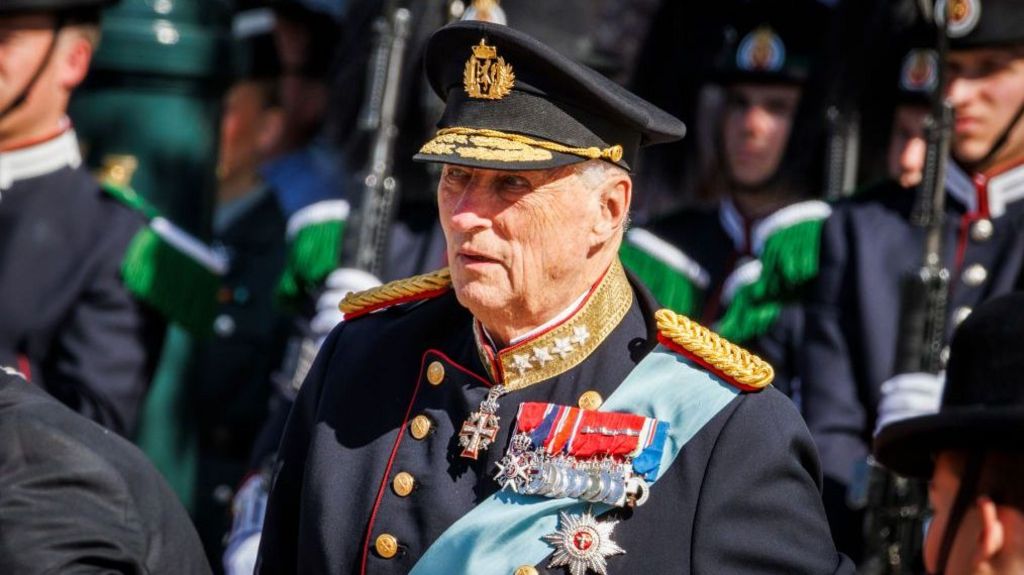
After a week of medical treatment for a rare blood disorder, Norway’s King Harald V, one of the most popular monarchs in the nation’s modern history, has died at the age of 89. According to an official announcement from the Oslo Royal Palace, the king passed away peacefully at 6:35 a.m. local time on Friday at Oslo University Hospital, with his entire immediate family by his side in his final hours. The royal standard flying above the palace has been lowered to half-mast, and crowds of grieving Norwegians have already begun leaving floral tributes at the palace gates.
Born on February 21, 1937, at the Skaugum estate just outside Oslo, Harald made history as the first Norwegian monarch born on Norwegian soil since the 14th century. His childhood was upended at age three when Nazi Germany invaded Norway during World War II, forcing the royal family to flee first to neutral Sweden, then to the United States, where they were hosted by President Franklin D. Roosevelt. The family returned to Norway at the end of the war, and Harald completed his schooling, compulsory military service, and went on to study social science, history, and economics at Balliol College, Oxford between 1960 and 1962.
Harald’s commitment to breaking with centuries of royal tradition began long before he took the throne. After meeting Sonja Haraldsen, a commoner and the daughter of a Norwegian businessman, at a social gathering, he faced nine years of opposition from his father, King Olav V, who had hoped he would marry a European royal. When Harald ultimately told his father he would remain unwed if he could not marry Sonja, Olav relented. The pair married at Oslo Cathedral on August 29, 1968, in a union that paved the way for all future generations of Norwegian royals to marry partners outside aristocratic bloodlines. The couple celebrated nearly 58 years of marriage before Harald’s death, and he is survived by Queen Sonja, their daughter Princess Märtha Louise, their son Crown Prince Haakon, and six grandchildren.
When Olav V died in January 1991, Harald ascended to the throne, having served as regent since his father’s declining health began in 1990. Historians note that over the first decade of his reign, the once reserved, shy king evolved into a open, empathetic leader deeply connected to the Norwegian public. His 35-year reign was defined by sweeping reform that modernized and democratized the Norwegian monarchy, opening up royal finances and health disclosures to the public and shifting the institution toward far greater egalitarianism.
Harald cemented his place in Norwegian national identity during the nation’s darkest modern moment: the 2011 Anders Breivik terror attacks that killed 77 people, most of them teenage activists at a summer camp on Utøya. Just one day after the attacks, he delivered a landmark televised address to the nation, speaking through tears as he framed his grief as both a king and a family man. “I can only imagine the depth of your pain. As King of this nation, I feel for each and every one of you,” he said, urging Norwegians to stand together and reject fear. Historians still point to this moment as one that redefined the role of the Norwegian monarchy for the modern era.
In 2016, Harald again drew international acclaim for a passionate speech embracing diversity, highlighting that Norway’s population includes people of every ethnicity, religion, and sexual orientation. A dedicated environmentalist, he was a founding figure of the Norwegian branch of the World Wide Fund for Nature, serving as its president for 20 years. He was also an accomplished competitive athlete, representing Norway in sailing at three Olympic Games before officially retiring from competitive sailing in 2022. He remained a beloved fixture at major national sporting events, famously welcoming the Norwegian men’s national football team to the palace after their historic run to the 2026 World Cup quarter-finals.
In the final years of his life, as his health declined, Harald permanently reduced his public engagements in April 2024. In recent weeks, he was admitted to Oslo’s national hospital to receive treatment for hemolytic anemia, a rare blood condition that reduces the body’s count of healthy red blood cells. Crown Prince Haakon stepped in as regent to handle official royal duties ahead of his father’s death, and he officially succeeds Harald as King of Norway.
In the past year, the Norwegian royal family has faced a cascade of scandals and health crises that have tested public support for the monarchy. Documents revealed Crown Princess Mette-Marit’s repeated past contact with disgraced late sex offender Jeffrey Epstein, for which she publicly apologized, admitting poor judgment. Most recently, her son Marius Borg Høiby was convicted of rape in Oslo district court in June 2024, and is currently appealing his four-year prison sentence. Just days after the conclusion of Høiby’s trial, Mette-Marit underwent a life-saving lung transplant to treat a rare pulmonary fibrosis diagnosed eight years earlier; she remains in a fragile condition, with doctors not expected to declare her stable until one year post-transplant.
These controversies have pulled public support for the monarchy down from 72% in 2024 to 54% in the most recent poll for major Norwegian newspaper Aftenposten, and nearly half of Norwegians now say Mette-Marit should not become queen when Haakon takes the throne. But royal commentators and historians uniformly note that criticism of the royal family has almost never been directed at Harald personally, who retained widespread affection across the nation until his death. Often called the “People’s King”—a title he shared with his father Olav V—Harald was widely described by those who observed his reign as a down-to-earth, unpretentious figure, often called the “grandfather of the nation.” His willingness to show emotion, humor, and vulnerability, royal experts say, made him relatable to generations of Norwegians. “When things go wrong in the royal family, people tend to blame anyone but the king,” historian Trond Norén Isaksen noted.
Now, as the nation enters a period of national mourning, all eyes turn to the new King Haakon, who will face the challenge of steering the monarchy through ongoing public scrutiny while supporting his wife through her ongoing recovery. While questions remain about how the recent turbulence in the royal household will shape his reign, commentators say Haakon has already demonstrated steady leadership through the crises of the past year. For the moment, however, Norway’s focus remains on honoring the life and legacy of the king who transformed the nation’s monarchy and earned a permanent place in the hearts of its people.