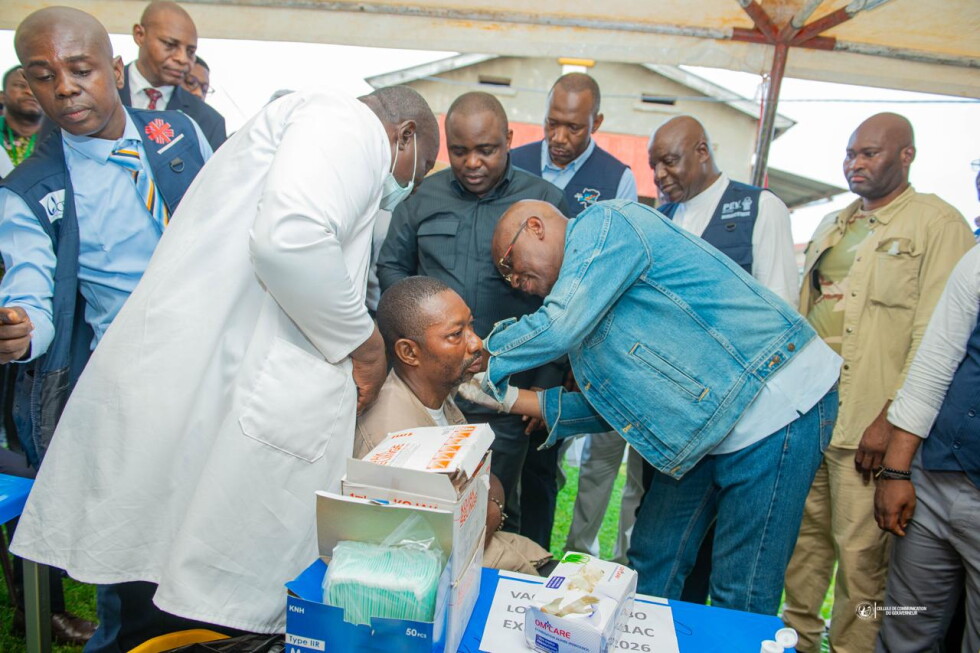
KAMPALA, Democratic Republic of Congo – In a urgent, long-awaited step to curb the deadliest Ebola outbreak the nation has ever faced, Congolese health authorities officially launched a nationwide vaccination campaign on Thursday in the eastern provincial capital of Kisangani, Health Minister Roger Kamba announced.
The campaign prioritizes high-risk groups first, with frontline health workers, response personnel and close contacts of confirmed Ebola patients topping the list of those to receive doses. Minister Kamba confirmed that the campaign will use the Ervebo vaccine, currently the only widely available Ebola vaccine authorized for emergency use. As of this week, government data puts the outbreak’s toll at 5,713 confirmed cases across six affected provinces – Ituri, North Kivu, South Kivu, Tshopo, Haut-Uele, and Bas-Uele – with 2,744 recorded deaths, translating to a 48% mortality rate among confirmed infections.
This current outbreak, driven by the rarely-seen Bundibugyo Ebola variant, has spread rapidly against a backdrop of crippling systemic challenges: persistent regional insecurity, mass population displacement, a recent nationwide strike by health care workers, and unregulated cross-community population movements. The World Health Organization (WHO) has warned the outbreak remains fully out of control, and is on track to exceed the 2014-2016 West Africa Ebola epidemic – the previous global deadliest on record, which claimed more than 11,000 lives across Guinea, Liberia and Sierra Leone.
To address the crisis, global health bodies have fast-tracked vaccine shipments to Congo. Congolese state media confirm the country has already received more than 50,000 doses of Ervebo, while the WHO approved a total of 70,000 doses for deployment in the outbreak response last week. Of the total approved doses, 50,000 are allocated to frontline and at-risk health workers, with the remaining 20,000 reserved for a clinical trial investigating Ervebo’s efficacy against the Bundibugyo variant.
Crucially, Ervebo is only formally approved to protect against Zaire ebolavirus, a different strain of the virus, and no vaccine is yet specifically authorized for Bundibugyo Ebola. The rollout is proceeding under a compassionate use framework, which permits unapproved off-label use of medical products during public health emergencies when no targeted alternatives exist. Health officials note that the two Ebola strains are genetically related, leading experts to hypothesize Ervebo may offer partial cross-protection, though this hypothesis remains unconfirmed and is the subject of ongoing clinical investigation.
Placide Mbala Kingebeni, director of research, clinical trials and innovation at the Africa Centers for Disease Control and Prevention (Africa CDC), confirmed that systematic efficacy data will be collected throughout the vaccination campaign to answer critical questions about Ervebo’s performance against Bundibugyo Ebola. The initial phase of the campaign will target 14 high-risk health zones across Tshopo, Bas-Uele, and Haut-Uele provinces, the three current hotspots of transmission.
In his remarks launching the campaign, Kamba issued a strong call to action for all frontline health workers to accept vaccination, emphasizing that protecting care providers not only saves their lives, but also prevents secondary transmission of the virus from health settings into the broader community.