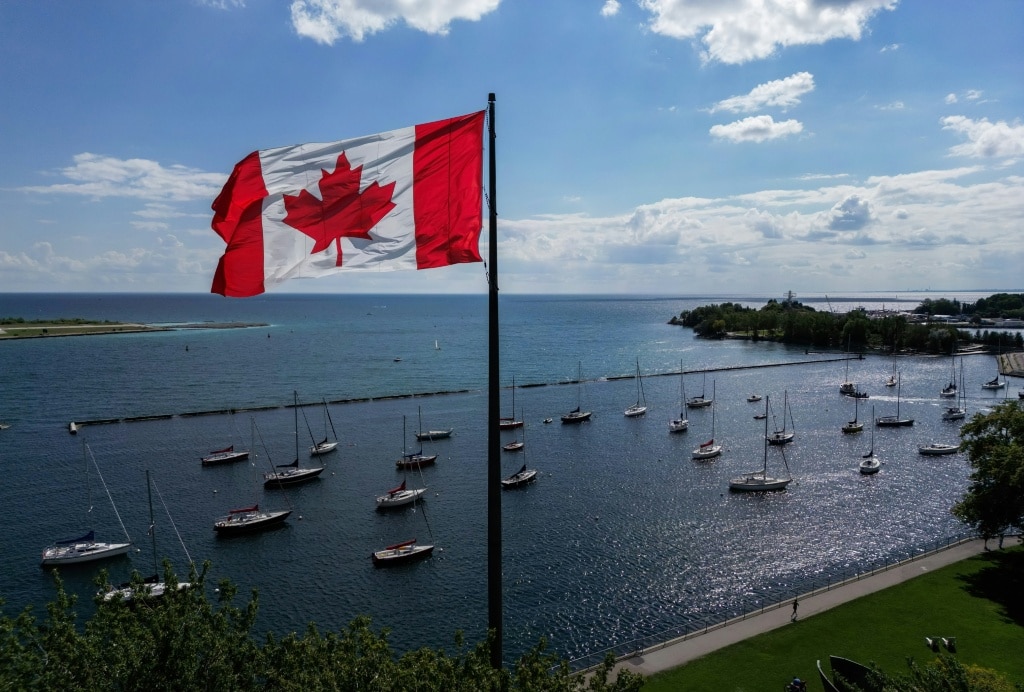
In a provocative escalation of the ongoing trade conflict between the United States and Canada, former US President Donald Trump signed an executive order Thursday that would unilaterally rename the shared border body of water Lake Ontario to “Lake America,” drawing an immediate and firm rejection from Canadian Prime Minister Mark Carney. The unprecedented diplomatic gambit comes just days after high-stakes bilateral trade negotiations collapsed at the eleventh hour, leading the two longstanding North American allies to impose matching retaliatory tariffs on each other’s goods.
Speaking to reporters at the White House during the signing ceremony, the 80-year-old Republican confirmed the name change would take effect immediately. When pressed by an Agence France-Presse reporter on why he chose to target a close ally rather than traditional US adversaries over the dispute, Trump dismissed Canadian officials as “nasty people” who had “treated us very badly.” Visual aids behind the president in the Oval Office underscored the gesture: two maps, one overwriting the lake’s historic name with “Lake America” in bold red text, and another bearing the slogan “Making the Great Lakes Even Greater.”
As the smallest of the five Great Lakes by surface area, Lake Ontario straddles the US-Canada border, touching the Canadian province of Ontario and the US state of New York. Trump’s order mirrors a similar unilateral action he took in January 2025, when he renamed the Gulf of Mexico the “Gulf of America” — a change that Mexico has also refused to recognize. The executive order directs the US Department of the Interior to update all official geographic naming records within 30 days and mandate that all federal agencies adopt the new name, justifying the move on the grounds that the lake’s deepest section lies within US territory, giving the United States “claim to most of the Lake’s volume.”
Carney, a former central banker for both Canada and the United Kingdom, quickly pushed back against the order in a public post on X, noting that the name “Lake Ontario” has persisted for 400 years — predating the founding of both the United States and Canada, and deriving from an Indigenous term meaning “the lake is beautiful, the lake is big.” “We know that America is changing,” Carney wrote. “Canadians also know that naming reality means calling it Lake Ontario — then, now and always.” Carney’s recent defiant stance against Trump has earned widespread approval from Canadian voters, after he declared earlier this week that Ottawa was “at war” following what he framed as unfair economic attacks from the US.
The name change dispute is not an isolated incident: throughout his second presidential term, Trump has repeatedly angered close US allies with outlandish territorial and naming claims. He has previously suggested Canada should become the 51st US state, laid a public claim to Greenland (an autonomous territory of NATO member Denmark), and claimed he would annex Venezuela as a US state after American forces captured former Venezuelan leader Nicolas Maduro. In recent days, he has also announced plans to claim the Strait of Hormuz, the strategic waterway between Iran and Oman, as US territory amid the ongoing active conflict with Iran.
Trump’s latest provocation comes as he faces plummeting domestic approval ratings tied to the ongoing Iran war and widespread economic struggles at home, with critical midterm congressional elections scheduled for November. The president hinted that the Lake Ontario renaming could just be the start of a broader effort, suggesting he may also move to rename the Atlantic and Pacific Oceans that border the United States. “We have a gulf and we have a lake. Now all we need is an ocean,” Trump said. “So, maybe we’ll have to change the name of the Atlantic and/or the Pacific. Maybe we’ll change them both.” The president added that the renaming idea was one he had pondered for years, after confirming earlier this week that he was giving the proposal serious consideration and releasing a TikTok video Wednesday confirming he would move forward with the order.