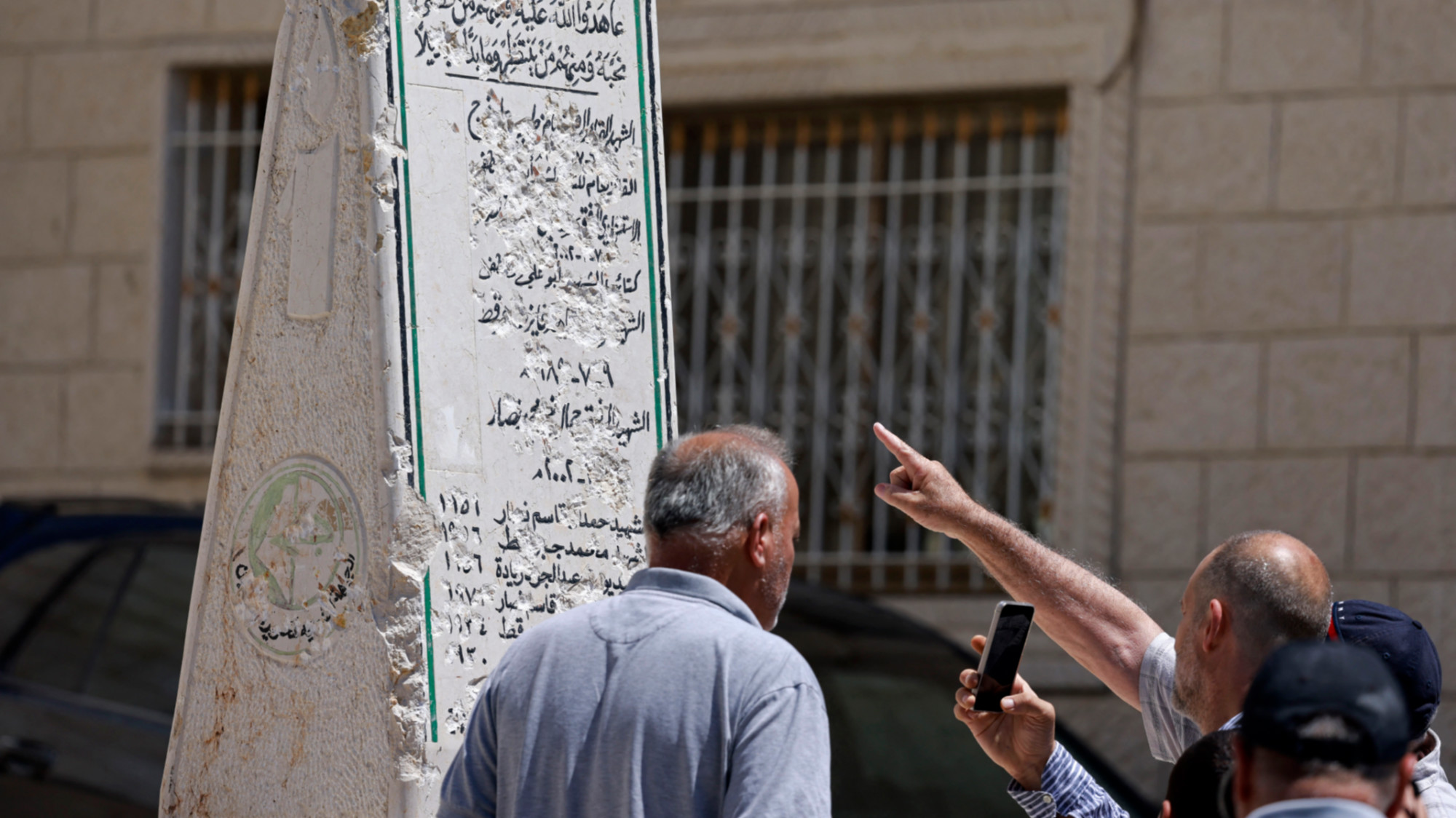
A controversial act of vandalism by a sitting Israeli parliamentarian has triggered widespread political fallout this week, after an Israeli Knesset member from the far-right Religious Zionism party smashed a prominent Palestinian memorial in the occupied West Bank on Tuesday, drawing condemnation from across the country’s political divide.
Zvi Sukkot, who chairs the Knesset’s influential Education Committee and is affiliated with Finance Minister Bezalel Smotrich’s far-right faction, was captured on camera striking the Palestinian Martyrs’ Monument in Madama, a small village located south of Nablus, with a sledgehammer. In a video of the incident posted to his Facebook account, Sukkot justified his action by claiming the memorial honored two Palestinian militants who had killed Israeli civilians, arguing that the structure had no place standing in the region. He added that leaving the memorial intact risked radicalizing local children passing the site, encouraging them to seek martyrdom themselves.
The incident unfolded with Israeli military personnel present at the scene, despite the Israeli Defense Forces later issuing an official statement disavowing any authorization for the demolition. According to Israel’s public broadcaster Kan 11, military forces had conducted raids across multiple Palestinian villages in the broader Nablus area after Sukkot submitted a formal request to inspect a series of memorials in Beita, Burin, and Madama. The IDF clarified that the destruction of the Madama monument had never gone through required official approval protocols, and that troops on the ground moved to halt the vandalism once it became clear what was happening. In a sharply worded rebuke, the military accused Sukkot and his team of acting “in a deceptive and manipulative manner,” noting that their unauthorized actions had put Israeli soldiers at unnecessary risk. Even so, the IDF reaffirmed its longstanding policy of regularly demolishing Palestinian memorials labeled as “symbols of incitement,” framing these actions as a core component of Israel’s counterterrorism operations.
In response to the military’s criticism, Sukkot’s office said the lawmaker had moved forward independently after the army failed to act on repeated demands to remove the memorial. Footage from the scene confirms that multiple members of Sukkot’s staff joined him in the vandalism, and his spokesperson Yossi Rainer even published a photo on the social platform X showing himself holding a sledgehammer in front of the partially destroyed structure.
Local village leaders have pushed back against the IDF’s account of the incident. Rami Nassar, head of the Madama village council, told Israeli newspaper Haaretz that the memorial had stood at the site for roughly 20 years without incident, despite consistent Israeli pressure to have it removed over the decades. Nassar added that threats against the monument had grown more severe in recent weeks, with unidentified Israelis seen measuring the structure several weeks prior to the attack. Contradicting the military’s claim that troops halted the demolition, Nassar said Israeli soldiers simply stood by and allowed Sukkot and his team to damage the memorial unimpeded.
Sukkot’s targeted campaign against Palestinian memorials in the area launched at least two weeks before Tuesday’s attack. Eleven days prior to the incident, he published a video filmed outside Madama calling for the mass removal of all monuments honoring Palestinian fighters across the region. “The time has come to smash these memorials,” Sukkot stated in the earlier clip, adding that every monument “in memory of the terrorists here and in other villages must be destroyed and broken.”
The release of footage from Tuesday’s vandalism has drawn fierce criticism from across Israel’s political spectrum, with opposition figures arguing that the incident is proof that Prime Minister Benjamin Netanyahu’s ruling coalition has allowed rampant lawlessness to take hold in the occupied West Bank. “Sukkot’s behaviour is a disgrace for someone who claims to represent the public and be a leader,” veteran opposition politician and former Israeli army chief Gadi Eisenkot wrote on X. Eisenkot charged that Netanyahu “allows anarchists” like Sukkot “to do whatever they please, endangering security in the settlements and harming Israel’s standing in the world.”
Yair Golan, leader of the Israeli opposition party The Democrats, went even further in his criticism, saying that Sukkot “should be behind bars, not in Israel’s Knesset.” “For this coalition, flames are a working method,” Golan said, against a backdrop of repeated Israeli military warnings that the incident could spark widespread escalation in the already volatile West Bank. “As long as the public is afraid and fighting amongst itself, they can continue to rule,” he added.
Even some figures within the ruling coalition voiced criticism of Sukkot’s actions, though many stopped short of full condemnation. Foreign Minister Gideon Sa’ar noted that Sukkot and other elected lawmakers “are not the sovereign” in the occupied West Bank, emphasizing that “decisions must be made and carried out by the state and its authorities.”
Tuesday’s incident is far from the first time Sukkot has been recorded vandalizing Palestinian property. Just one month earlier, the Knesset member published footage of himself damaging infrastructure at the Islamic Orphanage Secondary School in Jerusalem’s Old City. In June, he led an incursion into a Palestinian school in the northern Israeli town of Tuba-Zangariyye, where he attempted to break into the school building using a circular saw.