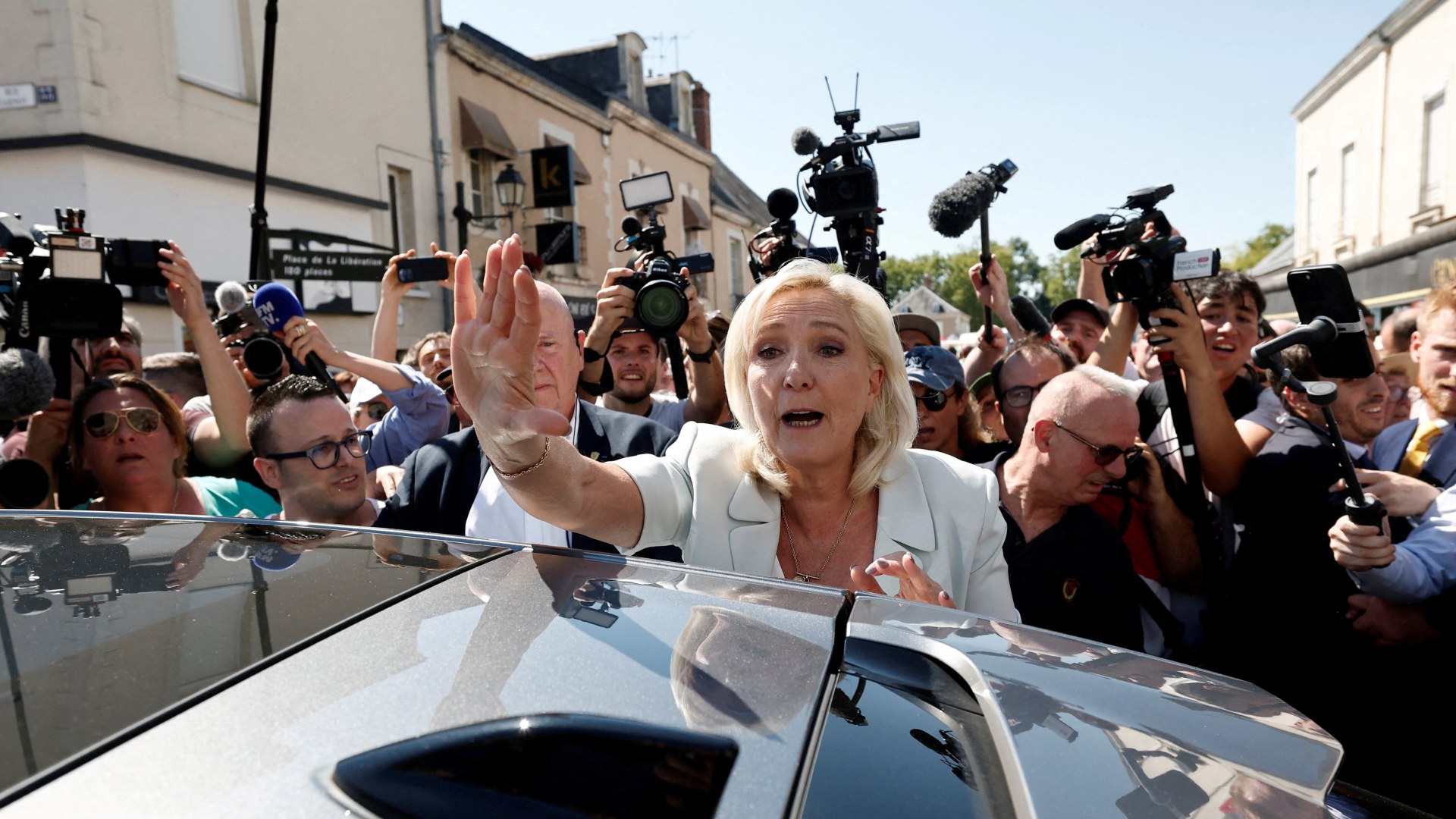
A new nationwide survey conducted by Toluna Harris Interactive for leading French broadcasters RTL and M6 has revealed a seismic shift in France’s pre-election political landscape, placing far-right presidential hopeful Marine Le Pen at a record-high polling position that projects her to win the April 2027 presidential contest. The poll, which surveyed 1,764 eligible French voters aged 18 and older, shows Le Pen holding a lead of at least 16 percentage points over every other declared or potential candidate, an unprecedented margin three years out from the vote. The results also signal a clear upward trajectory for left-wing pro-Palestinian figure Jean-Luc Melenchon, leader of the La France Insoumise (LFI) party, who has jumped from 12% support in April polling to a current 16 to 17%. This growth puts Melenchon on track to outperform centre-right former prime minister Edouard Philippe and secure a spot in the mandatory second-round runoff, according to poll analysts. In a projected head-to-head runoff between Le Pen and 75-year-old Melenchon, the survey estimates Le Pen would claim a decisive victory with 68% of the vote against Melenchon’s 32%. Under French presidential election rules, if no candidate secures an absolute majority in the first round of voting, the top two finishers advance to a second and final round of balloting. This 2027 race marks the fourth presidential bid for Le Pen, who lost back-to-back elections to outgoing President Emmanuel Macron in 2017 and 2022, taking 41.4% of the second-round vote in 2022. Macron is constitutionally barred from running for a third consecutive term, opening up the election for the first time in a decade. France’s left-wing bloc has been grappling with internal division heading into the contest, with dozens of potential candidates splitting voter support across ideological lines. To address this fragmentation, multiple left-wing party leaders have scheduled a “united left” primary for October 11 to select a single unified contender. However, LFI and two other major left-wing parties have rejected the initiative, deepening rifts within the bloc that could benefit Le Pen’s candidacy. Le Pen’s path to the 2027 ballot was only cleared earlier this summer after a French appeals court revised a prior criminal conviction tied to an embezzlement scheme involving European Parliament funds. Last year, Le Pen and 20 other members of her Rassemblement National (RN) party were found guilty of misappropriating roughly €4.5 million in EU public funds to pay unregistered RN party staff instead of the European Parliament employees the funds were allocated for. The original ruling handed down a four-year prison sentence and a five-year ban from holding public office, which would have blocked Le Pen from running in 2027. But on July 7, the Paris Court of Appeal upheld the conviction but drastically reduced the sentence: Le Pen will now serve a one-year house arrest sentence monitored by an electronic ankle tag, removing the ban on political office that would have disqualified her campaign. Following the ruling, Le Pen announced she would file a further appeal to France’s highest criminal court, the Cour de Cassation, in a bid to have the electronic monitoring requirement removed. If the high court fast-tracks the appeal and rejects her challenge, Le Pen could be forced to conduct her 2027 campaign wearing the court-ordered ankle tag. The RN, originally founded as the Front National by Le Pen’s father Jean-Marie Le Pen, carried a decades-long reputation marred by virulent antisemitic scandals that left it ostracized by mainstream global political actors. For generations, Israel enforced a strict boycott of European far-right parties over their antisemitic or Holocaust-denying histories and ties to fascist movements, and the former Front National was a core target of that policy. But in recent years, the RN has undertaken a deliberate campaign to rebrand itself, distancing itself from its extremist origins and shifting sharply to a pro-Israel policy stance. This shift has coincided with a broader rapprochement between Israel and far-right parties across Europe. Earlier this year, Le Pen held a private, unannounced meeting with Joshua Zarka, Israel’s ambassador to France, in a sign of the warming bilateral relationship between the RN and the Israeli government. Last year, during Israel’s military campaign in Gaza, Le Pen repeatedly criticized Emmanuel Macron’s public condemnations of Israeli military actions and his formal recognition of a Palestinian state. In a 2023 television interview, Le Pen framed Israel’s military operations as “a war against Islamic terrorism”. Most recently, Israeli Diaspora Affairs Minister Amichai Chikli publicly endorsed Le Pen’s party during 2024 parliamentary elections, and extended an invitation to RN party president Jordan Bardella to speak at an international conference on antisemitism to be held in Jerusalem in March 2025. Beyond her foreign policy shifts, Le Pen has centered her domestic agenda on strict hardline immigration policies, framing the growth of Muslim communities in France as a process of “Islamisation” that poses an existential threat to France’s secularist constitutional values. She has previously called for the repeal of laws granting legal residency to undocumented migrants, and has pushed to cut social welfare benefits for all immigrants to reduce incentives for new arrivals to settle in France.
French far-right leader Marine Le Pen polling at record high ahead of 2027 election