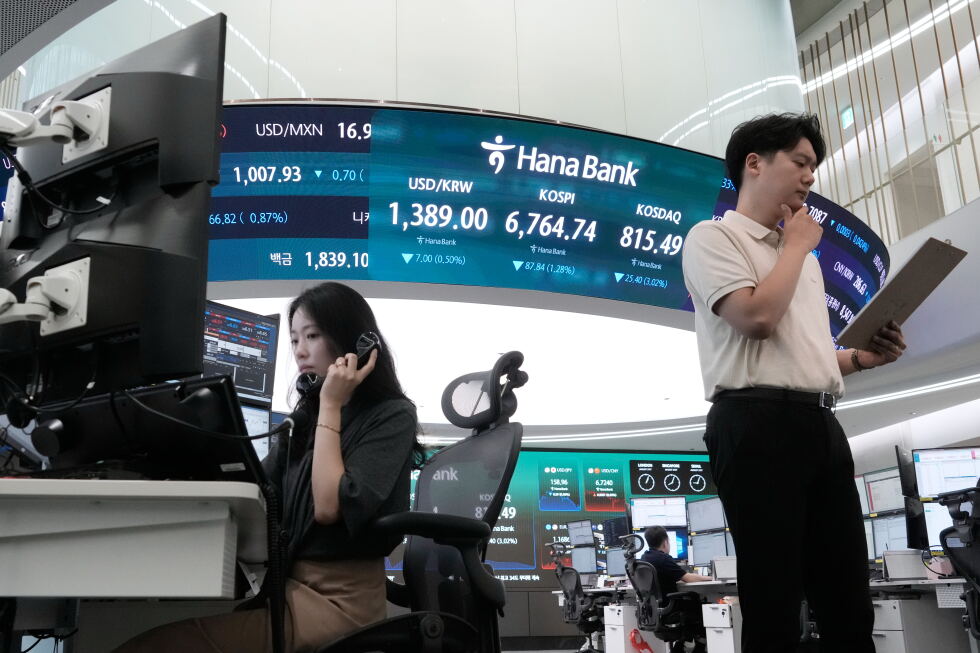
As global markets kicked off a high-stakes trading week Monday, most Asian equity benchmarks retreated and crude oil prices pulled back, with investors across the world holding their breath ahead of the annual gathering of top U.S. economic policymakers at Jackson Hole, Wyoming. U.S. stock futures also ticked downward in early pre-market trading, setting a cautious tone across the Asia-Pacific region.
Across major regional markets, the downturn was broad-based. Japan’s benchmark Nikkei 225 index dropped 0.5% to close at 65,678.45, while South Korea’s Kospi suffered a steeper 3.5% decline to land at 6,664.36. Hong Kong’s Hang Seng index fell 2.1% to 25,465.23, and China’s Shanghai Composite index edged 0.7% lower to 3,877.30. Taiwan’s Taiex also followed the downward trend with a 0.5% loss. Australia bucked the regional slump, however, with its S&P/ASX 200 gaining 0.5% to reach 9,107.40.
This week’s market calendar holds several make-or-break economic releases and events that could shape near-term global policy. On Wednesday, U.S. officials will release the July reading of the Personal Consumption Expenditures (PCE) price index, the Federal Reserve’s preferred metric for tracking inflation. Current forecasts and recent data signal U.S. consumer inflation remains stuck above 3%, well above the Fed’s long-term 2% target.
Inflation has reaccelerated after a brief cooling period in early 2025, driven by two key global shocks: broad-based U.S. tariffs imposed on trading partners worldwide, and output disruptions caused by the ongoing Iran conflict, which has cut oil shipments through the critical Strait of Hormuz and pushed energy prices sharply higher starting in early 2026.
Persistent inflation pressures have already sent bond yields surging in recent weeks, creating cascading volatility across financial markets. Last week, spiking long-term yields forced an unusual intervention from the U.S. Treasury Department, led by Secretary Scott Bessent. To calm markets, Bessent announced the government would double its buyback program for longer-term bonds, a move designed to push down 10-year Treasury yields and ease pressure on mortgage rates. The relief was short-lived, however: by Friday, the 10-year yield climbed back to 4.73%, matching a multi-year high, and held near that level at 4.71% in early Monday trading. The 30-year Treasury yield, another key target of the buyback program, also rose to levels not seen since 2007.
The unexpected failure of the Treasury’s intervention has amplified investor concerns. Higher sustained yields raise government borrowing costs, which in turn weigh on consumer spending—the core engine of U.S. economic growth. Many market participants are also growing increasingly wary of the risks posed by continuous large-scale government borrowing, a trend that has put persistent upward pressure on yields. The bond market remains highly volatile, and all eyes are now turning to the Jackson Hole summit, where Federal Reserve Governor Kevin Warsh is set to deliver a key speech that could signal upcoming shifts in interest rate policy.
U.S. equities closed last week on a fragile positive note: the S&P 500 gained 0.4% on Friday, notching only its second gain in six trading days after hitting an all-time high earlier the previous week. The Dow Jones Industrial Average climbed 1% and the Nasdaq composite edged up 0.4%, supported by better-than-expected spring corporate profits that have helped drive major U.S. indexes to record levels in recent weeks.
Geopolitical uncertainty continues to cloud the outlook, however. On Sunday, the new head of Iran’s top security body warned that Tehran would view any country’s support for new U.S. economic sanctions against the Islamic Republic as an act of war, even as Iran’s president defended a recent memorandum of understanding with the U.S. as the best path forward to de-escalate the stalled conflict. Persistent doubts about when oil tankers will be able to safely resume full transit through the Persian Gulf have kept energy markets volatile. Early Monday, crude prices pulled back from recent highs: Brent crude fell 1.4% to $93.10 per barrel, while U.S. benchmark crude dropped 1.6% to $85.63 per barrel.
One unusual bright spot amid the market volatility has been cryptocurrency. Bitcoin, which tends to rally when interest rate expectations fall and liquidity increases in global financial markets, has benefited from expectations that the Treasury’s intervention will push long-term yields lower. Additional tailwinds have come from growing hopes for pro-crypto industry legislation working its way through Washington. Early Monday, bitcoin traded near $77,000, according to data from CoinDesk.
In currency markets, the U.S. dollar edged slightly lower against the Japanese yen, falling to 158.89 yen from 158.94 yen at Friday’s close. The euro held steady, remaining unchanged at $1.1678 against the greenback.