When discussing the ongoing crisis in the Strait of Hormuz, raw missile counts and military deployments tell only a small fraction of the story. The most revealing metric of the current instability can be found not in defense briefings, but in global shipping insurance ledgers.
Before the latest escalation of tensions, war-risk premiums for tankers transiting the strategic waterway averaged just 0.15% of a vessel’s total value – a negligible expense that rarely registered on shipping company balance sheets. At the peak of conflict this year, however, that same premium skyrocketed to between 5% and 10% of a tanker’s value, with some reports noting brief spikes thousands of times higher than pre-crisis levels.
To put that surge in perspective: for a $100 million supertanker, the cost of war-risk insurance jumped from $150,000 per one-way voyage to between $5 million and $10 million per trip. This pricing shock has gutted commercial traffic through the strait, which carries roughly a fifth of global oil supplies. Where daily transits once averaged around 178 vessels, traffic fell by as much as 95% at the most tense points of the crisis.
This quiet disruption reveals a core reality of Iran’s asymmetric strategy: Tehran does not need to formally close the Strait of Hormuz to achieve its geopolitical goals. It only needs to inject enough uncertainty into the market to push global underwriters to pull coverage or raise costs to prohibitive levels, turning the private insurance industry into an unintended ally of Iranian policy.
### A Problem Military Power Cannot Fix
For decades, U.S. strategy in the Persian Gulf has rested on a single core assumption: overwhelming naval force would deter aggression and keep commercial shipping lanes open. This framework worked for generations, but it has failed to address Iran’s unorthodox approach.
Instead of building a conventional fleet to match U.S. naval power, Iran has invested in asymmetric capabilities: naval mines, fast attack craft, drones, and anti-ship missiles. These weapons are not designed to win a full-scale war against the U.S. Instead, their purpose is to generate enough persistent risk to force London-based Lloyd’s of London underwriters to reprice the cost of transiting the strait, until shipping companies choose to avoid the route entirely.
This reality explains why traditional U.S. responses – naval escort missions and the Trump administration’s $40 billion reinsurance backstop through the International Development Finance Corporation – have only treated the symptoms of the crisis, not its root cause. While escorts can get individual vessels through the strait, they do little to convince global underwriters that the region has returned to sustainable safety. As a Crisis Group analyst bluntly notes, there is no military solution to this standoff: the strait will only fully reopen through negotiation, not show of force.
This is the essence of the current asymmetric standoff: Iran cannot defeat the U.S. Navy, and it has no intention of trying. It only needs to rattle global insurance markets long enough to make “freedom of navigation” too expensive for U.S. partners to sustain.
### The High Cost of Every Policy Path
None of Washington’s available policy options come without significant tradeoffs. Further military strikes risk targeting critical Gulf energy infrastructure, which would only drive risk premiums even higher. Decades of economic sanctions have proven they can cripple Iran’s economy, but they have failed to force Tehran to surrender to U.S. demands.
Negotiation remains a viable path, with recent reporting indicating that new Iranian President Masoud Pezeshkian has internally pushed to de-escalate the confrontation from a position of strength, opposing hardline factions that favor continued tensions. Yet neither Washington nor Tehran has been willing to appear as the first party to back down – a dynamic that led to the quick collapse of the Islamabad Memorandum ceasefire. While the deal managed temporary political de-escalation, it failed to address the underlying economic reality: every new attack on commercial shipping resets market risk pricing from scratch.
### Pakistan’s Overlooked Stakes in the Hormuz Crisis
Most analysis of Pakistan’s role in the crisis focuses on its obvious positioning: it shares a border with Iran, maintains security ties with Gulf states, has deep economic links to China, and preserves working relations with Washington, leading it to adopt a hedging stance. But this framing misses the direct economic impact that a Hormuz insurance shock has on Pakistan’s own economy, as well as the unique opportunities the crisis creates for Islamabad.
Three key points outline Pakistan’s stake. First, Pakistan imports nearly all of its oil via the Gulf, so war-risk premiums added to every tanker bound for Karachi or Port Qasim are not a distant geopolitical issue – they directly raise domestic fuel prices and widen Pakistan’s already strained current account deficit. This is an immediate, tangible concern for economic policymakers in Islamabad.
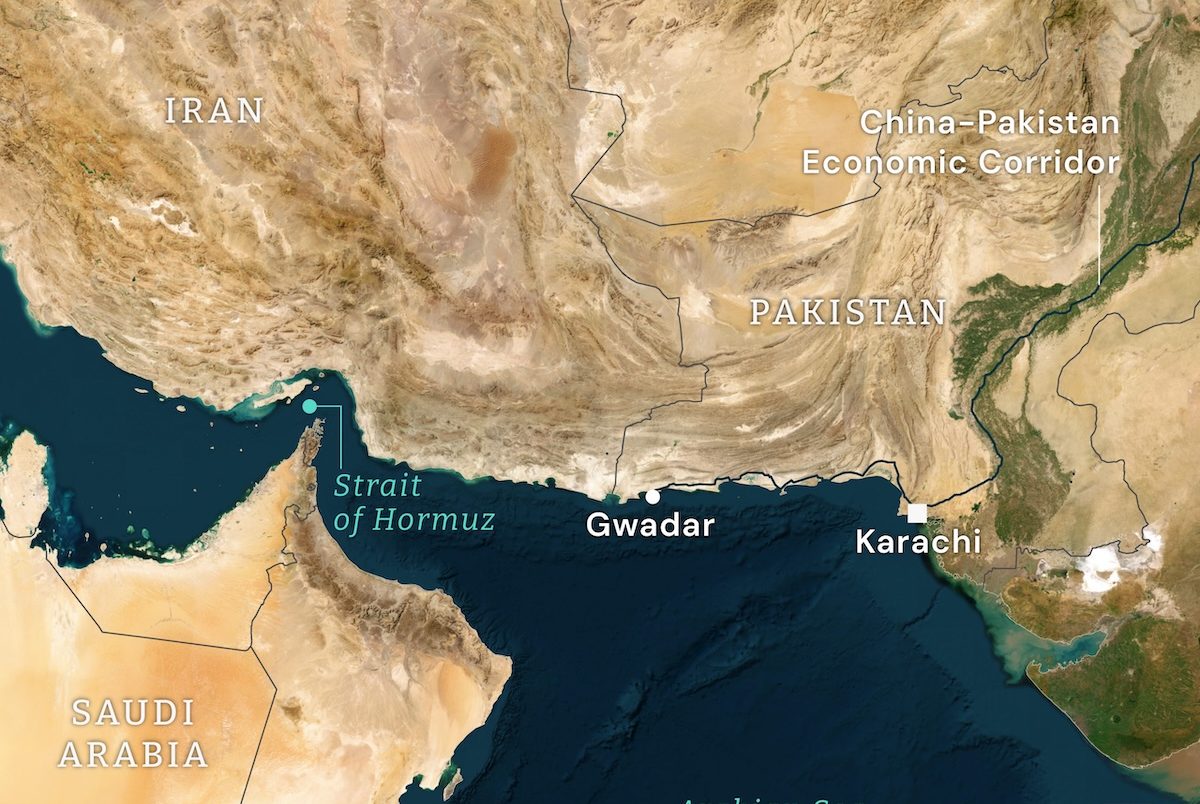
Second, the port of Gwadar – long framed primarily as a showcase project for the China-Pakistan Economic Corridor (CPEC) – offers a unique alternative for shippers. Located on the open Arabian Sea, entirely outside the Strait of Hormuz, Gwadar is one of the few major regional ports that does not force commercial vessels to run the gauntlet of high Hormuz war-risk premiums. To date, few Pakistani officials have actively marketed this advantage to shippers and energy traders looking to diversify their routing to cut risk, but the opportunity remains untapped.
Third, Pakistan’s existing diplomatic and economic ties create a natural buffer against the crisis. Its Makkah Joint Defense Agreement with Saudi Arabia, paired with new investment frameworks for mineral development at Reko Diq and under the Project Vault initiative, function as Pakistan’s own “insurance policy” against Hormuz-related market shocks. A posture that combines Gulf security partnerships with economic and connectivity ties to both Gulf states and China gives Pakistan far more leverage than a generic neutral stance.
This exposes a common trap for Pakistani policy: treating “active neutrality” as an end in itself, rather than a foundation for a proactive economic strategy. Neutrality without a targeted economic plan is just unmanaged risk disguised as diplomatic prudence. A productive approach would turn Pakistan’s unique geographic advantages – Gwadar’s position outside the strait, its border with Iran, its ties to both Riyadh and Washington – into concrete shipping contracts and infrastructure investment, rather than just praise for avoiding direct conflict.
### A Broader Global Pattern
Zooming out from Pakistan’s specific situation, the Hormuz crisis reveals a new global mechanism of coercion that is not unique to the Persian Gulf. A near-identical dynamic played out in the Red Sea during Houthi attacks on commercial shipping: war-risk premiums rose roughly fivefold, and shipping volumes collapsed even though most vessels never encountered an actual mine or missile attack.
Analysts who study this phenomenon note that the formula works anywhere with three core features: a narrow maritime chokepoint, few viable alternative routing options, and a functioning private insurance and reinsurance market. This applies to other critical global chokepoints, from the Strait of Malacca to the Taiwan Strait to the Turkish Straits. Coercion through risk pricing has become a powerful new weapon that does not require a single shot to be fired to achieve its goals, and the U.S.-led reinsurance backstops being built for Hormuz may end up serving as a template for future crises around the world.
For the United States, this is an uncomfortable lesson: even if it dismantles all of an adversary’s conventional military capabilities, it can still lose the quiet argument that matters most to the shipowner deciding whether to route through a high-risk waterway. For Pakistan, the lesson is not just uncomfortable – it is actionable. Few non-belligerent countries are positioned as close to a major chokepoint crisis as Pakistan, and few hold the same combination of strategic assets: Gwadar’s location, existing Gulf security ties, and access to Chinese infrastructure investment. These assets can turn proximity to the crisis into tangible economic leverage, if Islamabad chooses to treat the moment as an opening rather than just a diplomatic high-wire act.
Most analysts expect the Strait of Hormuz will eventually reopen to full commercial traffic, through talks rather than force. But global insurance markets, which have already completely repriced risk for the entire Persian Gulf, will not forget this shift quickly. The actors that recognize this structural change early will emerge with a lasting advantage over those that only focus on the political theater of the crisis.