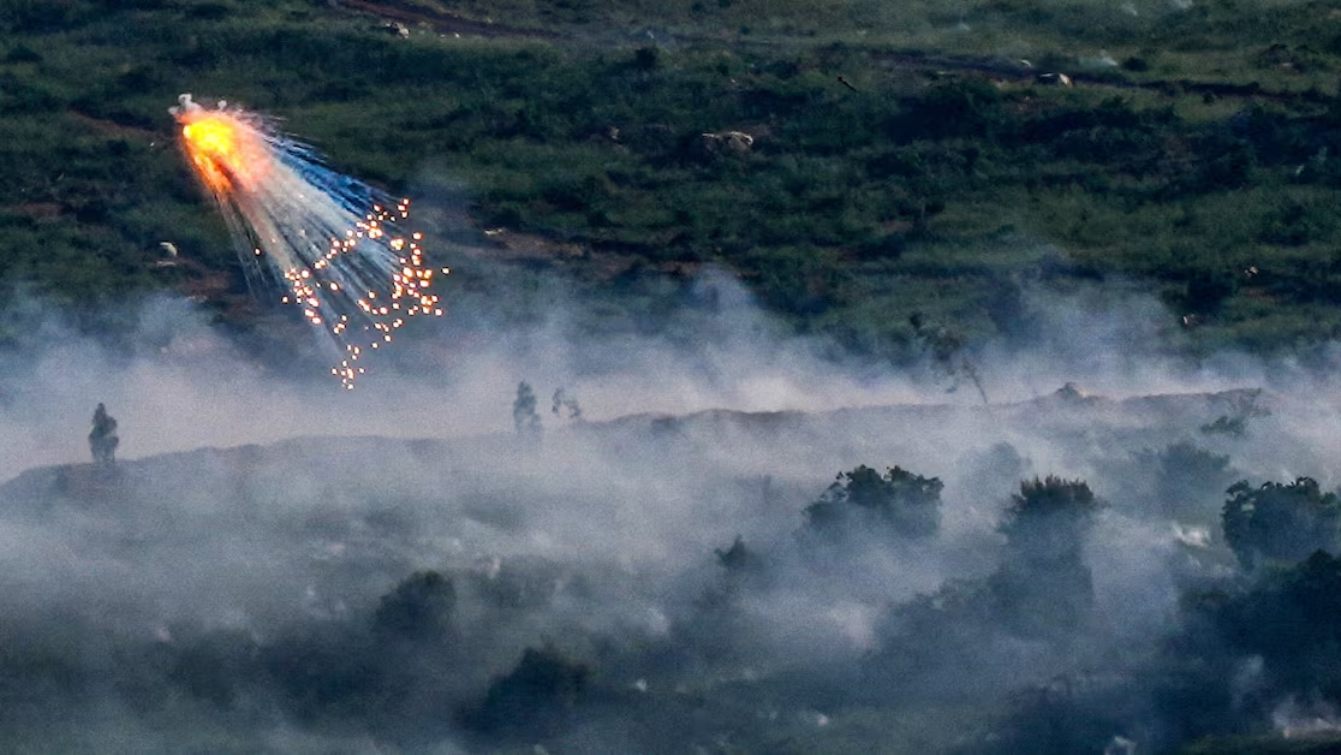
A new wave of intensive Israeli military strikes has swept through multiple regions of southern Lebanon overnight into Saturday, leaving widespread damage to civilian infrastructure and raising renewed international alarms over the reported use of controversial white phosphorus munitions, Lebanon’s official National News Agency (NNA) has confirmed.
Early Saturday morning, heavy Israeli artillery barrages targeted three key locations: the coastal town of Mansouri, the territory surrounding Bayt al-Sayyad, and the outer outskirts of Majdal Zoun. These strikes followed hours of sustained large-scale assaults across the same three areas overnight, NNA reported.
In Bayt al-Sayyad, the destruction has been catastrophic. The state-run news outlet confirmed that every residential structure in the town sustained damage, with many reduced to rubble. Additional blasts were recorded in the southern Lebanese towns of Hadatha, Beit Yahoun and Aita al-Jabal, while Israeli troops also deployed sustained machine gun fire toward nearby agricultural and residential valleys, according to the report.
Israeli military drones maintained continuous patrols over population centers across both the western and central sectors of southern Lebanon through the early morning hours, NNA added. In a separate targeted operation, Israeli warplanes carried out two separate air raids on Ali al-Taher hill, located on the northern edge of Nabatieh al-Fawqa.
The most contentious element of the latest assaults is the confirmed use of phosphorus shells during overnight and early morning shelling of three additional areas: the outskirts of Dawhat Kfar Remman, the territory surrounding Dabsha hill, and the wooded zone of Ali al-Taher.
This reported deployment of white phosphorus comes after repeated public warnings from international human rights organizations over Israel’s ongoing use of the incendiary weapon in southern Lebanon. International law explicitly bans the use of airburst white phosphorus in or near dense civilian populations, due to its indiscriminate nature that causes irreversible, often fatal harm to civilian bystanders.
White phosphorus is a pyrophoric incendiary chemical that ignites immediately on contact with oxygen. When it touches human skin or structures, it causes deep, third-degree burns that often penetrate to the bone, and can burn through tissue all the way to bone. Inhalation of its toxic fumes causes severe respiratory damage, chemical burns to the airway, and can lead to fatal asphyxiation.
This is not the first documented use of the weapon by Israeli forces in the region. In 2023, Human Rights Watch (HRW) published a report confirming that Israeli troops had deployed white phosphorus in the densely populated Gaza Strip, as well as in two rural border zones along the Israel-Lebanon frontier. In 2024, visual evidence collected and shared by HRW including geolocated photos and video footage showed white phosphorus munitions striking residential buildings in multiple southern Lebanese border villages, including Kafr Kila, Mays al-Jabal, Boustane, Markaba, and Aita al-Chaab.