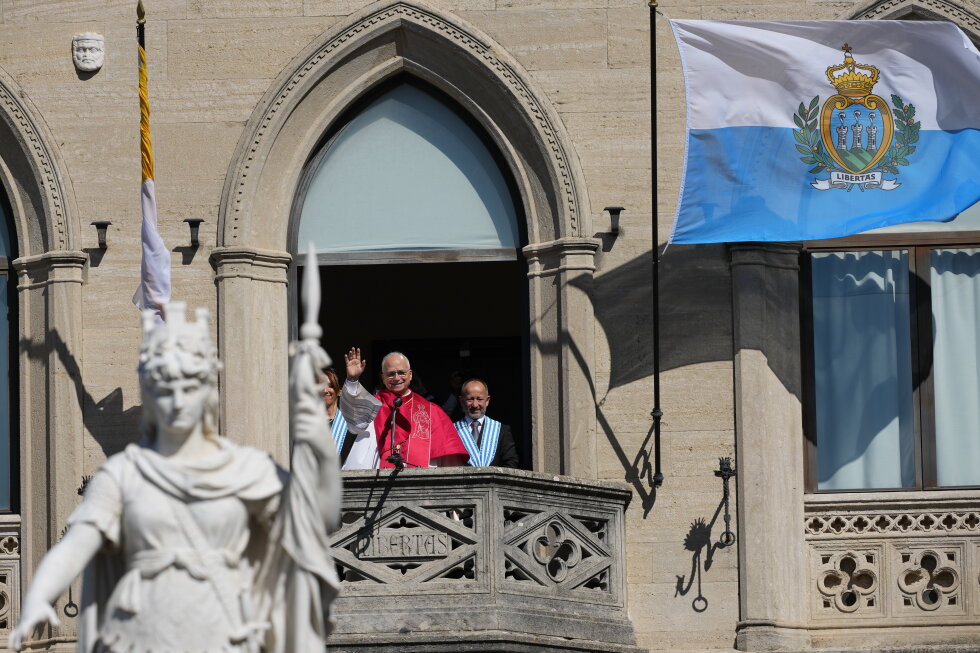
On a historic one-day visit to the world’s oldest continuously existing republic, Pope Leo XIV delivered an address to local authorities that framed the micro-state of San Marino as a timeless example of civic virtue and political freedom. Fully enclosed within Italy’s borders, this 35,000-person nation carries a political heritage stretching back to the 4th century, shaped by its unique power-sharing governance structure. Pope Leo’s Saturday trip marked only the third papal visit to San Marino, following journeys by Pope St. John Paul II in 1982 and Pope Benedict XVI in 2011.
Opening his remarks, the pontiff anchored San Marino’s founding legacy to Saints Marino and Leone, two early Christian figures whose work laid the foundation for a community built on the core values of individual freedom, reciprocal respect, and collective solidarity. He explained that the pair translated Christian teachings into a radical new model of community and political life, one that remains embedded in the republic’s national identity 17 centuries later. Describing the nation as a “laboratory of good politics,” Pope Leo highlighted San Marino’s distinct system of governance: a 60-member national parliament that elects two joint heads of state (captains regent) every six months, an institutional design intentionally created to prevent the dangerous concentration of political power.
Against a global backdrop of rising polarization, eroding trust in institutions, and growing social division, Pope Leo argued that small, cohesive political communities like San Marino offer critical lessons for the modern world. He praised the nation’s identity as a society rooted in “respect for one’s own freedom and that of others and above all on respect for the sacred Will of God,” noting that its centuries-old republican experiment has sustained a culture of civic responsibility unmatched in many larger modern nations.
The pope paired his celebration of San Marino’s legacy with a pointed warning to modern societies about growing threats: rising violence, deepening social fragmentation, and ideological and economic systems that prioritize individual self-interest and the accumulation of power over the common good and the inherent dignity of every person. “We live in a world wounded by many conflicts,” he stated, pointing to rising violence, societal closure, and growing fear of marginalized groups and outsiders. He urged Christians worldwide to respond to these challenges through intentional practices of forgiveness, cross-community solidarity, and consistent care for the most vulnerable members of society.
Consistent with longstanding Vatican social teaching, Pope Leo explicitly called for all public life and policy to uphold the dignity of every human person “from conception to natural death” — phrasing that is widely associated with the Catholic Church’s official opposition to abortion and euthanasia. This comment comes three years after San Marino voters approved a 2021 referendum legalizing abortion within the first 12 weeks of pregnancy, a landmark policy shift that overturned a decades-old national ban in one of the world’s most culturally Catholic countries. While the pontiff did not directly reference the controversial 2021 referendum, he reiterated his core message: that all political, social, and economic systems must center human dignity as their core purpose, warning that systems which claim to advance freedom often end up failing to serve people and the collective public good.
Pope Leo closed his address by commending the small rural communities of the San Marino-Montefeltro region, which have organized mutual support networks and cooperative initiatives to counter the challenges of rural depopulation and declining local public services.
The report was filed by correspondent Zampano from Rome.