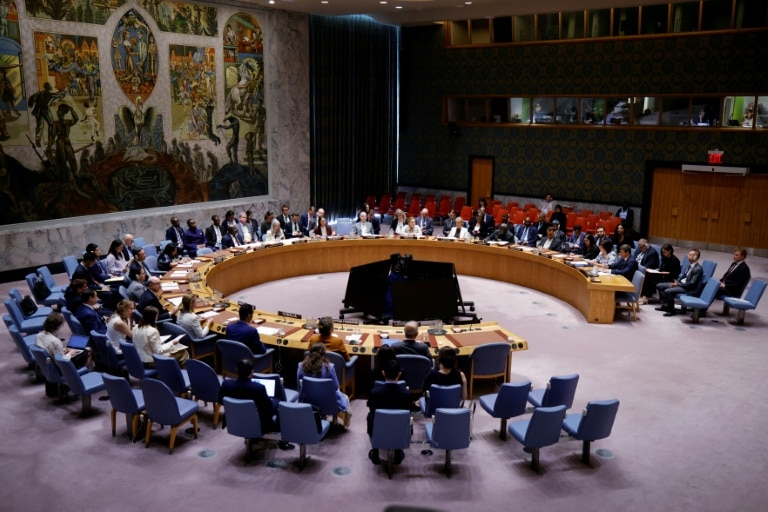
The race to succeed António Guterres as United Nations Secretary-General entered a new phase Friday, as the 15-member UN Security Council gathered for a second informal straw poll to measure support for the expanding field of candidates. Guterres’ second five-year term is set to conclude on December 31, 2026, kicking off a months-long selection process that is being shaped heavily by the power of the Security Council’s five permanent veto-wielding members.
Last month’s first closed-door, secret ballot informal poll placed Costa Rica’s Rebeca Grynspan as the early front-runner among the existing field of contenders. The full roster of candidates already includes Rafael Grossi of Argentina, the current head of the International Atomic Energy Agency, former Chilean president Michelle Bachelet, Maria Fernanda Espinosa of Ecuador, Carolyn Rodrigues-Birkett of Guyana, Olara Otunnu of Uganda, and former Senegalese president Macky Sall. Since the first straw poll, Ecuador’s Ivonne A-Baki has also entered the race, expanding the pool of hopefuls vying for the UN’s top leadership role.
Following Friday’s vote, Christina Lassen, Denmark’s UN ambassador and the current holder of the Security Council’s rotating presidency, confirmed that candidates would receive results through their nominating countries’ permanent representatives to the UN, and offered no further public comment on the internal proceedings. Lassen also noted that the council is still weighing when to schedule the next informal survey of support. Zenon Ngay Mukongo, ambassador from the Democratic Republic of the Congo, a sitting Security Council member, echoed the widespread uncertainty, telling reporters that “it’s too early to have a consensus” on a leading contender.
The opaque selection process has long drawn criticism from member states that argue it lacks transparency, but the informal straw poll system has remained in place since its creation in the early 1980s, when it was introduced to break a selection deadlocked by multiple vetoes. Under the process rules, each Security Council member votes anonymously, labeling every candidate as either “encourage,” “discourage,” or “no opinion.” Analysts say the results often give low-support candidates clear signal to exit the race voluntarily, though no rule requires them to withdraw. Daniel Forti, an expert with the International Crisis Group, noted ahead of Friday’s vote that “there is a good chance that some nominees realize after (Friday’s) vote that their campaigns have reached the end of the road.”
Unlike in later rounds of voting, all ballots in the early polls share the same color, meaning that the veto power of permanent members (P5) — China, France, Russia, the United Kingdom, and the United States — is not made visible in these early stages. After several rounds of polling, P5 ballots will switch to a different color, allowing delegates to identify if a candidate faces a veto from one or more permanent members, without revealing which specific power rejected the candidate. Even if a candidate hits the required threshold of nine out of 15 Security Council votes, they still need to avoid a veto from any of the five permanent powers, which are currently deeply divided on a range of global issues that could shape the selection.
Many diplomats have declined to predict a final outcome, citing the outsized influence of the P5 powers. Ahead of the vote, Forti noted that the five veto-wielding nations may hold off on announcing their preferences until later in the process, leaving the door open for additional candidates to join the race. Russia’s UN ambassador Vassily Nebenzia confirmed that possibility Thursday, telling reporters that if the current field deadlocks with no candidate emerging as a clear favorite, “we may see other candidates as well.”
Once a candidate successfully passes the Security Council’s voting and veto requirements, their nomination is sent to the full UN General Assembly for final confirmation. Longstanding UN tradition holds that the secretary-general role rotates between geographic regions, and under that norm, the 2026 selection should produce a leader from Latin America — a region that already accounts for most of the current candidates, though two hopefuls, Sall and Otunnu, hail from Africa.