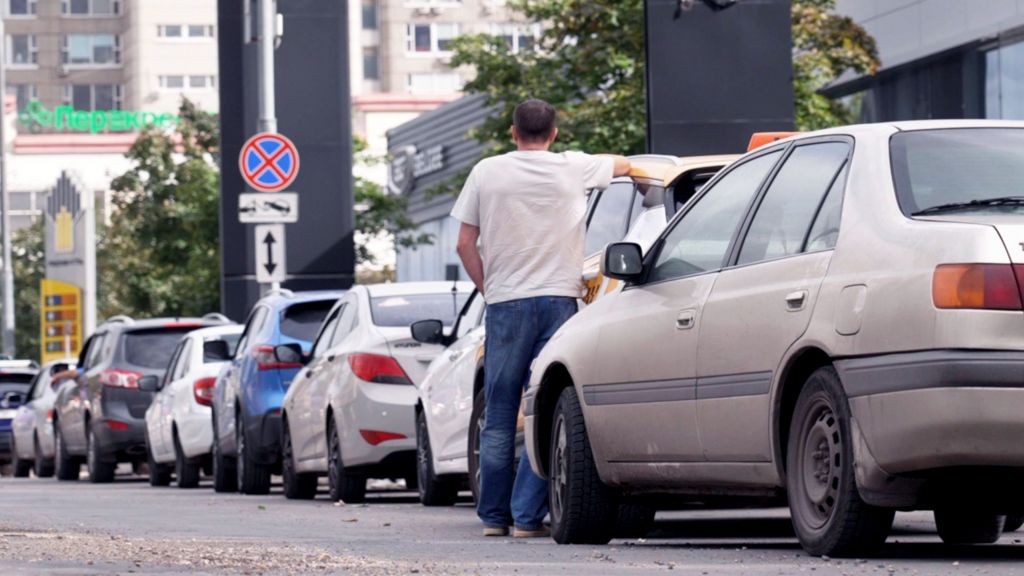
In the sweltering late summer days of August 2026, motorists across Moscow and large swathes of Russia are trapped in a growing fuel crisis, triggered by sustained Ukrainian drone attacks on key oil refining infrastructure that have plunged daily life into disruption.
At a petrol station in southeast Moscow, 58-year-old driver Svyatoslav has sat idling in a two-hour queue, only to watch the facility’s digital sign flip to a stark notification: no fuel available. With barely any fuel left in his tank to reach another station, he holds out faint hope that a new delivery will arrive soon. “They say there will be petrol here, they just don’t know when. Maybe today, maybe tomorrow,” he says, his quiet optimism belying the scale of the shortage gripping the capital.
This is not an isolated incident. This week, lines of dozens, even hundreds of vehicles have stretched for blocks from petrol stations across the city, with wait times stretching into hours for drivers desperate to fill their tanks. In one station alone, 80 vehicles were counted waiting in a single line. For many motorists, the scramble for fuel has become a daily grind. Elizaveta, another driver waiting in line, recalled waiting until midnight the previous night just to reach the pump, only for the station to close for two hours before she could refuel. Lyubov, who drove into Moscow from a provincial region, said every station she passed along her route was completely empty. To calm her nerves during the hours-long wait, she gently strokes her small pet dog Agatha in the passenger seat.
Russian officials have attributed the shortage to unscheduled maintenance at domestic oil refineries – a framing that omits the direct cause of these repairs: repeated long-range Ukrainian drone strikes on refining facilities. These attacks first sparked widespread fuel shortages earlier this summer, and targeting of oil infrastructure has continued unabated. This second wave of shortages has produced even longer queues than the first, and Russian authorities are struggling to address gaps in refining capacity and supply chain logistics. Leading Russian broadsheet *Nezavisimaya Gazeta* declared this week that “the second wave of the fuel crisis is building.”
The irony of the crisis is impossible to ignore: Russia, long billed as a global energy superpower and one of the world’s top crude oil exporters, has been forced to take extraordinary emergency measures to stem the shortage. The Kremlin has authorized imports of finished petrol to boost domestic supply, and temporarily lifted a 13-year ban on lower-grade Euro 2 petrol, a high-sulfur fuel phased out over environmental and engine health concerns. While faster to produce than modern Euro 5 fuel, state newspaper *Rossiyskaya Gazeta* warned that regular use of Euro 2 damages critical engine components including fuel injectors, spark plugs, catalytic converters and soot filters – while a single tank will not destroy an engine, it drastically cuts an engine’s operational lifespan and safety margin.
The fuel shortage is not the only way the Ukraine war has been brought home to ordinary Russians. Recent Ukrainian strikes on logistics centers for Wildberries, Russia’s largest domestic e-commerce platform equivalent to Amazon, have disrupted online shopping and caused significant financial losses for small sellers across the country.
Russian President Vladimir Putin has acknowledged that these attacks on industrial and energy infrastructure do cause damage, but has downplayed the severity of the crisis. “There are no critical consequences from such attacks. There have not been and cannot be,” Putin said this week, urging the public not to panic. But independent observers and recent polling suggest a growing gap between the Kremlin’s official narrative and public sentiment.
Andrei Kolesnikov, a columnist for independent Russian outlet *Novaya Gazeta*, argues there is a fundamental disconnect between Putin’s framing of the situation and the reality ordinary Russians experience. “It is a disconnect between people’s feelings and the description of reality by Vladimir Putin, the description of his personal reality in his head,” Kolesnikov said. “Maybe he’s trying to hypnotise himself that everything is okay.”
Recent polling from Russia’s Public Opinion Foundation confirms that public anxiety is rising, and the Kremlin’s call for “keep calm and carry on” is failing to resonate with the public. “This permanent feeling of anxiety is with everyone right now. You feel that something is wrong. Anxiety is the main sentiment,” Kolesnikov explained. He added that the Russian government has failed to outline any clear vision for the future, leaving the public with a very short planning horizon and a reluctance to think long-term.
Just minutes from the petrol stations choked with queues, a stark contrast played out across Moscow this week for Russian Flag Day: state-organized patriotic events featuring street concerts, free candyfloss for families, and public displays of military hardware, including Kalashnikov rifles and hand-held rocket launchers that children were invited to handle and pose with. The event highlights the growing militarization of everyday Russian society, and the Kremlin’s efforts to maintain public morale amid growing hardship.
For some Russians, the difficulties have reinforced patriotic unity. “Difficulties unite us. The harder things are, the stronger we get,” said pensioner Tatyana, who attended the Flag Day event. But for many others, the fuel shortages and drone attacks have created a persistent undercurrent of fear and uncertainty. “When you go to sleep you don’t know if you’ll wake up in the morning,” said Muscovite Angelina. Another resident added: “The problems we have are high prices, petrol shortages and last night, for the first time, my windows shook…I heard ‘boom boom!’”
Many ordinary Russians report feeling powerless to change the situation, saying the only option available to them is to adapt and maintain their psychological strength. “Right now, it’s important to take care of your psychological state, so that it’s strong and unbreakable. So that, whatever happens, you can say: ‘Oh well, never mind,’” one resident said. Even as state events keep patriotism on full display, for millions of Russians across Moscow, the daily struggle to find petrol has made the cost of the war impossible to ignore.