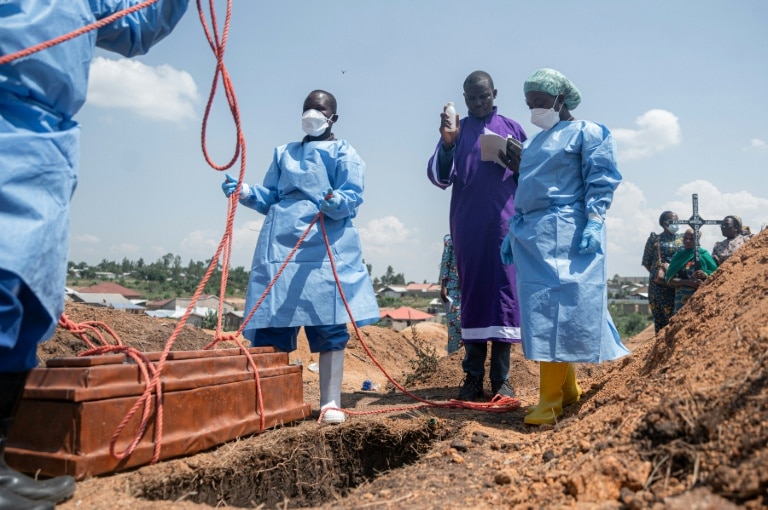
An Ebola outbreak raging across the Democratic Republic of Congo (DRC) is spreading at an exponential rate, with the official death toll surging past 2,500 and half of those fatalities recorded in just the last 20 days, the United Nations’ senior Ebola response coordinator confirmed Friday.
This outbreak, the 17th recorded Ebola event in DRC history, is already the deadliest the country has ever faced, and is expanding faster than any previous Ebola outbreak on record. Speaking to reporters via remote connection from Bunia – the outbreak’s epicenter – Julien Harneis, the UN’s top coordinator for the crisis, painted a stark picture of the rapidly worsening situation.
“The epidemic is spreading widely. It’s now covering an area that is bigger than France…. It is growing faster and wider than the Ebola response,” Harneis said. Experts believe the outbreak began spreading quietly for several weeks before it was officially declared by DRC authorities on May 15, giving the virus a critical head start on containment efforts.
The virus has taken hold primarily in northern and eastern regions of DRC, where long-standing systemic vulnerabilities have created a perfect environment for unchecked spread: weak central government presence, crumbling and under-resourced health infrastructure, and decades of activity by dozens of armed armed groups that have destabilized communities.
The international medical charity Doctors Without Borders (MSF) echoed the UN’s alarm Friday, warning the outbreak is accelerating “at an alarming rate.” “This epidemic continues to spread, moving faster than the response can keep up,” MSF president Javid Abdelmoneim said in an official statement.
The ongoing response effort has faced widespread criticism for its slow rollout and poor coordination, and is further complicated by deep-rooted mistrust of medical authorities among local populations. To date, confirmed cases have been reported across six DRC provinces, with some cases detected near the South Sudan border and a previous cluster in neighboring Uganda. Uganda, which recorded 20 cases and two deaths before containing its outbreak, declared itself Ebola-free last month.
Complicating response efforts further, the current outbreak is driven by the Bundibugyo Ebola strain, for which no specifically approved vaccine or targeted treatment exists, though multiple clinical trials are currently underway. The World Health Organization (WHO) announced Thursday that DRC will receive 70,000 doses of Ervebo, an approved vaccine that has proven highly effective against the more common Zaire Ebola strain.
Earlier this month, WHO vaccine experts endorsed a full-scale human trial of Ervebo to test whether it provides cross-protection against the Bundibugyo strain. While early data from animal trials suggests the vaccine may offer partial protection, WHO spokesman Christian Lindmeier emphasized Friday that “it is not yet known whether Ervebo is protective against the Bundibugyo virus in humans.”
Bringing the outbreak under control, which spreads through direct contact with infected bodily fluids and causes life-threatening hemorrhagic fever, faces a host of additional barriers. Harneis pointed to widespread insecurity across eastern DRC and a chronically weak public health system as major obstacles.
“The law and order is undermined, and the basic services, particularly health, have been fragmented,” he said, describing working conditions for frontline responders as “brutal.” Since the outbreak began, 160 healthcare workers have contracted Ebola, and 43 of those workers have died. Frontline teams have also faced repeated targeted attacks on ambulances and response facilities.
Harneis added that a barely functional banking system has made it difficult to deliver timely wages to response workers, while recent cuts to international funding have reduced the response capacity of humanitarian organizations operating in the region by one third.
In closing, Harneis issued an urgent call for expanded international support and resources. “If we provide more staffing, if we get more resources into remote areas across … the east of the Democratic Republic of Congo, within months we can slow the transmission and move to stopping it,” he said. “If we do not, … then this epidemic will become more deadly. It will spread wider and it risks to spread into neighbouring countries.”