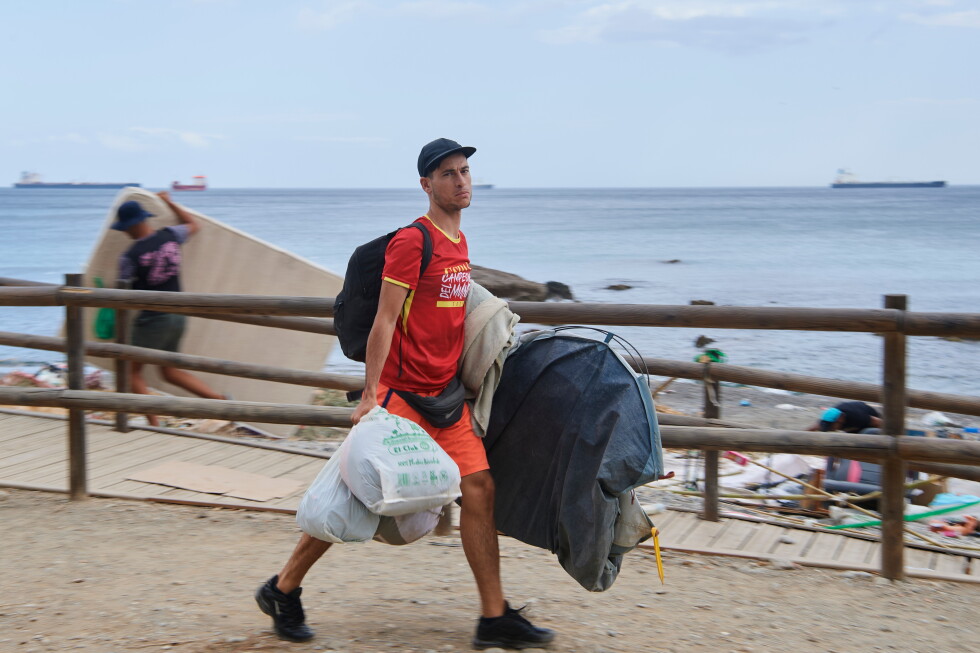
On a late August morning in the Spanish North African exclave of Ceuta, the sands of El Trampolin Beach sat empty after weeks of holding a makeshift camp for thousands of stranded migrants. Just hours earlier, Spanish police had escorted the last of the beach encampment residents to temporary shelters across the territory. By mid-morning, new arrivals were already picking through the discarded remains of the camp, searching for anything usable: a frayed abandoned mattress, weathered plastic chairs, worn bed sheets, and scraps of waterproof tarp. This quiet turnover lays bare the ongoing, unresolved humanitarian emergency that has gripped Ceuta three weeks after a historic mass border crossing.
In late July 2026, more than 72,000 migrants poured across the border from neighboring Morocco into the small territory, which is home to just 84,000 Spanish residents. The crossing left at least 90 people dead, and while the majority of migrants eventually returned to Morocco, daunted by the challenges of surviving in Ceuta and the near-impossible odds of reaching mainland Europe, thousands remain unaccounted for and unsheltered. Today, conflicting official and non-official estimates put the remaining migrant population somewhere between 5,000 and 10,000 people, including roughly 2,000 minor children.
Most of those who crossed are from Morocco, but significant numbers of people fleeing conflict in Sudan, Mali, and Yemen also made the journey, all seeking better opportunities or international protection. For weeks, many of these stranded people lived in primitive conditions along Ceuta’s beaches, sleeping on cardboard sheets, building rough shelters from reeds, and keeping their meager possessions in tattered plastic bags. Many more hid in the surrounding hills, camped outside the official migrant reception center, or wandered the territory’s streets with no fixed place to stay.
The United Nations High Commissioner for Refugees (UNHCR) has warned of severe humanitarian and operational gaps in the response, particularly around access to safe shelter, basic public services, and consistent food supplies. The agency is pushing Spanish authorities to speed up processing of asylum claims, estimating that roughly 1,200 of the remaining migrants meet the criteria for international protection. “They help the minors and the youngsters, but they haven’t found any solutions for us,” explained 20-year-old Moroccan migrant Khadija Rifai, who crossed into Ceuta with her husband in late July. Her husband was deported back to Morocco, but she hid from authorities to stay in the territory, hoping to eventually reunite with him and move to mainland Spain. “Even though we suffered here in Ceuta, we hope that once we reach the mainland, life will be good and we will have a house, a car, and everything we dreamed of,” she added.
Spanish national authorities have taken steps to address the crisis, announcing that they have secured 1,800 shelter spots in a repurposed parking lot and a military facility that is occasionally used for large religious gatherings. The national government has also allocated 6.5 million euros ($7.6 million) in emergency funding to support local response efforts, and aid groups have been distributing roughly 4,000 meals to migrants every day since August 3. A ministry spokesperson emphasized that each case requires individual processing: police first must identify all irregular entrants, confirm their nationality and background, screen for asylum eligibility, and determine who can stay and who must be deported, either voluntarily or through forced removal.
Even with these interventions, hundreds of migrants, including many women and children, remain sheltered only in informal, locally run makeshift centers, and dozens more continue to roam Ceuta’s streets. Local political leaders have grown increasingly critical of the national government’s response. Ceuta Mayor Juan Jesús Vivas, a member of the center-right Popular Party, argued that moving migrants from beach camps to other sites within the territory does not amount to a real solution, and accused the national government of failing to take decisive enough action to resolve the crisis.
For the migrants who remain, life is defined by uncertainty. Many have participated in public protests calling for faster asylum processing and permission to travel onward to mainland Europe. For 18-year-old Chadian migrant Mohamed Yaqoub, who hid in the woods for days after being chased by Spanish soldiers shortly after his crossing, the immediate priority is securing legal documentation. Yaqoub hopes to eventually continue his studies in France, but exiting Ceuta for mainland Europe or other EU countries requires official exit checks that are nearly impossible for irregular migrants to pass. “We ask them to allow us entry and give us the necessary papers and documents,” Yaqoub wrote in a note to The Associated Press. “The most important thing for us is to get the papers.” Despite the uncertainty and hardship, most migrants say they are willing to wait as long as it takes for a path forward to open up.