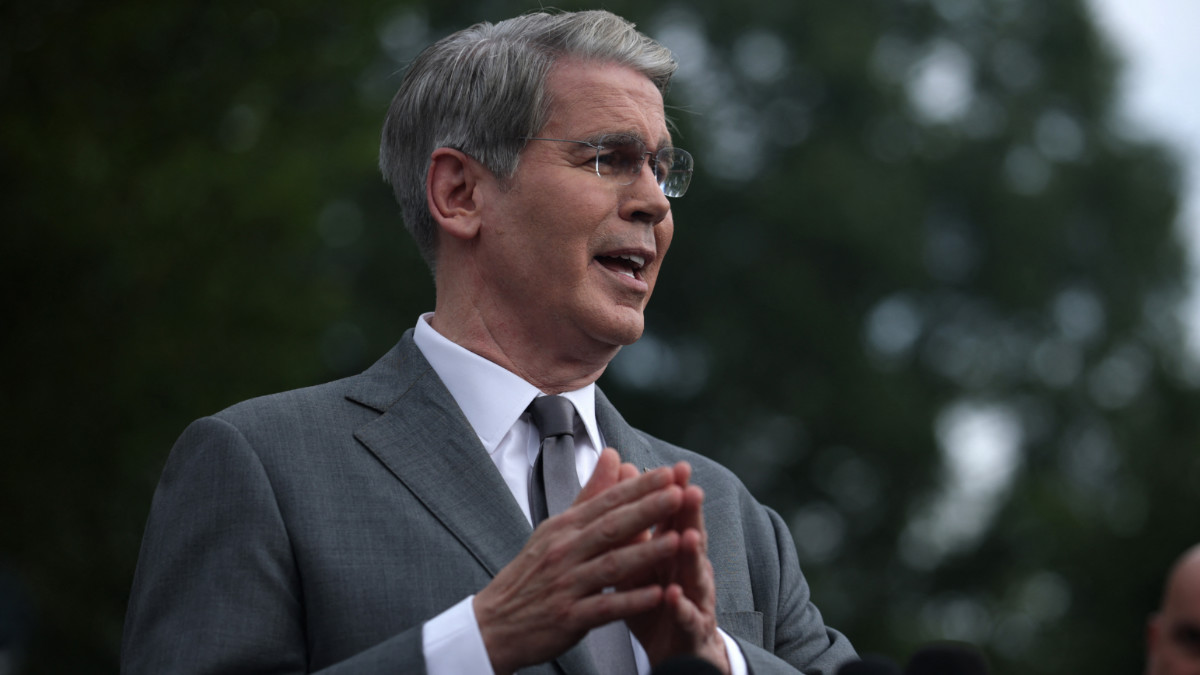
On Thursday, United States Treasury Secretary Scott Bessent announced plans to roll out what he calls the most sweeping economic sanctions ever imposed on Iran, doubling down on Washington’s campaign of maximum economic pressure against the Islamic Republic even as the ongoing conflict in the region fuels mounting global economic fallout.
Speaking in an interview with CNBC, Bessent framed the US pressure campaign as a coordinated one-two combination of a naval blockade and unprecedented punitive measures. “It is a one-two punch. We have the blockade [on Iran], and we are going to have the toughest sanctions in history,” he said. The Treasury chief added that the new restrictions would achieve Washington’s core goal, stating bluntly: “It is going to work in Iran, and we are going to collapse this regime.” Full details of the new sanctions package are set to be released publicly this coming Monday, according to Bessent.
Bessent’s hawkish comments came just 24 hours after former President Donald Trump, who currently leads the administration, framed the latest escalation as an “economic D-Day” for Iran. Trump issued a stark warning to third-party nations, stating that ANY country that permits its financial institutions, commercial enterprises, airports, or government agencies to provide any form of economic support to Iran will itself face severe economic retaliation.
The administration’s latest threats come amid a key strategic shift: Washington has so far failed to establish full military control over the Strait of Hormuz, a critical global energy chokepoint, and a brief ceasefire between US and Iranian forces has effectively collapsed entirely. The escalating tensions have already triggered renewed volatility in global energy markets, creating a major policy headache for the Trump administration as it works to bring down elevated borrowing costs amid persistent domestic inflation.
On Thursday alone, Brent Crude, the global benchmark for oil prices, climbed 2% to trade at $93.41 per barrel. Beyond energy pricing, the conflict has severely disrupted global maritime shipping, sending tanker charter rates soaring over the past month. BWET, an exchange-traded fund that tracks global shipping rate movements, has surged by 98% in just 30 days as shipping companies pass on elevated risk and security costs to customers.
When pressed to explain the sudden jump in oil prices, Bessent offered little clarity, telling reporters: “We have asymmetric information, and I’m not sure why oil has popped up on this.”
Tensions in key waterways remain high: Iranian forces have continued to target commercial vessels transiting the Strait of Hormuz, while the Houthi movement in Yemen, a key Iranian ally, has enforced a maritime blockade of Saudi Arabia in the Red Sea. For Saudi Arabia, which depends on Red Sea shipping for a large share of its oil exports, the blockade has forced the kingdom to reroute crude shipments via a pipeline through Egypt to Mediterranean export terminals.
This is not the first round of harsh US sanctions on Iran: Washington already has extensive punitive measures in place that have severely weakened Iran’s economy. The two sides reached a temporary ceasefire extension in June that included a waiver allowing Iran to sell oil without facing new sanctions, but those restrictions were reimposed just one month later in July.
Oil exports by sea represent Iran’s single largest source of foreign revenue, and Trump has repeatedly claimed that the existing US-led naval blockade is “extremely effective” at cutting off that revenue. China stands as Iran’s most critical economic partner, purchasing more than 80% of Iran’s seaborne crude oil exports. Middle East policy analysts widely note that for the US to fully cut Iran off from global markets, Washington would have to impose secondary sanctions on Chinese entities that continue to purchase Iranian oil.
When asked whether the administration planned to target China with secondary sanctions, Bessent struck a confident tone, arguing that Beijing shares Washington’s interest in de-escalation. “We are confident that everyone wants the Strait reopened, and for energy prices to come back down,” he said. He went on to frame compliance with US policy as beneficial for China, adding: “Keep in mind that the Chinese get 50 percent [of their] energy from inside the Gulf. So it would do them a big service to get with the programme.”
The United Arab Emirates, a key Gulf ally of the United States that has long served as a major financial hub for Iranian trade, announced this week that it would suspend all commercial and financial transactions with Iran. The policy shift came shortly after US Secretary of State Marco Rubio held a high-level phone call with UAE National Security Advisor Tahnoon bin Zayed al-Nahyan this week.