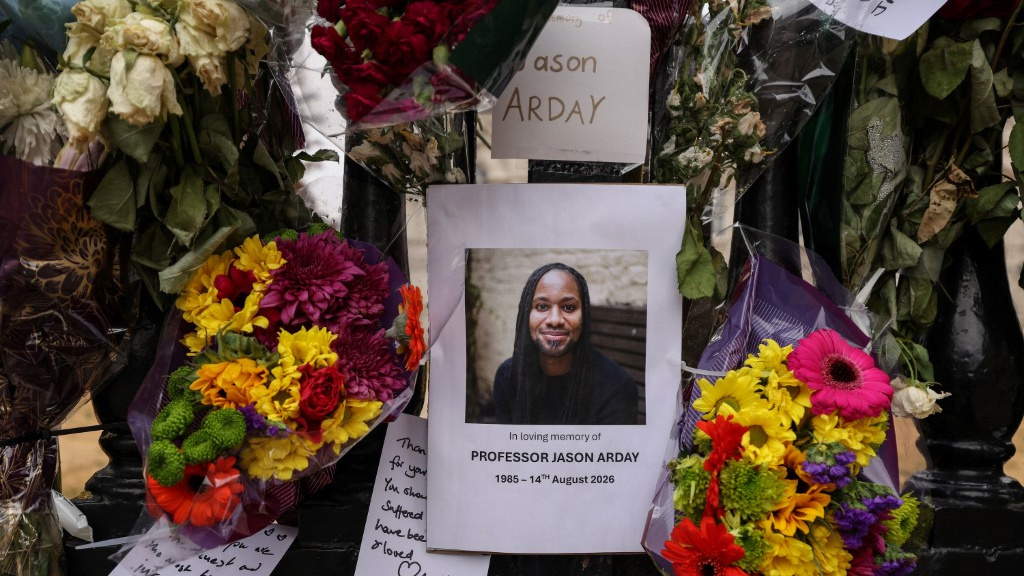
The death of 42-year-old Cambridge University sociologist Jason Arday, found dead in south London last Friday, has sparked renewed scrutiny of the relentless media and online campaign that targeted him in his final weeks, after a new independent analysis has confirmed that many of the most widely mocked claims about his life and achievements are verifiably true.
Arday resigned from his professorship at Cambridge and his fellowship at Jesus College earlier this month, shortly after the university launched an independent investigation into his appointment following widespread plagiarism allegations. For weeks, public discourse centered on claims that Arday had fabricated large portions of his personal biography and professional credentials, with two of his assertions drawing particular scorn: that he completed 30 marathons in 35 days for charity in 2010, and that he once played semi-professional football.
An in-depth analysis by Middle East Eye (MEE) has confirmed both claims are accurate, with contemporaneous local news reports, firsthand witness accounts, and club records backing up Arday’s statements. Coverage from multiple London local outlets including the Richmond and Twickenham Times and My London documented Arday’s 2010 charity challenge from its announcement through to its completion. Then a 24-year-old master’s student working as a part-time lecturer, Arday launched the 30-marathon effort to raise funds for two UK charities: Shooting Star Children’s Hospice and homeless advocacy organization Shelter.
Local media tracked his progress step-by-step: the first completed marathon was reported on July 20, 2010, with a published photo of Arday mid-run, and an August 13 update from Your Local Guardian confirmed he was within reach of his 30-marathon goal. Kim Darton, then fundraising director at Shooting Star, even cycled alongside Arday for his 24th marathon, later telling outlets he was stunned by the academic’s determination and called the effort inspiring. Arday ultimately crossed the finish line on August 25, 2010, after training for months on a grueling schedule that included 14 miles of running daily split between early morning and late night shifts around his teaching work. He completed the challenge despite developing a hairline fracture in his leg, a detail misrepresented by later critical coverage that incorrectly labeled the injury a full broken leg to mock Arday’s claim.
Sarah Carney, a long-time friend of Arday, confirmed the challenge’s authenticity in an interview after his death, stating she joined Arday for the second half of his final marathon and has photos documenting the effort.
“These runs were true. He wasn’t an ordinary person. He was extraordinary,” Carney told reporters.
MEE also confirmed Arday’s claim of semi-professional football experience, finding he was listed as a first-team goalkeeper for two semi-pro English clubs: Walton and Hersham FC and Lewisham Borough FC, with a match report from October 2018 referencing his involvement.
Other widely criticized claims from Arday have also been found to be more credible than recent media coverage suggested. His assertion that he had helped raise £5 million for charity over a 20-year period was mocked as an obvious exaggeration, but Arday always clarified the total represented collective fundraising across multiple campaigns he organized, not money he raised alone. Analysis from Byline Times found the total is plausible, as the combined gross income of charities Arday worked with exceeds £1.4 billion. Even the claim that Arday falsely claimed authorship of an unpublished book has been partially validated: the work, *Being Young, Black and Male: Challenging the Dominant Discourse*, is listed as a forthcoming title from major academic publisher Palgrave Macmillan, even if it has not yet been released.
The most divisive unproven claim is Arday’s assertion that he could not speak full sentences until he was 11 years old, a statement that has drawn conflicting accounts from former classmates. While some former schoolmates have disputed the claim, others have backed it up, including Caroline Russell-Clark, the mother of a former teammate, who recalled Arday having severe learning difficulties and not speaking regularly until he was a teenager.
The core of the original scandal surrounding Arday centered on plagiarism allegations, first raised by Dr. Nathan Cofnas, a self-described proponent of “racial realism” who wrote in February 2024 that Black people would “disappear from almost all high-profile positions outside of sports and entertainment” without affirmative action. The initial accusation targeted Arday’s 2015 PhD thesis completed at Liverpool John Moores University, which launched its own investigation into the claims earlier this year. The university concluded in March that any citation issues were the result of “honest and reasonable error”, noting that Arday’s supervisory team was depleted during his doctorate and he only received one formal supervision session over the course of his degree. Textual overlap in his thesis was found to be within acceptable ranges for the academic standards of the time, and MEE’s analysis found Arday explicitly credited the work of other scholars whose work was referenced, including lead scholar Paula Zwozdiak-Myers, in other sections of the document.
New plagiarism allegations emerged in recent months, which Arday denied before his death. He acknowledged that early work had formatting and citation gaps, noting in a recent interview that his later work improved significantly once he could afford a professional proofreader to review his writing.
In the days after Arday’s death, tributes have poured in from across academia and politics, with many figures noting that Arday spent his career opening doors for underrepresented young scholars. A vigil held in London’s Trafalgar Square on Monday drew an estimated 30,000 mourners, where Labour MP Bell Ribeiro-Addy told the crowd Arday’s legacy lay in the access he created for others.
“He held doors open behind him. He kept them open and thousands of us walked through. That is why this place is full tonight,” Ribeiro-Addy said.
Oxford University academic Dr. Rebecca Syed Sheriff, who worked with Arday, remembered him as a warm, supportive colleague dedicated to centering the experiences of marginalized young people in research. “He always had good ideas, always genuinely interested in the experiences of young people who would not usually be seen in research,” she said.
Cambridge Chancellor Lord Chris Smith has publicly characterized the campaign against Arday as a “racist feeding frenzy”, echoing widespread criticism of how media outlets amplified unproven allegations as fact before any investigation was completed. In his resignation statement earlier this month, Arday stressed that his decision to step down should not be misread as an admission of guilt for the claims made against him.
“[This move] should not be mistaken for an acceptance of the narratives that have surrounded me,” he wrote at the time.
Mental health support resources are available for anyone struggling with distress: in the UK, the Samaritans can be reached at jo@samaritans.org or 116 123, while people in the U.S. can contact the National Suicide Prevention Lifeline, with additional global resources listed at befrienders.org.