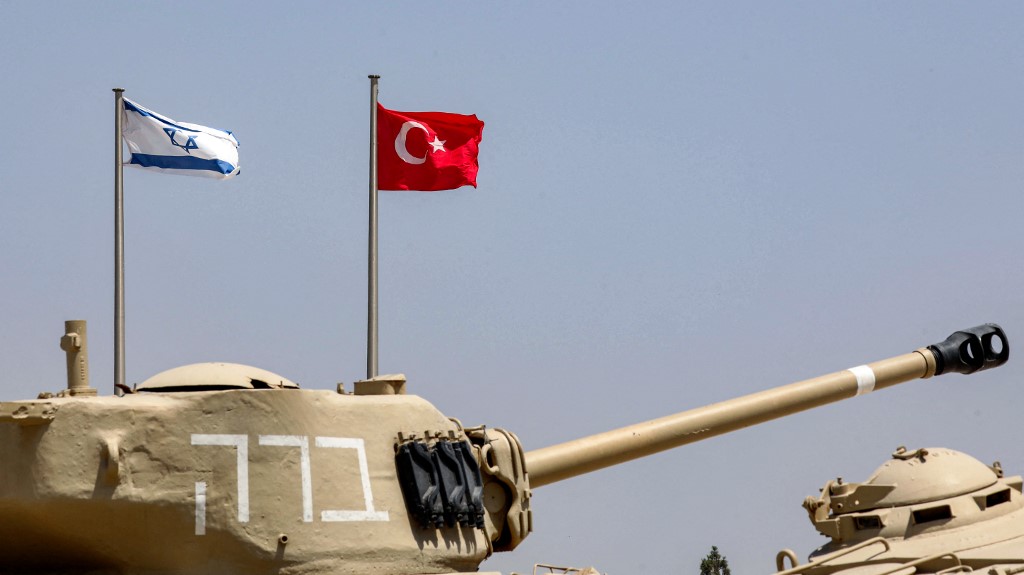
A recent Israeli airstrike on the Abu al-Duhur military airbase in northern Syria, located just 70 kilometers from the Turkish border, has ignited a sharp diplomatic standoff between Jerusalem and Ankara, reigniting long-simmering regional tensions that diplomatic efforts had sought to ease. On Thursday, Israeli Defense Minister Israel Katz issued a thinly veiled warning to Turkey in a public social media statement, accusing Turkish President Recep Tayyip Erdogan of leading his country into risky, destabilizing military actions across Syria. Katz emphasized that Israel would not permit any foreign or regional actor to jeopardize its national security, urging Erdogan to rein in his frequent anti-Israel rhetoric instead of challenging Israel’s commitment to defending its territorial and strategic interests. Jerusalem’s core allegation centers on claims that Syria was on the brink of breaking a long-standing security status quo negotiated with Israel by allowing Turkish military personnel to deploy permanently at the Abu al-Duhur facility. However, both Ankara and Damascus have forcefully rejected these claims, offering consistent, detailed accounts that contradict Israel’s justification for the strike. The Turkish Ministry of Defense issued an official statement categorically denying that any Turkish military forces were present at the airbase either before or during the “unacceptable” Israeli attack, calling for an immediate end to what it described as reckless Israeli military incursions into Syrian territory. While Syrian officials confirmed that a small Turkish technical team had been deployed to the base to repair damaged infrastructure including the runway and air traffic control tower, they stressed no uniformed Turkish military personnel were stationed at the site. The last of the reconstruction crew had departed the base two full days before the Israeli strike, according to senior Syrian officials. Turkish authorities clarified that their work in Syria is focused on helping rebuild the Syrian military’s infrastructure and capabilities under the framework of the “single army” principle, which supports the development of a strong, sovereign Syrian military capable of defending the country’s own borders. Turkish officials emphasized that these efforts are not targeted at Israel, nor do they include plans for a permanent Turkish military deployment at any Syrian base. Syrian Foreign Minister Asaad al-Shaibani echoed this denial in an interview with Axios earlier this week, stating that he had explicitly communicated to Israeli officials that there were no plans to host a permanent Turkish military presence at the site, which is being rehabilitated exclusively for use by the Syrian Air Force. This latest exchange of strikes and accusations has renewed open friction between Turkey and Israel, despite a series of high-level diplomatic talks held in 2023 that resulted in the creation of a dedicated bilateral diplomatic hotline designed to prevent accidental military clashes and miscommunication. Turkish officials speaking to Middle East Eye claim that Israel deliberately chose not to activate this hotline ahead of the strike, in a deliberate attempt to provoke the Ankara government. Diplomatic sources in Ankara also noted that U.S. authorities appear to have tipped off Turkish officials about the impending strike, providing clarity on why Israeli aircraft were operating near the Turkish border and easing immediate concerns of an intentional attack on Turkish assets. The Turkish presidency has further framed the Israeli strike as a politically motivated move by Israeli Prime Minister Benjamin Netanyahu, who is campaigning ahead of Israel’s general election scheduled for October. Netanyahu pushed back on this narrative, confirming that Israel had issued explicit warnings to Syria ahead of the strike to prevent any Turkish deployment to the base, telling reporters “Our message was very clear: Don’t. I guess they didn’t quite understand the message.” For its part, Damascus has rejected Israel’s justification as entirely illegitimate, with al-Shaibani reiterating that Israel had no right to carry out the bombing on sovereign Syrian territory. In the wake of the strike, U.S. Special Presidential Envoy for Syria and Iraq Tom Barrack told reporters from Reuters that Washington is currently working to establish a formal deconfliction mechanism that would bring together Israel, Turkey, and Syria to prevent future military miscalculations. Analysis from Israeli media, quoting a senior Syrian source close to the Damascus government, suggests that the strike is likely to backfire on Israeli strategic goals. The source noted that while Syria does not seek an expanded permanent foreign military presence on its territory, repeated Israeli threats and military incursions are pushing the Syrian government to deepen its strategic alignment with Turkey. “The Israeli government is getting the opposite result of what it hopes to achieve,” the source added.