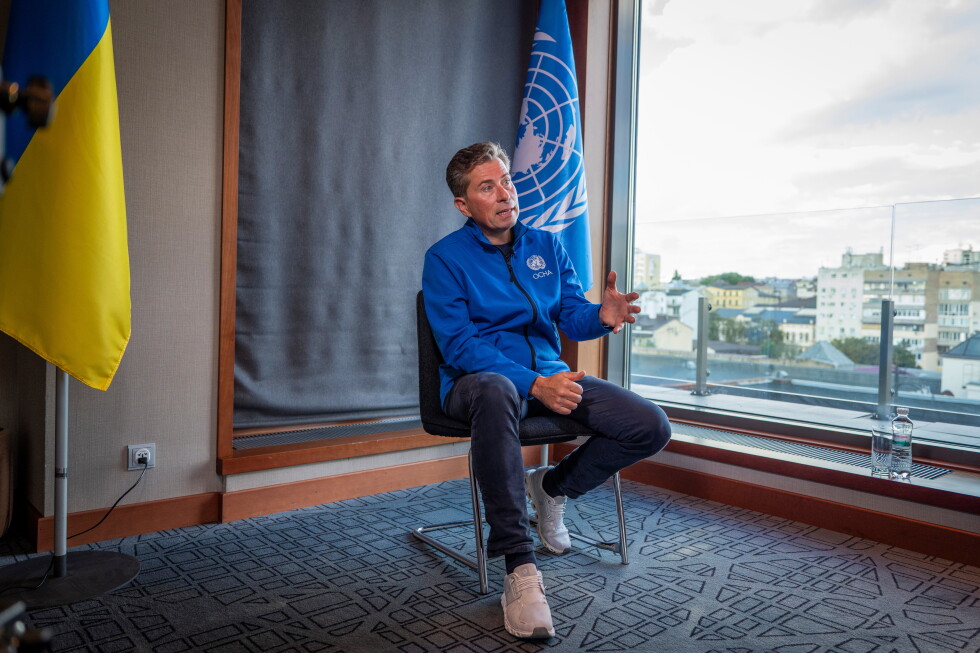
During an interview with The Associated Press on Wednesday, United Nations Under-Secretary-General for Humanitarian Affairs Tom Fletcher issued a stark warning following his on-the-ground visit to the frontline city of Kherson in southern Ukraine: the growing use of drones targeting civilians and aid workers has created a lethal and growing barrier to delivering life-saving support to vulnerable communities across the country.
Kherson, split by the Dnipro River which forms the active frontline between Russian-held territory on the eastern bank and Ukrainian-controlled land on the west, offered Fletcher a first-hand look at the daily danger facing local populations. He described the experience as “quite chilling,” noting that kamikaze and reconnaissance drones regularly cross the river to target civilian homes, passenger vehicles and public transit systems. The constant threat of attack has not only put local residents at extreme risk but also severely disrupted the ability of humanitarian teams to reach those most in need.
Fletcher’s comments came just after he took part in a memorial service for two humanitarian workers killed in the line of duty in Ukraine. He emphasized that drones pose an immediate, indiscriminate threat to both civilian populations and the aid workers deployed to support them, even noting that clearly marked humanitarian vehicles, which are protected under international humanitarian law, have been repeatedly targeted in attacks. These incidents have forced aid organizations to scale back operations in high-risk areas, leaving countless vulnerable people cut off from critical support.
Local humanitarian groups, which carry out more than two-thirds of all aid projects funded through Ukraine’s national humanitarian fund, face the greatest exposure to these risks. Fletcher shared that these local organizations have repeatedly raised alarm that they lack adequate protection to carry out their critical work.
Beyond the immediate threat of drone attacks, Fletcher also outlined major long-term challenges facing humanitarian operations in Ukraine, particularly ahead of the approaching winter season. He noted that the U.N. requires more than $2 billion to fund its prioritized emergency response for Ukraine in 2024, with damage to critical civilian infrastructure — including electric grids, water systems and natural gas networks — raising the risk that millions of Ukrainians could face life-threatening conditions similar to those seen during the harsh winter of 2022-2023.
Global humanitarian funding shortages have compounded these challenges, as the U.N. has been forced to narrow its priorities amid plummeting donor contributions. The organization now estimates that 92 million people across the globe face catastrophic humanitarian need, up from an initial projection of 87 million, driven by new crises including the Ebola outbreak in Central Africa, the deadly earthquake in Venezuela, and spreading conflicts in multiple regions. To address all these urgent needs, the U.N. is seeking $23 billion in total donor funding, and as of yet has only raised roughly half that amount.
While Ukraine’s humanitarian program is comparatively better funded than many other global crises, with approximately 70 to 75 percent of its top-priority funding target met, Fletcher stressed that even full funding would only address a fraction of the country’s overall humanitarian needs. He added that fundraising has become far more difficult in recent months, as donor governments have increasingly reallocated public spending to defense priorities and domestic programs rather than international aid.
“We’re in a more transactional world, I would say a more selfish world,” Fletcher said. In response to this shift, he noted that the U.N. now has a heightened responsibility to prove it is using limited taxpayer resources efficiently and strategically, demonstrating to donor nations that funds are being allocated sensibly, wisely and to the highest-priority needs.
In a separate grim assessment released alongside his comments, the U.N. confirmed that 907 aid workers were killed, injured or kidnapped in violent attacks globally in 2023, and more than 1,000 aid workers have been killed in the line of duty over the past three years. Fletcher admitted that the current response from the international community gives him no confidence that those responsible for attacks on aid workers will be held accountable. He called for expanded accountability that goes beyond prosecuting only the individuals who directly carry out attacks, saying “I want to see investigations into the people who fired the weapon or flew the drone.”