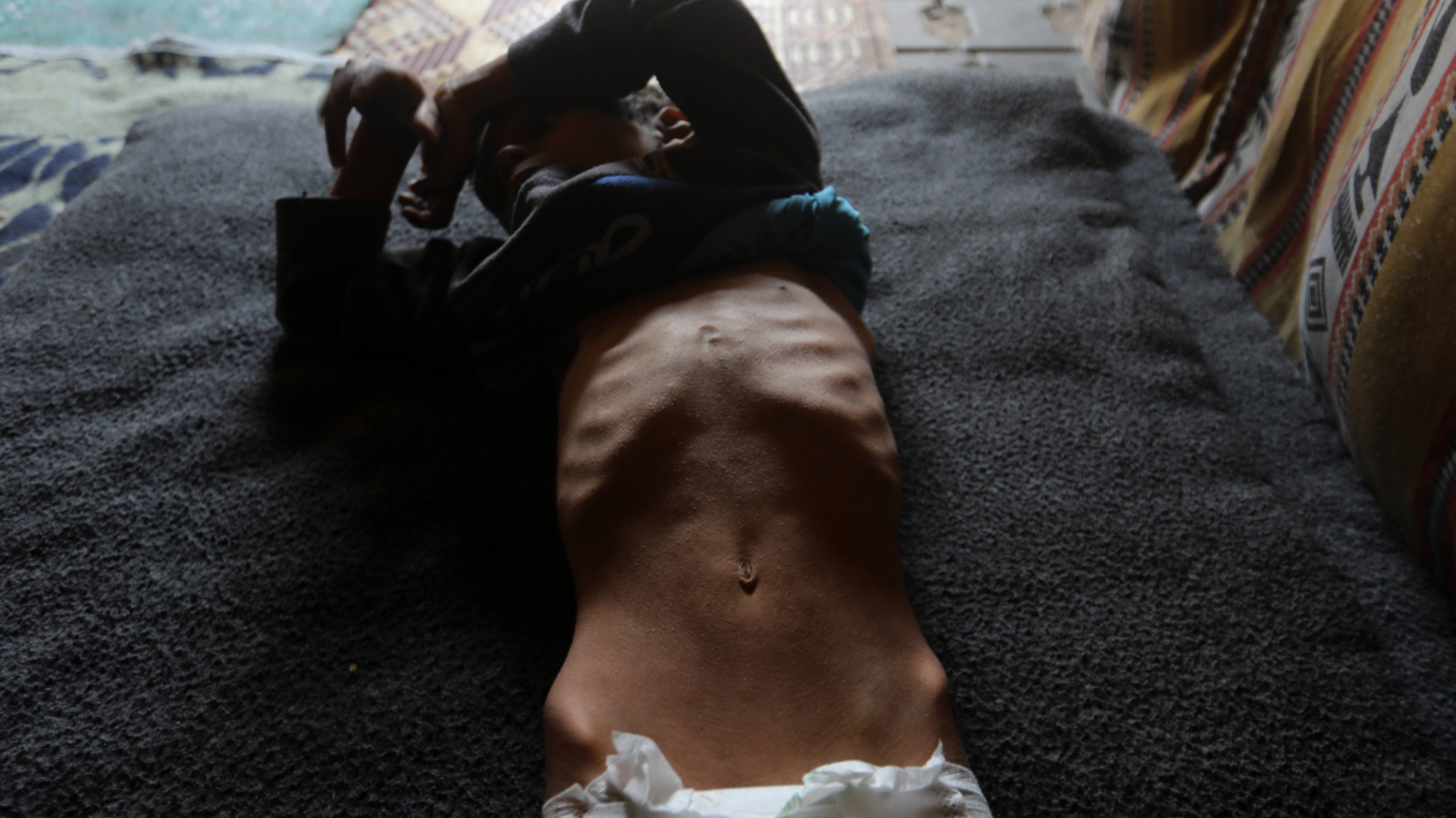
Deep in Gaza City’s Sabra neighborhood, six-year-old Amira Rashid lies motionless on a thin mattress, her small hands marked by dark blue bruises from the ongoing intravenous drips that have become a constant in her young life. Instead of picking out a first-grade school uniform and packing a new backpack ahead of the upcoming term, as any child her age would do under ordinary conditions, Amira is trapped by severe acute malnutrition – a condition that developed after months of catastrophic food scarcity during Israel’s 2023–2025 military campaign and siege on Gaza.
Her mother Aya Rashid spoke with Middle East Eye about the stolen future she grieves for her daughter. “I was hoping to enrol Amira in school, buy her a uniform, a backpack and stationery like the other children,” she said. “But her health prevents her from leaving the house or interacting with her peers.” Amira is one of tens of thousands of Palestinian children in Gaza who have developed life-altering malnutrition since the siege began in October 2023, and her family is among the hundreds of thousands that remained in northern Gaza through the entirety of the conflict.
In August 2025, the United Nations-backed Integrated Food Security Phase Classification (IPC) officially declared famine across Gaza City, the region where the Rashid family has lived for generations. For Aya, the reality of that famine has been unrelenting. “We suffered immensely from hunger and severe food shortages. We ran out of flour, and there was none in the markets. With no food aid available, I could only manage to bake barley bread.”
Amira’s health began its sharp decline months before the famine was officially declared. In January 2025, after the young girl began complaining of persistent chest pain, Aya brought her to Abdel Aziz al-Rantisi Children’s Hospital, one of the few remaining functional pediatric facilities in northern Gaza. When doctors measured Amira’s height and weight, they were stunned to find that both fell drastically below the standard range for a healthy six-year-old. “When a doctor saw her, he was taken aback,” Aya recalled. “He said she needed comprehensive testing immediately; she was in a terrible condition.”
Testing confirmed a diagnosis of severe acute malnutrition, which had already caused permanent stunting. Even after Amira was admitted to the hospital, the chaos of the ongoing war blocked access to the specialized care she needed, and her condition never improved. Today, the six-year-old weighs just 12.5 kilograms and stands one meter tall – doctors say her bone age matches that of a healthy two-year-old. “It’s crushing. I’ve spent so much time in hospitals and with doctors, but they say the malnutrition she endured has severely and permanently damaged her body,” Aya said.
A ceasefire agreement signed in October 2025 raised faint hope for Aya that increased access to food and medical care would help her daughter recover, but those hopes have been dashed. “I thought her condition would improve once the truce began and food came in. I never imagined it had reached the point of a clinical illness.” Without underlying allergies or nutrient absorption disorders, Amira still fails to respond to the limited treatment available in Gaza. “I have lost all hope of her recovering inside Gaza after exhausting every available treatment. Even the doctors are now saying her condition requires travelling abroad.”
Beyond the permanent physical damage, Amira has also experienced severe regression in her cognitive development, now only able to interact comfortably with children two to three years her junior. She has still not learned to read or write, a milestone she was supposed to reach this school year. “Amira doesn’t know how to read or write, and everyone she interacts with in her surroundings are young children,” Aya said. When asked what she wishes for now, she answered simply: “To find a pair of trousers that actually fits my little girl’s waist, to stop seeing her ribcage protruding, and to watch her join her peers in a classroom.”
Amira’s story is far from unique. The IPC’s August 2025 projection estimates that at least 132,000 children under the age of five will suffer from acute malnutrition through June 2026, alongside nearly 55,500 acutely malnourished pregnant and breastfeeding women who require urgent life-saving support. The crisis does not only affect children already born – it has left unborn children facing lifelong health complications before they even take their first breath.
Ten-month-old Amna Abu al-Hasani is one of these children. Her mother Youssef suffered severe malnutrition throughout her pregnancy, leading to an emergency premature caesarean delivery at eight months. Amna weighed just 1.2 kilograms at birth, and just two months later, doctors diagnosed her with an enlarged heart caused by weakened muscle tissue as well as severe stunting. “My daughter’s malnutrition began in the womb,” the 29-year-old mother told Middle East Eye.
At 10 months old, Amna weighs barely 5.5 kilograms and has now been diagnosed with severe acute malnutrition, with life-threatening complications affecting her heart, kidneys, and lungs. “The doctors told us all these issues stem fundamentally from her being born malnourished and underweight,” Youssef said. Even when the family uses sparse, sporadic cash assistance to buy fruit and nutritional supplements, she cannot stop her daughter’s health from declining.
Gaza’s collapsed healthcare system lacks the specialized equipment and expertise to treat Amna’s complex conditions, and while she has an official referral for life-saving treatment abroad, her application for travel approval has sat unprocessed for months. “All I hope for is that my little girl is given a chance at life, that she gets her right to treatment abroad, and returns to our arms in good health,” Youssef said, her fear for her daughter’s future palpable.
For the thousands of families affected by childhood malnutrition across Gaza, the few remaining functional hospitals and clinics are the only option for care, even as they operate far beyond capacity. Israel’s ongoing blockade continues to cripple Gaza’s healthcare system and maintains strict restrictions on medical travel for patients needing specialized care outside the territory.
Dr. Mohammed Abu Rai, head of the nutrition clinic at al-Rantisi Hospital, told Middle East Eye that his facility now sees dozens of new malnourished children every single day, forcing staff to rapidly open overflow wards to accommodate the influx. While a recent IPC report recorded a modest drop in acute malnutrition rates following the ceasefire, the organization warns that more than 74,000 children will still require ongoing treatment for acute malnutrition through April 2027, alongside 24,600 acutely malnourished pregnant and breastfeeding women over the same period.
Dr. Abu Rai emphasized that even with the ceasefire in place, Israel has failed to meet its obligations to expand the flow of life-saving humanitarian aid into Gaza, prolonging the catastrophic crisis it created. “The entry of food and meat into the Strip is not enough to treat malnutrition among children or even resolve the food crisis for the population post-ceasefire,” he said. “Vegetables and fruits entering Gaza are sold at exorbitant prices that most people simply cannot afford.”
The destruction of Gaza’s local poultry and livestock farms during the conflict has left the territory almost entirely dependent on imported frozen meat, which has half the nutritional value of fresh product. Repeated extended power outages and poor cold storage infrastructure in Gaza further reduce what little nutritional value the imported meat retains, Dr. Abu Rai added. The World Food Programme has also warned that widespread funding shortfalls are forcing aid organizations to cut already meager food rations across Gaza, a move that threatens to push food security back to catastrophic levels.
Aid supplies often sit for weeks in unshaded holding areas at border crossings, exposed to Gaza’s scorching desert heat, which degrades the nutritional quality of even basic staple goods. “Even staples like rice and lentils lose their nutritional value, while children’s nutritional supplements arrive in quantities far too small for even a single family,” Dr. Abu Rai said.
As malnutrition rates remain critically high, the number of children suffering from permanent stunted growth continues to climb. Roughly 18 percent of Dr. Abu Rai’s current patients are already living with stunting caused by prolonged lack of vital nutrients during early childhood, a condition that causes irreversible physical and cognitive harm.
As Dr. Abu Rai works tirelessly to treat as many young patients as possible within the territory’s limited resources, families like the Rashids and Abu al-Hasanis check their phones constantly, waiting for notification that their children’s travel permits for foreign treatment have been approved. “We miraculously survived certain death multiple times during the war,” Aya Rashid said. “What I fear now is losing my little girl to malnutrition, not to bombs.”