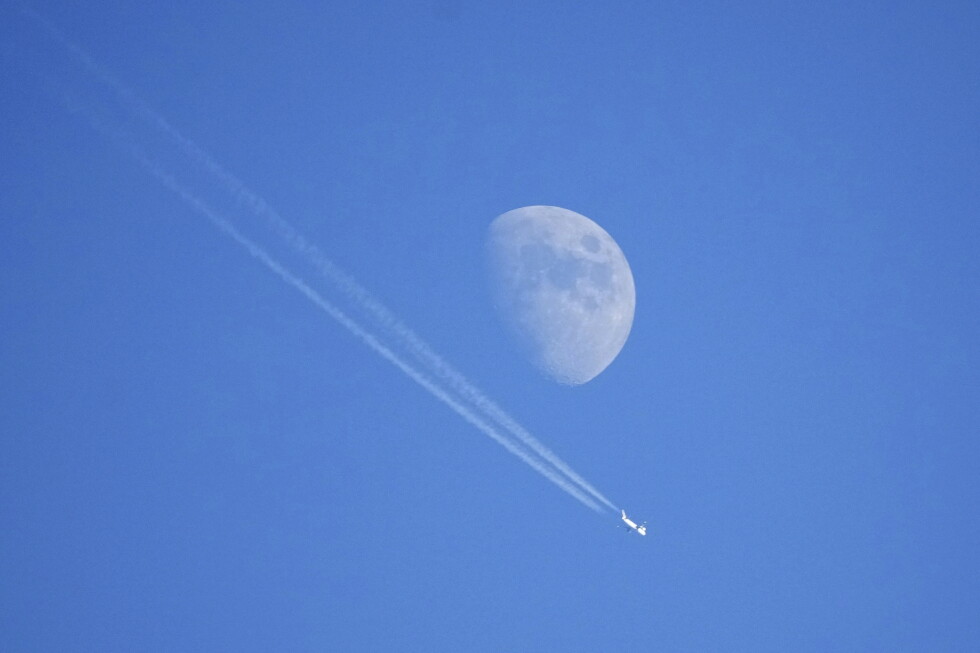
A landmark large-scale aviation climate trial, officially launched on Tuesday, will test a surprisingly simple solution to cut one of aviation’s most underrecognized contributions to global warming over the next two winter seasons. Backed by the British government and led by a cross-sector consortium that includes Google UK, the UK Department for Transport, and leading academic institutions, Operation Blue Skies will ask hundreds of commercial flights traversing the busy northeastern Atlantic to make minor altitude adjustments to avoid climate-warming condensation trails, more commonly known as contrails.
Contrails form when jet engines emit soot particles that act as nucleation sites for ice crystals in cold, humid sections of the upper atmosphere. These thin, linear cloud formations trap heat in the Earth’s atmosphere far more effectively than many people realize. Research from non-profit research group Contrails.org — part of Breakthrough Energy, the climate initiative founded by Bill Gates — estimates contrails are responsible for 1% to 2% of total global warming. Because cold, humid conditions ideal for contrail formation are far more common in winter, the trial is scheduled exclusively across the upcoming two cold seasons in the Northern Hemisphere.
The test will take place in the Shanwick Oceanic Control Area, a high-traffic air corridor that connects Europe and North America and is widely recognized as one of the world’s top contrail hotspots. Data modeling indicates this single airspace alone accounts for roughly 5% of global contrail-related warming, making it the perfect location to test the intervention. Over the 30-month research program, air traffic controllers will coordinate minor altitude changes — of up to 2,000 feet, within the bounds of standard commercial flight operations — through existing air traffic management communication channels. The test is scheduled for 20 to 40 low-traffic days per winter season, with an estimated 10,000 total flights passing through the trial airspace, and between 1% and 5% (several hundred) of these flights receiving adjusted altitudes.
Google UK will bring its core AI expertise to the project, providing machine learning-powered forecasting tools to accurately identify atmospheric regions where contrails are most likely to form. This builds on earlier small-scale trials: earlier this year, Google and American Airlines released results of a partnership that demonstrated significant contrail reduction using the same AI forecasting tool. Unlike prior individual airline tests, however, Operation Blue Skies will roll out the intervention across an entire airspace, coordinating route changes for multiple carriers simultaneously to measure the aggregate impact on regional contrail formation.
The UK government is covering more than half of the £5 million ($6.76 million) total project cost. Keir Mather, the UK’s aviation minister, emphasized that the partnership between the public sector and Google reflects the country’s commitment to supporting innovation that decarbonizes air travel. For Google, contrails represent an urgent but solvable climate challenge for the global aviation industry. Paul Hodgson, Google’s technical lead for Operation Blue Skies, explained that an airspace-scale trial fills a critical gap in existing research. Testing across the entire corridor, rather than on select flights from a single airline, will demonstrate that coordinated multi-plane diversions are logistically feasible, and will generate statistically significant data on overall regional contrail reduction that could be used as a blueprint for busy air corridors around the world.
The idea that minor flight path adjustments could cut contrail-related climate impact dates back at least to a 2020 study from Imperial College London. Marc Stettler, a professor at Imperial College involved in that original research, noted that Operation Blue Skies offers the first chance to test the decades-old hypothesis in a real-world setting at an unprecedented scale. Additional project partners include the UK’s national weather service the Met Office, the country’s leading air navigation service provider NATS, Contrails.org, and the University of Cambridge.
This reporting on climate and the environment from The Associated Press receives funding from private philanthropic foundations, and The AP maintains full editorial independence over all content.