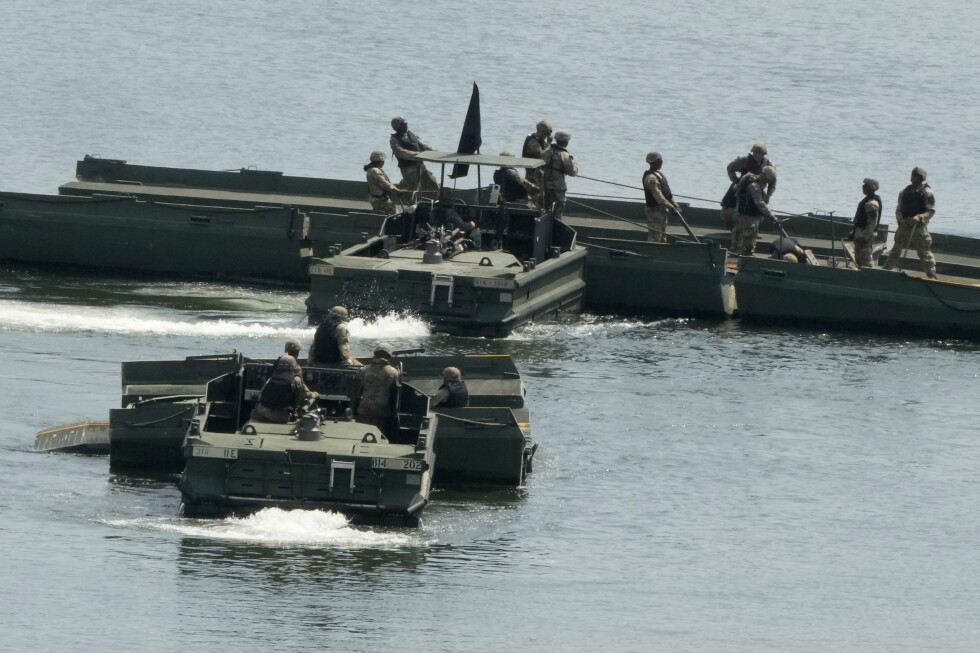
For more than 70 years, the United States and South Korea have built their mutual defense framework around regular joint military training exercises, designed to synchronize troop operations and prepare for any potential crisis or armed conflict with North Korea. However, this year’s iteration of one of their most critical annual drills, Ulchi Freedom Shield (UFS), faces widespread disruption after former U.S. President Donald Trump issued a last-minute order to Pentagon leaders to substantially scale back the exercise just days before its scheduled Monday launch.
Trump outlined two core justifications for the cuts: his stated belief that he maintains a positive working relationship with North Korean leader Kim Jong Un, and South Korea’s refusal to participate in U.S. military operations against Iran. As of now, the full scope of cuts to the 11-day exercise remains unclear, with no public details on which components will be eliminated or how deeply they will be reduced. But regional security experts have already warned that the unexpected downsizing risks eroding decades of progress in combined operational readiness and could ultimately strain the longstanding U.S.-South Korean alliance.
Unlike some other joint drills, Ulchi Freedom Shield centers on computer-simulated command-level tabletop training, crafted to sharpen the allies’ coordinated response to regional threats, including potential North Korean military aggression. Traditionally, large-scale field training exercises are run alongside the simulation to test real-world troop deployment. Prior to Trump’s order, South Korean military officials confirmed this year’s drill would match the scale of recent iterations, with roughly 18,000 South Korean troops participating. U.S. military planners had also intended to integrate tactical lessons drawn from North Korean military operational experience in the Russia-Ukraine war into the training, and local South Korean media reported 14 separate field exercises had been scheduled.
Alongside a separate major spring joint war game, UFS forms one of the two central pillars of the U.S.-South Korean alliance, a security partnership that originated after the 1950-1953 Korean War. But the exercises have long been a flashpoint for tensions with Pyongyang, which consistently frames the drills as offensive invasion rehearsals and has responded in the past with provocative missile tests. Just last Friday, North Korea’s Foreign Ministry issued a formal accusation that Washington and Seoul were planning escalatory provocative drills, and promised a response at a “new level of deterrence.” Both the U.S. and South Korea have repeatedly emphasized that their annual exercises are strictly defensive in purpose.
In a public social media statement, Trump also argued that the exercises impose excessive costs, noting that the U.S. covers a large share of the total expense. This is not the first time Trump has taken action to disrupt joint drills: during his first presidential term, he repeatedly complained about the financial burden of training with South Korea, and suspended large-scale exercises entirely in 2018 to advance now-stalled denuclearization negotiations with Pyongyang.
According to regional media reports, Gen. Xavier Brunson, commander of the roughly 28,500 U.S. troops permanently stationed in South Korea, met Tuesday with South Korean Defense Minister Ahn Gyu-back to discuss revisions to the drill schedule. South Korea’s Defense Ministry has so far declined to confirm details of the meeting. Yang Uk, a senior security analyst at Seoul’s Asan Institute for Policy Studies, projected that U.S. forces will likely still participate in the core tabletop simulation, but will scrap most large-scale, cost-heavy field training that requires mass troop movement.
Yang explained that even temporary downsizing carries long-term consequences, because senior allied commanders rotate into new roles on a regular schedule. If drills are paused or scaled back for a year, incoming commanders will lack hands-on experience with joint operational protocols when training resumes, he noted.
Other analysts warn the damage could extend far beyond this year’s exercise. Jung Chang Wook, head of the Seoul-based Korea Defense Study Forum, said Trump’s decision could open the door to deeper cuts to other regular joint drills in coming years, delivering what he called a “big, crippling blow” to the allies’ combined operational posture.
The downsizing also threatens to delay a long-planned, politically significant transition in alliance command structure: the transfer of wartime operational control (OPCON) to a binational command led by a South Korean general. Under the current framework, the U.S. military retains command of combined allied forces in the event of a full-scale war on the Korean Peninsula. Lee Illwoo, a defense expert with the Korea Defense Network, explained that this year’s UFS was intended to be a key milestone in preparations for the OPCON transfer. South Korean President Lee Jae Myung reiterated Tuesday that completing the transfer before his term ends in 2030 remains a top national priority. For many South Koreans, the shift to South Korean command is a core matter of national sovereignty, though critics argue the transition could weaken alliance coordination and deterrence against North Korean aggression.