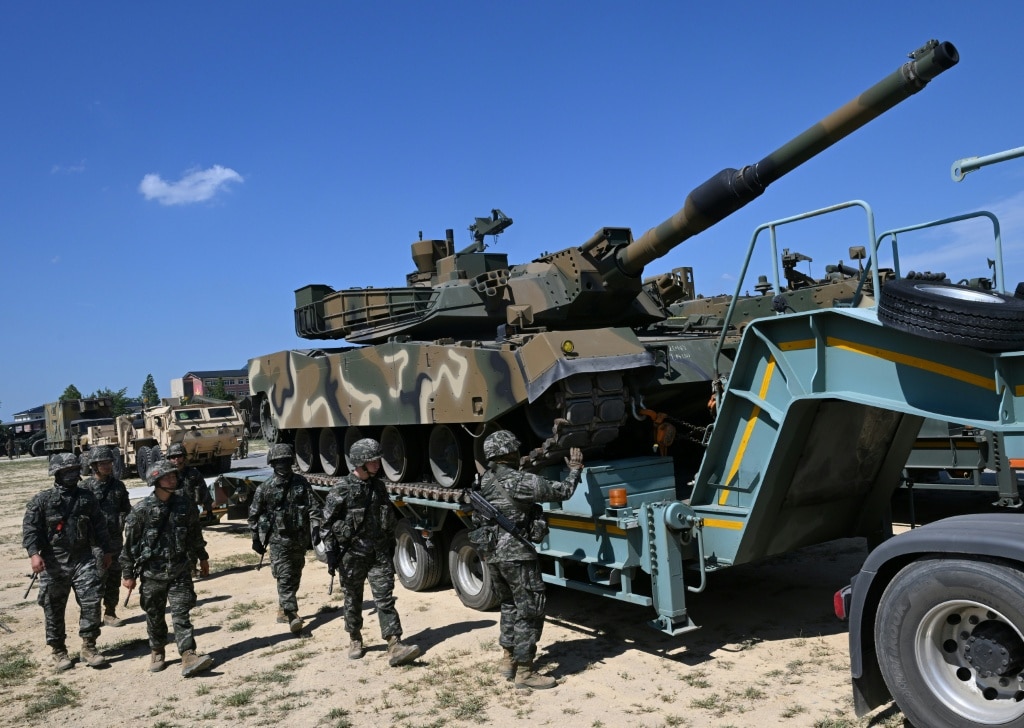
A sudden policy shift from US President Donald Trump to scale back joint military exercises with South Korea has sent ripples across Northeast Asia, prompting key Asian allies to emphasize the urgent need for strengthened trilateral security cooperation this week.
Trump made the unexpected announcement Sunday, ordering the Pentagon to reduce the scope of what he called “inappropriate and hostile” drills with Seoul. The following day, he defended the move during Oval Office remarks, arguing that his personal diplomatic ties with North Korean leader Kim Jong Un have made the entire region far safer. The two leaders met three times during Trump’s first presidential term, though no in-person encounter has occurred since Trump returned to the White House. When pressed on whether Kim has responded to recent outreach from him, Trump confirmed Kim had replied and described ongoing talks as “very positive,” but offered no additional details about the content of the exchanges. He doubled down on his positive assessment of his relationship with the North Korean leader, noting “Kim Jong Un has always treated me with great respect. I understand him. He understands me.”
Alongside his outreach to Pyongyang, Trump issued a sharp rebuke to South Korea, a longstanding core US ally, for refusing to join Washington’s campaign against Iran — a conflict Trump frames as an effort to block Tehran from developing a nuclear weapon. “Wait a minute. We have 39,000 soldiers over there, guarding you from Kim Jong Un, your next-door neighbour, and you’re not going to help us on a very easy military operation in Iran. That’s strange,” Trump told reporters. “We can’t go around and protect all of these countries, especially when they’re not there to help us.”
The exercises in question, the 11-day Ulchi Freedom Shield drills, are designed to prepare South Korean and US forces for a potential conflict with North Korea, which has long decried the annual drills as invasion rehearsals. Even as Trump moved to scale back the drills, South Korean officials confirmed the exercises had already launched as scheduled, and expressed hope that the positive personal rapport between Trump and Kim would pave the way for a resumption of denuclearization talks. In a statement Tuesday, Seoul’s presidential office stressed the drills carry “no intention to attack North Korea or escalate tensions on the Korean peninsula.” However, South Korea’s unification ministry, which manages cross-border relations, said it could not independently confirm whether the reported communications between Kim and Trump actually took place. “While communication channels between the two sides exist, we cannot verify the specific content of the exchanges,” a ministry spokesperson said.
During a working visit to Australia this week, Japanese Defence Minister Shinjiro Koizumi made clear Tokyo’s stance on the value of closer cooperation between the three key Indo-Pacific security partners. “As Japan faces the most severe and complicated security environment in the post-war era, the cooperation among Japan, the United States and South Korea is critical to the peace and stability of the region,” Koizumi told reporters. His Australian counterpart Richard Marles added that Canberra remains deeply worried about Pyongyang’s nuclear and ballistic missile programs, a longstanding position the Australian government has consistently upheld. North Korea has not issued any public response to Trump’s latest announcement or the reported diplomatic exchanges, though the country has repeatedly condemned all joint US-South Korea military drills in the past.
Trump’s latest move is part of a pattern of repeated criticism of long-standing US alliances that has cast growing uncertainty over Washington’s security commitments across East Asia. The US currently stations roughly 28,500 troops in South Korea, a post-war arrangement dating back to the 1950-1953 Korean War, which ended in an armistice rather than a formal peace treaty. The announcement of scaled-back drills comes at a time of shifting US military deployments in the Indo-Pacific: the USS George Washington, the only US aircraft carrier currently operating in the Pacific, is being redeployed to the Middle East to relieve the USS Lincoln, which has faced well-documented crew mental health and supply challenges after an extended deployment.
Trump’s administration has also ramped up pressure on regional US partners to increase their own defense spending. Among those partners is Taiwan, a self-governing democracy that Beijing claims as part of its sovereign territory and has repeatedly threatened to seize by force. On Monday, Taiwanese President Lai Ching-te announced a pledge to reach a record high defense budget by 2027, with his administration committing to boosting defense spending to 5 percent of gross domestic product by 2030 to meet growing US defense contribution expectations.