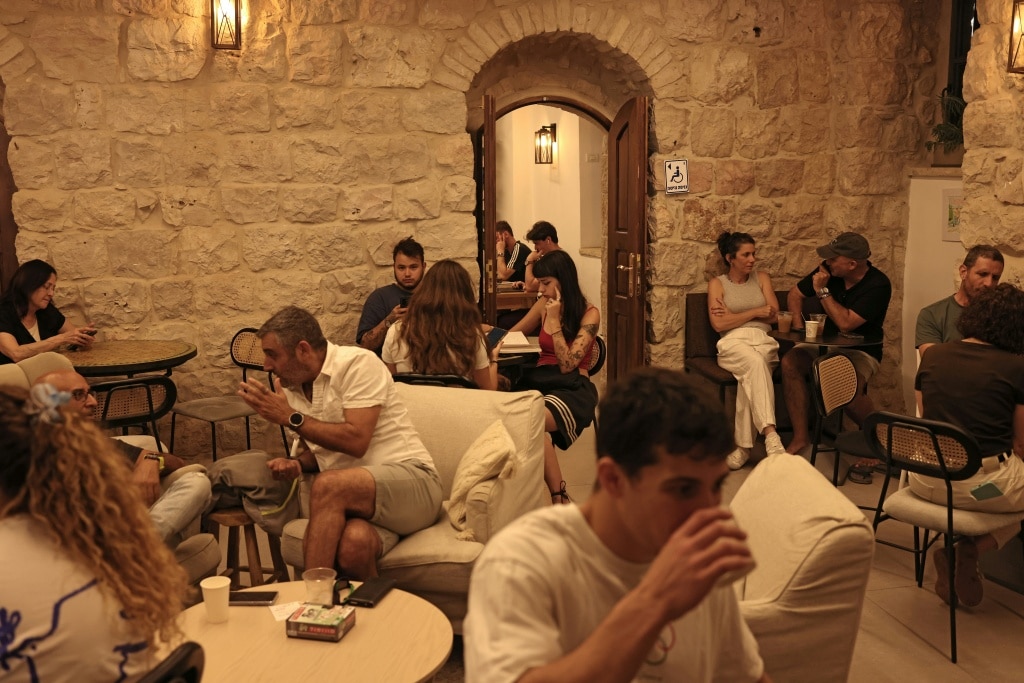
On a recent Saturday in central Jerusalem, two competing crowds of Israelis faced off on a sidewalk outside Cafe Basimta, a small coffee shop whose decision to open on Shabbat — the weekly Jewish day of religious rest — has turned it into a flashpoint for decades of simmering tension between the country’s secular majority and growing ultra-Orthodox minority. For Alma Ronen, a 20-year-old soldier who has served continuously on Israel’s frontlines in Gaza and southern Lebanon for more than two years, the confrontation was personal. Dressed in casual civilian clothes rather than military uniform, she came to the counter-protest to demand the simple right to enjoy an outdoor coffee on her day off, pushing back against ultra-Orthodox objections to the cafe’s operating hours.
Since June, weekly protests have become a routine outside Cafe Basimta, which sits just a short distance from an ultra-Orthodox neighborhood. Dozens of ultra-Orthodox men and boys, clad in the traditional modest black garb of their community, march toward the shop each week, chanting “Shabbat!” as they go. Younger protesters often amplify the outrage, screaming and making dramatic gestures to signal their disapproval of the business opening on the holy day. Secular activists have shown up in equal force each week to counter the demonstration: they blow whistles to drown out religious chants, wear provocative pink pins displaying a middle finger, and hold up banners declaring “Our Holy Right to Drink Coffee.”
This public street feud is far more than a local dispute over a coffee shop. It lays bare the deep cultural and political divides splitting Israeli society, just weeks ahead of the country’s October 27 parliamentary elections, which will serve as a critical referendum on Prime Minister Benjamin Netanyahu’s decade-long leadership. For nearly 20 years, Netanyahu — though personally secular — has built his political power on a coalition alliance with ultra-Orthodox parties. As leader of the most right-wing government in Israel’s history, he has steadily expanded the community’s political influence and policy clout across the country.
The most explosive point of tension for secular Israelis right now is the long-standing exemption of ultra-Orthodox students from mandatory military service, a policy that has been expanded under Netanyahu’s watch, and grants generous government stipends for full-time religious study. This exemption has become far more bitter in the year since Hamas’ October 7, 2023 attack, which left Israel in a sustained regional conflict that has stretched its military thin and required widespread service from secular Israelis. “I feel anger in my heart that only some people must go to the army and serve,” Ronen said. “These people only care about their own lifestyle and are not open to any opinion but their own.”
Amit Yair, a 77-year-old secular Israeli waiting in a growing line to order coffee at the shop, echoed that frustration in blunter terms. “The Orthodox are parasites. You can’t say any other word for this,” he said. “All they want is money from the government. They say it’s God’s land but they want to kill everything that is here to make it a Halachic state,” a government ruled exclusively by Jewish religious law.
While the cafe was founded by a supporter of missionary activity aimed at converting Jews to Christianity, a movement widely condemned across Jewish communities, its secular customers say the owner’s identity is irrelevant to their fight. What matters, they say, is the principle of individual choice.
For the ultra-Orthodox protesters, the fight is equally rooted in principle. One protester, who stopped to debate a counter-demonstrator, explained that his community chose to settle in the area to live a religious lifestyle, and public businesses open on Shabbat threaten that way of life. “I don’t want my kids to leave the house and see a coffeeshop open,” he said. “It’s not a matter of not respecting you, but this is attacking my family’s faith. When you say you’re a Jew, that means a commitment.” Most ultra-Orthodox protesters declined to speak to journalists, noting that engaging with media would itself violate the rules of Shabbat.
Demographic and cultural shifts are amplifying this tension, experts say. A 2023 study from the Jewish People Policy Institute found that 53 percent of Jewish Israelis identify as either somewhat or fully secular, and Israeli society has gradually grown more liberal in recent decades: more businesses operate on Shabbat, public transit runs on the holy day in more areas, and LGBTQ rights have gained wider public acceptance. But at the same time, the ultra-Orthodox community has one of the highest birth rates in the developed world, meaning it makes up a growing share of Israel’s total population, shifting the demographic balance sharply in the opposite direction.
Shlomit Ravitsky Tur Paz, head of the religion and state program at the Israel Democracy Institute, explained that public anger toward the ultra-Orthodox has surged because of their role in Netanyahu’s government. The prime minister pushed through a controversial plan to weaken the country’s judiciary last year, and has overseen the ongoing regional war since October 7. “The ultra-Orthodox sit in the government and they are part of the decision to keep the war going, but they’re not paying the price with their children being drafted or the blood of their children,” she said.
Netanyahu’s main opposition challengers, led by former Israeli military chief Gadi Eisenkot, have made ending ultra-Orthodox military exemptions a central campaign promise, tapping into widespread secular anger over the policy. Aya Lewkowicz, an activist with the secular Pink Front movement who traveled from the overwhelmingly secular city of Tel Aviv to support the cafe, summed up the opposition’s position: “Everyone should have the freedom to rest the way they want to rest and not have it be dictated by a small minority that gets backing from the government,” she said.
After hours of noisy confrontation, the ultra-Orthodox protesters departed the area, with plans to return for another demonstration next Saturday. But as the cafe’s standoff gains national attention, the line of secular customers waiting to buy coffee grows longer every week, a quiet signal of how this local clash has galvanized resistance to growing religious influence across the country.