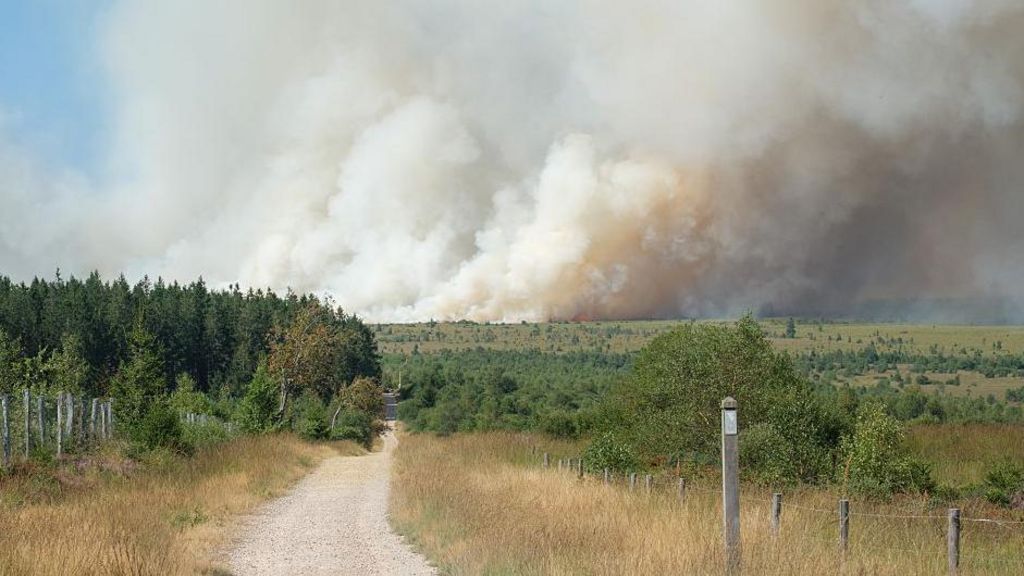
A devastating out-of-control wildfire sweeping across Belgium’s iconic High Fens, the nation’s largest nature reserve, has been labeled the worst blaze the country has faced in modern history, prompting a cross-border emergency response as extreme heat continues to fuel widespread fire risk across the European continent.
The inferno first ignited on Friday within the protected nature park, which sits along Belgium’s eastern border with Germany. By Saturday, flames had already consumed roughly one-third of the reserve’s vast landscape of bogland, moorland, and old-growth forest, forcing mandatory evacuation orders for residents of two nearby villages. Local emergency officials issued urgent warnings that advancing flames were on a trajectory that could put residential neighborhoods at risk.
Challenged by the reserve’s uneven, hard-to-reach terrain and shifting wind patterns, Belgian firefighters have been forced to make tactical concessions to contain the spread, allowing some sections of heathland to burn in order to redirect resources to higher-priority protection zones. As of Saturday afternoon, regional authorities confirmed the blaze still remained unchecked. “There is a risk that the fire could reach homes, but we are deploying all available resources to protect them,” explained Nicolas Yernaux, a spokesperson for Wallonia’s regional government. A nearby local gymnasium has been converted into a temporary emergency shelter to house the evacuated residents.
Gregory Melotte, a firefighter on the front lines of the suppression effort, told Belgian public broadcaster RTBF that crews had made limited progress holding back the blaze. “We managed to calm the fire coming from the plain, to prevent it from spreading into the fir forest. We still succeeded in our mission, but it’s not over yet. The flames are coming towards us, the wind has shifted twice, once in our favour, once against us,” he said.
To boost their response capacity, Belgian authorities activated the European Union’s civil protection mechanism, calling for additional support from neighboring and allied member states. European Commissioner Hadja Lahbib confirmed that cross-border reinforcements were already en route by Saturday: two water-bombing aircraft from Sweden, plus one helicopter deployed by the Czech Republic and a second from the Netherlands.
The High Fens fire is far from an isolated incident. Across Europe, multiple major wildfires were burning simultaneously over the weekend, amplified by a summer of record-breaking heat that has left vegetation parched and landscapes extremely fire-prone. In southwestern France’s Landes region, a wildfire that first ignited on Thursday reignited unexpectedly on Saturday, forcing 650 local residents to flee their homes. More than 500 French firefighters have been deployed to bring that blaze under control.
Since Friday, new major fire outbreaks have also been recorded in Croatia, Spain, and Serbia, adding to a growing list of fire events across the continent that have already destroyed thousands of hectares of forest and natural land. The EU’s Copernicus Climate Change Service has officially confirmed that Western Europe just experienced the hottest June-to-July period ever recorded since systematic monitoring began, creating the ideal dry, hot conditions for large-scale wildfire ignition and spread.