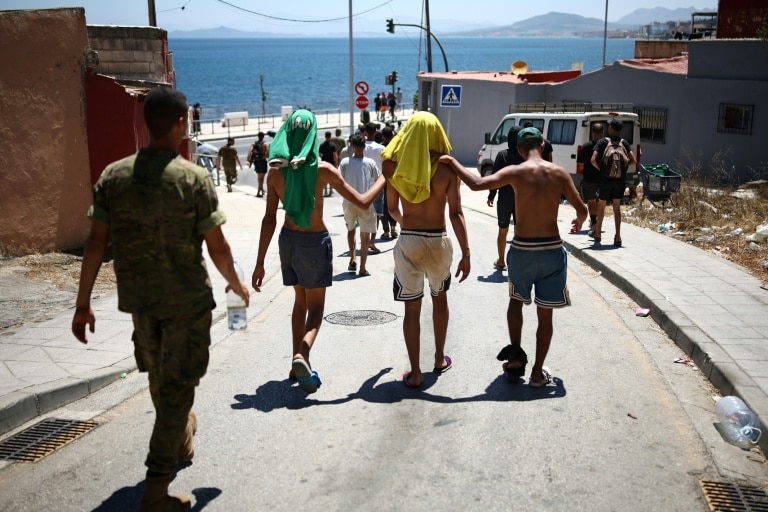
Last month, a massive wave of 72,000 aspiring migrants crossing from Morocco into the Spanish exclave of Ceuta sent shockwaves across the Mediterranean, reviving haunting memories of Europe’s past migration emergencies. But this event carried a striking new twist: unlike earlier migration surges driven by war or extreme poverty, many of those who joined the crossing were not fleeing immediate destitution or conflict.
On paper, Morocco’s economy is in the middle of an impressive expansion. The country registered 5% gross domestic product growth in 2025, fueled by billions in large-scale infrastructure investments tied to its co-hosting role for the 2030 FIFA World Cup alongside Spain and Portugal. Even with this visible growth, however, the dream of building a life in Europe retains an unshakable grip on many young Moroccans, rooted in deep-seated social and economic anxieties that official growth figures fail to capture.
In the immediate aftermath of the mass crossing, Moroccan security forces pushed roughly 70,000 migrants back across the border, and dozens of people lost their lives during the dangerous journey. Still, the allure of Europe remains powerful enough that Moroccan authorities have already intervened to block new calls circulating on social media for another mass crossing this Saturday, a public holiday in Spain.
Experts point to stark, persistent structural inequalities between Morocco’s urban centers and rural regions as a core driving force. Official data puts youth unemployment at 9.5% across the entire country, but that figure jumps to 27% for young people in rural communities. Even more striking are the gaps in overall wealth: World Bank data shows that Spain’s GDP per capita is roughly eight times higher than Morocco’s, despite both countries facing similarly high youth unemployment rates.
What has surprised analysts most about the recent crossing is the diversity of people who participated, according to Mohamed Benaissa, a researcher with the Northern Observatory for Human Rights (ONDH), which is based in Morocco’s border region adjacent to Ceuta. Benaissa notes that a significant share of those who risked their lives to reach Ceuta actually come from relatively stable socio-economic backgrounds, with many quitting steady jobs as waiters, day laborers, and fishermen abruptly to join the migration attempt.
One of those migrants, 38-year-old Tangiers-based craftsman Said Tribak, spoke to AFP shortly after leaving Ceuta during the peak of the crisis. Tribak explained he dropped all of his work and traveled to the border town of Fnideq with his children after seeing social media posts claiming the frontier was open. After witnessing the chaotic crowding at the crossing, he took his children back home before returning alone to swim across the border. “My life here was not bad,” Tribak told reporters, “but I thought I would earn more if I put the same amount of work in there as I do here.”
For Benaissa, the participation of people like Tribak in the mass crossing is far more than an economic protest: it is a clear signal of a deeper crisis of confidence in Morocco’s future, and in the ability of national institutions to deliver reliable social protection and equal opportunity for young people.
Sociologist Soumaya Naamane Guessos explains that the idea of Europe as a “European El Dorado” — a place of unlimited opportunity — remains deeply entrenched in Moroccan popular culture, especially among younger generations. “In the minds of young Moroccans, Europe is directly tied to success and upward social mobility that feels out of reach at home,” she said, adding that social media has played a powerful amplifying role in spreading this narrative. A recent ONDH survey of 500 young people living near the Morocco-Spain border underscores this: 74% of respondents said they actively follow social media accounts and content focused on preparing to emigrate to Europe.
Morocco has already seen the rise of youth-led social movements in recent years, including the GenZ 212 collective, which organized large-scale nationwide protests last year demanding improved public health and education services. But Guessos argues that young Moroccans still lack accessible, legitimate spaces to voice their frustrations, advocate for their rights, and participate in shaping national policy. “Young people don’t see themselves as actors in Moroccan society,” she said. “They feel like spectators watching a country being built without them.”