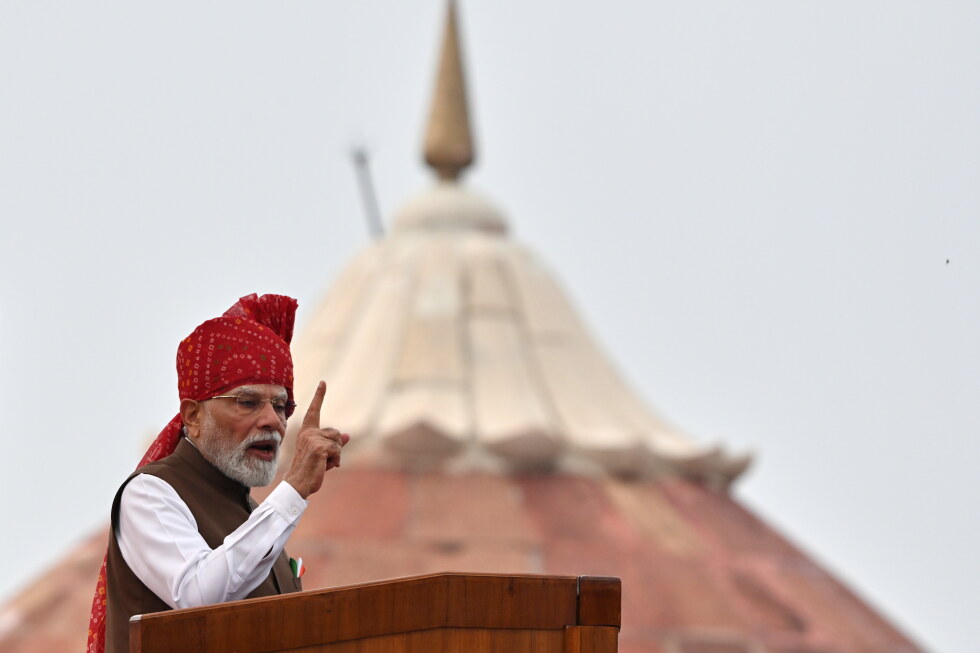
NEW DELHI – Standing atop the historic ramparts of the 17th-century Red Fort on August 15, marking India’s 79th year of independence from British colonial rule, Prime Minister Narendra Modi delivered a landmark national address Saturday that balanced progress updates, security assessments, and new policy commitments. The core announcement from the speech centered on India’s decades-long internal security challenge: the Maoist insurgency, better known locally as the Naxalite movement. Modi confirmed that after years of sustained counterinsurgency security operations, armed Naxal activity is “breathing its last,” drawing the conflict that has roiled central and eastern India for generations close to a final end.
The Naxalite movement, launched in 1967 with a peasant uprising in the West Bengal village of Naxalbari, drew its ideology from Chinese revolutionary Mao Zedong and organized to demand greater rights for landless agricultural workers, marginalized rural poor, and Indigenous communities displaced from forest lands. Over the decades of armed insurrection, the movement challenged state control across huge swathes of central and eastern India, leaving a death toll that counts thousands of civilians, rebel fighters, and Indian security personnel. For years, Indian authorities classified the insurgency as the single greatest threat to the country’s internal stability.
Modi, whose Bharatiya Janata Party (BJP) government took office in 2014, credited his administration’s combined approach of targeted security crackdowns and inclusive development initiatives for the sharp decline in Maoist violence. He argued that the insurgency had robbed generations of young people in affected regions of any chance at a stable future, saying “We have succeeded in clearing armed Naxals from the jungle regions.” But he immediately warned of a new, less visible threat that he labeled “dimagi Naxals” – or intellectual Naxals, who he says hold covert alignment with the insurgency’s ideology.
“These dimagi Naxals are constantly searching for opportunities to stoke violence and social unrest,” Modi stated. “They aim to pull Indian society onto the wrong path, and they must be identified and isolated from public life.”
The term “dimagi Naxal” is an extension of the BJP’s longstanding politically charged label “urban Naxal,” which Modi and other senior party leaders have used for years to describe activists, academics, intellectuals, and public critics of the current government. Political opponents and rights observers warn that these vague, broad labels have become a tool to stigmatize legitimate political dissent, a pattern that has drawn growing international scrutiny. For years, leading global human rights organizations including Amnesty International and Human Rights Watch have accused the Modi administration of using anti-terror legislation, sedition statutes, and foreign funding regulations to crack down on civil society groups, target independent journalists, and silence opposition voices critical of government policy.
The prime minister’s address also came on the heels of recent youth-led political unrest that has presented a rare public challenge to his government. Just weeks before Independence Day, a spontaneous grassroots protest movement calling itself the Cockroach Janta Party gained massive traction on social media, tapping into widespread youth frustration over unemployment and education policy. The movement’s pressure ultimately forced the resignation of Modi’s federal education minister, a major political win for young protestors. While Modi made no direct mention of the Cockroach movement or the recent protests in his address, he centered a large portion of his speech on new policy initiatives specifically targeted at India’s large youth population, alongside a broader push for greater national self-reliance across key economic sectors.
Among the new youth-focused programs announced are expanded artificial intelligence skills training programs and free online coaching for the competitive national entrance exams that determine entry to top civil service roles and higher education institutions. Beyond youth initiatives, Modi outlined a slate of new measures to boost economic self-reliance spanning from domestic defense manufacturing to agricultural innovation.
Looking ahead to the long term, Modi used the independence anniversary to reaffirm his administration’s flagship national goal: transforming India into a fully developed nation by 2047, the 100th centenary of the country’s 1947 independence from British rule. He highlighted India’s economic transformation over the past decade, noting the country has shifted from what he described as a “fragile” emerging economy to the fastest-growing major economy on the global stage today.