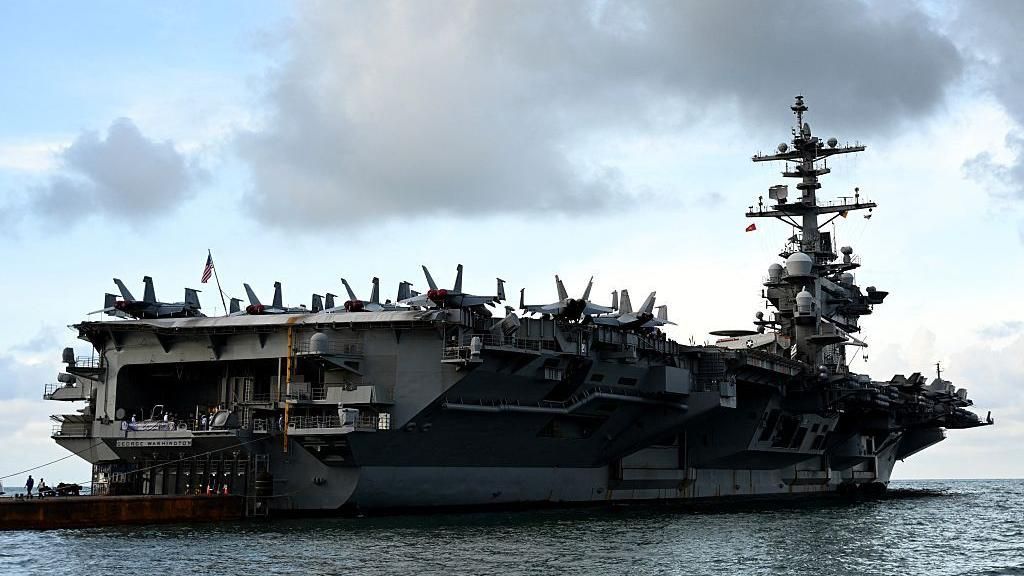
What was originally planned as a Pacific Ocean patrol for the USS George Washington has taken an unexpected shift in course, with the U.S. nuclear-powered aircraft carrier now heading toward the Middle East to relieve the USS Abraham Lincoln. The Lincoln’s deployment, which has stretched to nine months—three months longer than the typical six-month rotation—has sparked widespread public and political outrage after families of the 5,000 sailors onboard revealed severe living conditions, including crippling food shortages and deteriorating mental health among crew.
The USS George Washington departed its home base at Yokosuka, Japan’s naval facility in May to carry out scheduled patrols in the Indo-Pacific, but Pentagon officials confirmed last week it would be rerouted to the Middle East, according to reporting from CBS News, the BBC’s U.S. news partner. As of Thursday, the carrier was operating near Malaysian waters, and analysis from BBC Verify indicates that at its current cruising speed, it is on track to reach Duqm Port in Oman—roughly 500 miles from Iran’s coastline—by around August 22. Once the George Washington arrives in the region, it will join the USS George HW Bush, making three U.S. aircraft carriers deployed in the Middle East, and leaving no U.S. carrier strike groups patrolling the Pacific for the first time in recent years.
Tracking data from BBC Verify confirms the USS Abraham Lincoln has been continuously at sea since December 11 of last year, with its original end-of-deployment date pushed back from May. Multiple family members of sailors have come forward in recent days to share alarming accounts of life onboard the vessel. Reports from Military Times and Stars & Stripes first broke the story that multiple sailors had considered or attempted to jump overboard to escape the harsh conditions, which include broken plumbing systems, poor sanitation, extremely infrequent port stops, chronic crew exhaustion, and persistent shortages of fresh food and other critical supplies.
In an anonymous interview with the BBC, one relative of a Lincoln sailor said their family member has lost 29 kilograms (65 pounds) since deployment began, and suffers from constant exhaustion caused by unrelenting aircraft noise and ship vibrations. The source, who requested anonymity out of fear of professional retaliation against the sailor, confirmed multiple crew members had made attempts to jump overboard. Jefferson Kelly, father of sailor Jackson Kelly who is currently serving onboard the Lincoln, told CBS News that his family has grown increasingly desperate after nine months at sea, far longer than the standard deployment length.
“They should not be deployed this long,” Kelly said. “These are old ships. It’s not like they’re even state-of-the-art. And they take a lot of maintenance, a lot of work. It’s around the clock. I would get on a plane or helicopter tonight if it meant bringing him home to his mom and his siblings and his family.”
Family members have raised urgent alarms that the prolonged deployment and substandard conditions have triggered a widespread mental health crisis among the crew, but the U.S. Navy has pushed back against those claims. While service officials have acknowledged “supply challenges” onboard the Lincoln, they have repeatedly denied any rise in suicidal behavior or a broader mental health crisis. In a statement, the Navy noted that supply disruptions have been caused by ongoing combat-related activities linked to tensions with Iran. Top congressional Democrats have nonetheless joined families in calling for urgent action.
In a joint letter dated Wednesday sent to U.S. Defense Secretary Pete Hegseth and Secretary of the Navy Hung Cao, Connecticut Democratic Senator Richard Blumenthal said that credible reports of shortages and poor living conditions “warrant immediate attention.” The reports, Blumenthal added, also raise broader questions about whether the U.S. Navy can sustain the high operational tempo currently being demanded of its carrier fleet. Hegseth pushed back against the reporting during a press conference Thursday, claiming that many media accounts have been “completely misrepresented.” He told reporters that the U.S. government is committed to ensuring “every ship, every crew, every captain has everything we can provide them at every single moment.”