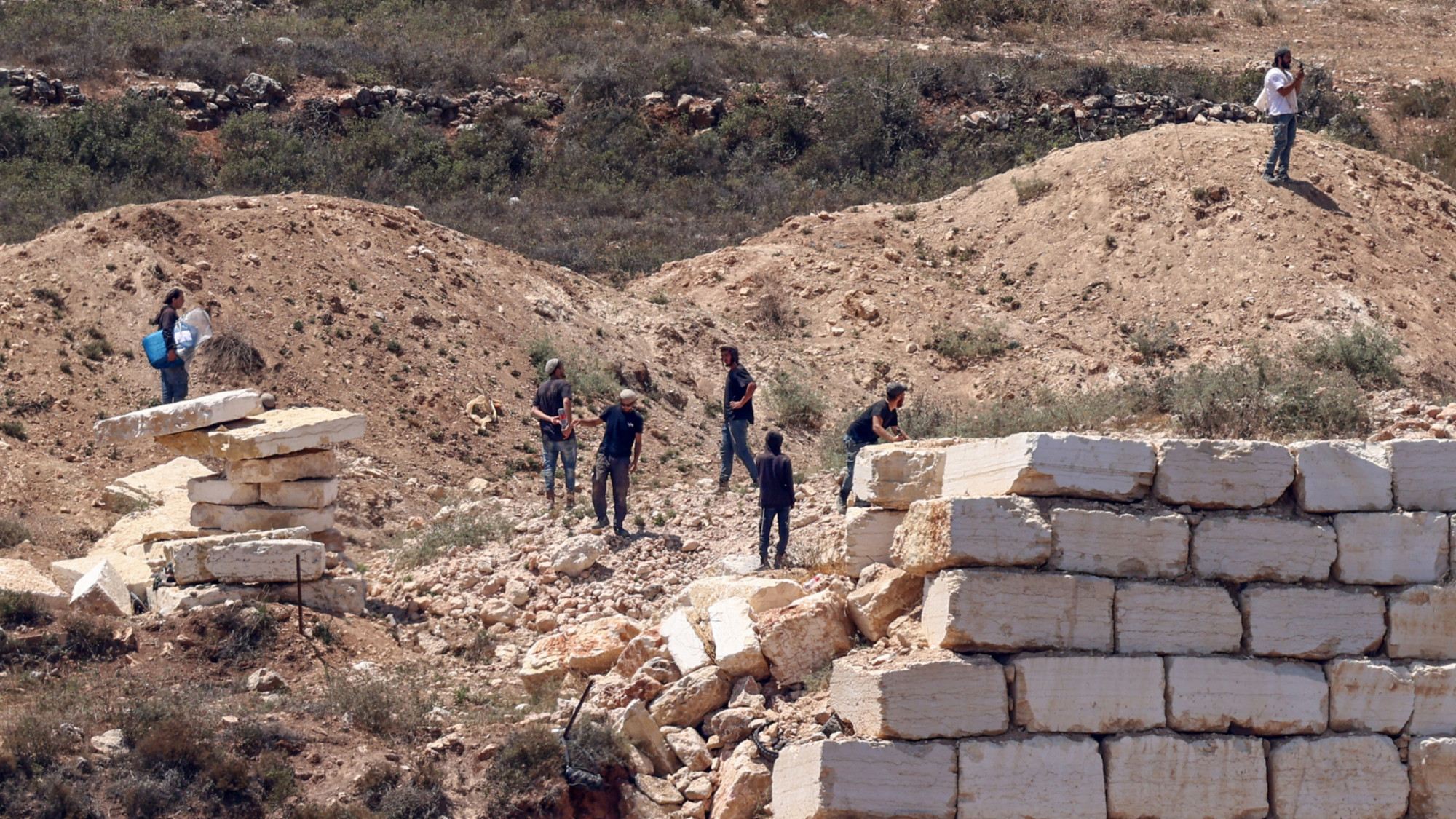
For six straight days, three Palestinian families have been trapped under a settler siege in the occupied West Bank village of Qusra, near Nablus, in a standoff that has exposed alarming gaps between Israeli military announcements and on-the-ground action, even as settler violence across the occupied territories surges to record levels.
The blockade began last Sunday, when a group of Israeli settlers surrounded three residential properties on Qusra’s Ras al-Ain hilltop, erecting tents directly outside the homes in what local residents describe as a deliberate campaign to seize Palestinian-owned land by forcing the families to abandon their properties. Settlers quickly cut off access to running water and electricity for the besieged homes, leaving children and adults trapped inside without reliable access to basic supplies including food and critical medicine.
When the trapped families called on the Israeli army for intervention, arriving troops were captured on online footage socializing with the settlers—drinking and praying alongside them—rather than executing orders to remove the interlopers. After the incident gained widespread international attention, the Israeli military officially announced it had launched an operation to evict the settlers and designated Qusra a closed military zone. To date, however, no settlers have been removed from the area, and no arrests have been issued in connection with the illegal blockade.
Far from targeting the settlers, Israeli forces responded by deploying more than 1,000 troops to Qusra, where they forcibly evicted approximately 20 Palestinian families from their homes and seized eight residential properties to convert into military outposts. Village council head Abdul-Azim Wadi told reporters that military liaison officials informed local leaders the army intended to seize 16 homes, giving residents only immediate eviction orders with no explanation for the seizure. When soldiers later withdrew from some of the seized properties, returning residents found widespread damage: one home had $1,500 stolen and all furniture destroyed, while others had personal property looted. Multiple properties were left with graffiti reading “We will return” scrawled on interior walls by troops.
Qusay Abu Rida, who has been sheltering in one of the three besieged homes to guard the property on behalf of his brother (a U.S. resident who built the home in 2023), said settlers have targeted the land for months. Previous attacks have seen settlers break through the home’s gate, destroy security cameras, and steal outdoor belongings, forcing Abu Rida and his family to move into the property four months ago to defend it from seizure. “They would constantly come into the yard, shouting and vandalising things. Then, on Sunday, they came and erected a tent directly in front of the house, cutting off our electricity and water,” Abu Rida explained to Middle East Eye.
Abu Rida added that Israeli forces have not only failed to remove the settlers, but have actively increased pressure on the trapped families. Soldiers forced Abu Rida and his neighbors out of two homes, confining them to a single smaller property, cut off all remaining access to essential supplies, and banned residents from leaving even to retrieve necessities from their abandoned homes. Though soldiers eventually withdrew from Abu Rida’s home after causing internal damage, and dismantled one settler tent, they also destroyed all security camera footage documenting the siege. Settlers quickly re-erected their tents, restoring the blockade.
Abu Rida noted the pattern of harassment mirrors an incident in nearby Jalud just one month prior, where repeated settler attacks backed by Israeli military inaction forced the al-Tubasi family to abandon their home, which settlers subsequently seized.
Local Qusra activist Hani Odeh described the ongoing crisis as “heartbreaking”, saying settlers and soldiers take turns pressuring Palestinian residents to abandon their land. Three out of four of the village’s expansion zones have already been seized by Israeli forces and settlers, leaving northern Qusra’s Ras al-Ain area as the only space remaining for the village to grow. Odeh explained that settlers have targeted Ras al-Ain for its strategic position overlooking five villages south of Nablus, despite the area being classified as Area B under the 1995 Oslo Accords—an administrative designation that puts the zone under Palestinian civil control, with only security responsibilities shared with Israel. Until recently, the nearest Israeli settlement activity was located 15 kilometers away.
According to Odeh, the encroachment began quietly months ago, when a single settler started grazing livestock in the area. More settlers gradually joined, launching repeated attacks on Palestinian homes to drive residents out. Attempts to deliver aid to the trapped families have been repeatedly blocked by Israeli forces: even Israeli activists who attempted to bring food last Friday were turned away, and an ambulance carrying supplies was also stopped and turned back at checkpoints. “This whole situation is worrying all the residents of Qusra. We don’t know where the settlers will go next after attacking homes in an area classified as Area B. The soldiers do not have the authority to remove the settlers; they only oppress us,” Odeh said.
The ongoing siege in Qusra comes amid a documented sharp spike in deadly settler violence across the occupied West Bank. The United Nations Office for the Coordination of Humanitarian Affairs (OCHA) reports that as of July 20, 2026, it has recorded more than 1,330 settler attacks that caused casualties or property damage across 250 Palestinian communities since the start of the year—an average of more than six attacks per day. So far in 2026, settler violence has killed at least 18 Palestinians, wounded 880 more, and displaced more than 2,300 people from their homes.
Currently, approximately 700,000 Israeli settlers reside in roughly 300 settlements and outposts across the occupied West Bank and East Jerusalem. The International Court of Justice has repeatedly ruled that all Israeli settlements in occupied Palestinian territory violate international law. In recent years, despite the Oslo Accords’ administrative divisions, settlers have increasingly expanded their illegal activity into Area B, a zone previously not targeted for large-scale settlement encroachment.