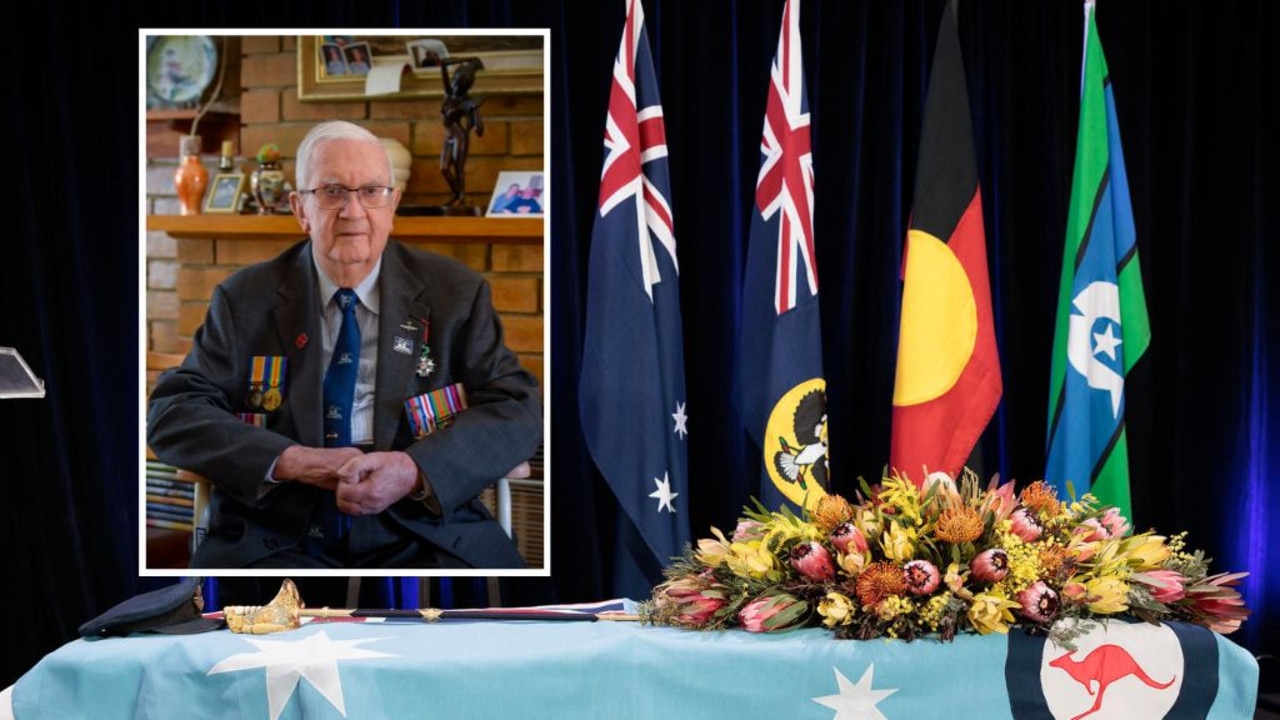
South Australia has gathered to bid a formal, heartfelt farewell to one of its most revered World War II veterans, Angas “Gus” Hughes, who passed away just weeks shy of his 103rd birthday, leaving behind a legacy of extraordinary courage and sacrifice. As the state’s last surviving Bomber Command veteran following the passing of Raymond “Ray” Merrill earlier in 2024, Hughes’ death closes a pivotal chapter in Australia’s wartime military history.
A state funeral, the highest civic honor for a distinguished citizen, was held at the Drill Hall on Adelaide’s Torrens Parade Ground to celebrate Hughes’ life of service. Around 150 mourners including active-duty military personnel, state government dignitaries, and Hughes’ extended family gathered to pay their respects, with the service also streamed online to allow people across the country to join the commemoration. In a mark of national respect, all Australian flags atop South Australian government buildings were flown at half-mast throughout the day of the service.
The ceremony space was decorated with mementos from Hughes’ decades-long connection to the military: his service medals, squadron flags, and personal artifacts that traced his journey from enlistment to his later work supporting the veteran community. His Royal Australian Air Force (RAAF) cap and sword were placed atop his casket as a symbol of his lifelong commitment to his country.
South Australian Premier Peter Malinauskas, one of the featured speakers at the 90-minute service, reflected on the awe-inspiring weight of Hughes’ sacrifice. “It is impossible to comprehend getting into a plane in the knowledge that there is a 45 per cent chance that it will result in the end of his life,” Malinauskas told the gathering. “We have grown up knowing peace and prosperity … the sacrifices cannot be fathomed. His was a life well lived and a story well told.”
Group Captain Greg Weller of the RAAF delivered the formal military eulogy, recalling his 10-year friendship with Hughes. “His story reflects the courage, mateship and airmanship which has become synonymous with the Bomber Command,” Weller said. “His story and legacy will help and inspire future generations.”
Beyond tributes to his military service, family members shared intimate memories of the man behind the medals. Hughes’ grandson Angas Quantrill and granddaughter’s husband James Collison delivered emotional personal tributes, recalling his warmth, humility, and enduring sense of adventure even in advanced age. Collison shared stories of Hughes’ trip to Normandy at 97 years old, and a visit to London where the veteran got to climb back into the cockpit of the same Lancaster bomber he had flown during the war.
The service concluded with a moving rendition of The Last Post, after which attending military personnel stepped forward to place a remembrance poppy on Hughes’ casket, a traditional gesture of respect for fallen service members.
Hughes’ military story is one of remarkable survival and resilience. He enlisted in the RAAF on his 18th birthday, serving as a bomb aimer and navigator with the No. 467 Squadron of Bomber Command, completing 31 dangerous combat operations over the course of the war. In September 1944, just days before his 21st birthday, his Lancaster aircraft was shot down over German-occupied Europe. Hughes managed to parachute to safety, evaded enemy capture for three days, before being taken prisoner. He spent seven brutal months in a German prisoner of war camp, enduring a 200-kilometer forced march across frozen Europe in the depths of winter as Allied forces advanced. Hughes documented his harsh experience in a personal journal, recording that he survived on just one piece of bread a day during the march, wearing the same clothes for the entire 21-day journey.
After returning to Australia at the end of the war, Hughes remained an active and beloved member of the national veteran community, sharing his story with younger generations to preserve the memory of Bomber Command’s sacrifices well into 2024. Post-war, he trained and worked as an accountant until his retirement, and built a loving family life. He was predeceased by his wife Elaine, and is survived by his daughter Sharyn, son Wally, five grandchildren, 10 great-grandchildren, and two great-great-grandchildren.