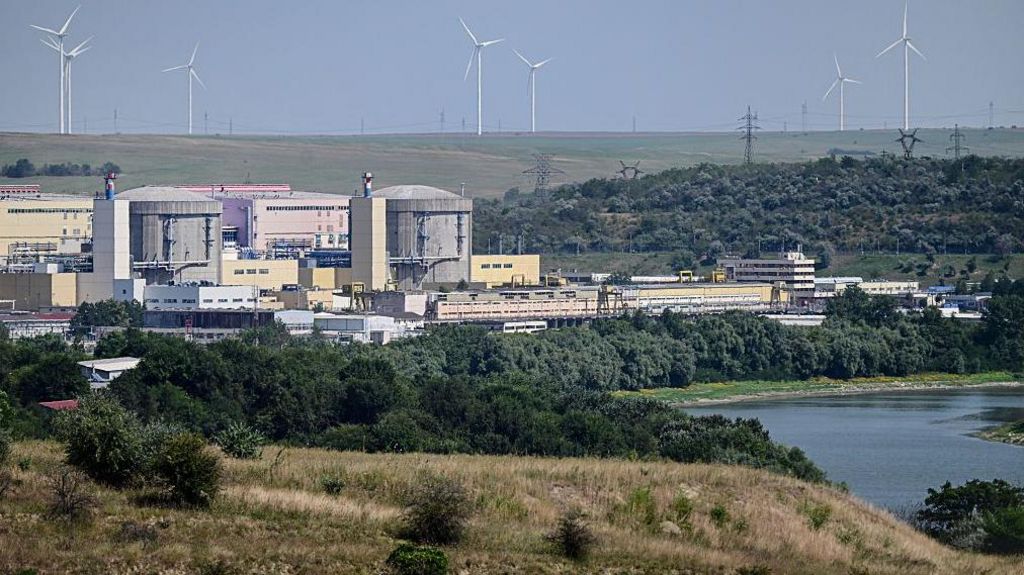
A record-breaking, climate-fueled drought that has parched much of Central and Southern Europe has forced the complete shutdown of Romania’s sole nuclear power facility at Cernavodă, triggering urgent concerns about energy shortages and economic fallout across the continent. The plant, whose two 706-megawatt reactors normally generate roughly 20% of Romania’s total electricity output, relies on water from the Danube — Europe’s second-longest river, where water levels have dropped to 30-year lows across multiple riparian nations. The second and final operating reactor at Cernavodă was taken offline just before midday Thursday, following the shutdown of the first reactor back in July.
Plant director Romeo Urjan confirmed to AFP that no restart is planned for at least the next 10 days, marking only the second time the facility has been fully shut down since it began operations, with the only previous full shutdown occurring in 2003. In a last-ditch effort to raise water levels around the plant’s cooling intake infrastructure, Romanian authorities sank rock-loaded barges in the Danube earlier this week, but the intervention failed to reverse the falling water levels enough to keep the reactors running.
Neighboring Hungary, which also operates its only nuclear plant — the Soviet-era Paks facility with four reactors — on the Danube, has so far avoided a similar shutdown, but the threat remains imminent. Last month, Hungarian Prime Minister Péter Magyar warned that Paks could be forced to shut down entirely for the first time in its history if water levels continue to drop. Plant officials have already noted that Danube levels are so low that some of the facility’s water intake suction nozzles are no longer fully submerged.
The full shutdown of Cernavodă has created an immediate gap in Romania’s energy grid that officials are scrambling to fill. While solar and wind generation are able to offset most of the shortfall during hot, windy daylight hours, evening demand requires increased output from coal and gas-fired power plants, as well as additional energy imports from neighboring countries. Romania’s large hydropower sector, which could otherwise fill the gap, has also seen its output slashed dramatically by the same low river levels that forced the nuclear shutdown.
Beyond energy security, the ongoing drought and accompanying extreme heat waves are causing widespread disruption across the European continent. Key waterways including the Rhine are seeing record-low levels that have severely restricted commercial shipping traffic, while the agricultural sector has suffered billions of euros in damage. Italy’s largest agricultural trade association Coldiretti estimates that climate-related damage from drought, hailstorms and wildfires this year could exceed €3 billion. In France, Environment Minister Monique Barbut warned that recent heat waves could result in between €10 billion and €15 billion in combined direct and indirect economic losses.
The extraordinary conditions have even revealed long-submerged remnants of history: dozens of sunken World War II ships that have sat hidden beneath the Danube’s waters for decades have now re-emerged as levels have dropped. Across Western Europe, the heat wave has pushed temperatures to record levels. On Thursday, temperatures at London’s Kew Gardens provisionally reached 38.1°C (100.6°F), which would mark the hottest day recorded in the United Kingdom so far this year if confirmed. Some parts of England already saw temperatures top 37°C (99°F) earlier the same day.
Scientists from the European Union’s Copernicus Climate Change Service confirm that climate change is the primary driver of these extreme conditions, noting that Europe is warming twice as fast as the global average, making it the fastest-warming continent on Earth. This accelerated warming is leading to more frequent and intense summer heat waves, increasing water scarcity, and spurring more severe wildfire seasons across the continent. Economists warn the extreme conditions could already erase much of the European Union’s projected economic growth for the year. Dutch bank Triodos noted that the EU’s projected 1.1% annual growth, and the International Monetary Fund’s 0.9% growth forecast for the euro area, are at severe risk from the cascading impacts of the drought and heat wave.