North of Jericho in the occupied West Bank, Ein al-Auja once stood as a lush, life-giving Palestinian oasis: a cascading natural spring whose waters flowed at more than 1,000 cubic meters per hour, sustaining hundreds of people, thousands of hectares of irrigated farmland, and a tight-knit Bedouin community that had called the land home for generations. Today, that oasis is a hollowed-out shell, its spring reduced to a faint trickle, its soil parched and cracked, and its entire Indigenous population displaced to remote, underserved encampments miles away. For Haitham Rashaidh, one of the last residents to abandon Ein al-Auja, the departure was not a choice—it was the breaking point of years of relentless pressure.
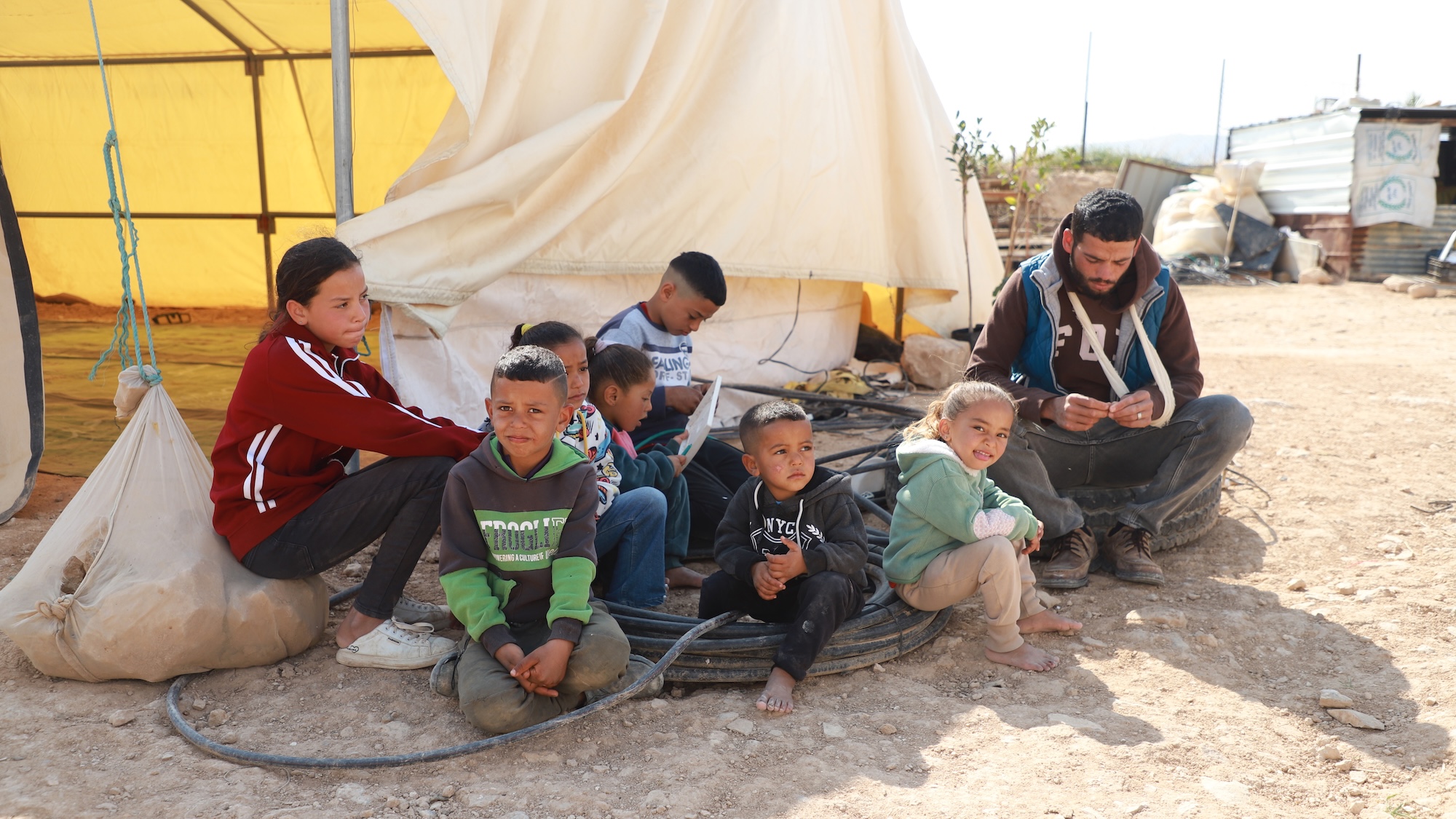
Rashaidh’s family packed their tents and loaded all their possessions onto a tractor earlier this year, trekking two hours across rough terrain to al-Balqa, a sparsely populated stretch of the Jordan Valley where they now camp alongside dozens of other displaced neighbors. “Leaving Ein al-Auja felt like losing a part of ourselves,” Rashaidh told Middle East Eye in an interview. For years, he said, his community resisted repeated attempts to push them out. “We did not leave the first time they tried to push us out. We came back, rebuilt what we could, and tried to continue our lives. But it didn’t stop. Every time we returned, the pressure came back stronger: more restrictions, more attacks, less access to water.” By January 2026, the community could endure no more.
For displaced families in al-Balqa, the consequences of displacement are immediate and devastating. The remote encampment has no access to public services, and the nearest city center is more than two hours away. Rashaidh’s children can no longer attend school regularly, a reality shared by dozens of displaced children across the area. The crisis in Ein al-Auja has accelerated dramatically since the October 7 attacks and the outbreak of the Gaza war, reshaping life for Palestinian communities across the occupied West Bank.
United Nations Office for the Coordination of Humanitarian Affairs (OCHA) data underscores the sharp escalation of violence: between 2017 and 2023, the agency recorded just two settler attacks resulting in casualties or property damage in the Ein al-Auja area. Since early 2024, however, Israeli settlers have established multiple new illegal outposts in the region, pushing the number of documented attacks to at least 38 in 2025 alone. Access to water has become the primary battleground, OCHA noted in a January 2026 report: settlers linked to the new outposts have repeatedly cut and damaged water pipes connected to the Ein al-Auja spring, blocked access roads for water delivery, emptied residential water tanks, and assaulted residents and herders attempting to collect water, destroying local livelihoods in the process. In one high-profile incident earlier this year, 124 people across 26 families were forcibly displaced amid coordinated violence by armed settlers and Israeli troops.
Environmental researchers trace the spring’s collapse to both systemic water diversion by Israeli authorities and compounding pressure from climate change. Ayman Abu Zaher, an environmental researcher who monitors the local hydrological system, explained that Ein al-Auja draws its water from a deep regional aquifer. Historically, three state-managed wells in the area reached depths of 500 to 600 meters, but over the past three decades, Israeli authorities have deepened these wells to nearly 1,000 meters and added a fourth. Collectively, these wells pump between four and six million cubic meters of water annually from the deep aquifer—water that is almost entirely diverted to nearby Israeli settlements, rather than supplied to local Palestinian communities.
Local Palestinian wells, by contrast, are limited to the shallow aquifer and rarely exceed 100 meters in depth, leaving them insufficient to meet community needs. Abu Zaher estimates that the spring’s flow has dropped by 50 to 70 percent in recent years, and it often runs completely dry during dry seasons. Where more than 3,000 hectares of irrigated orchards and cropland once covered the Ein al-Auja area, only 300 hectares remain actively farmed today, pushing the region toward accelerating desertification.
For displaced women like Naifa Zaied, who relocated to al-Balqa earlier this year, the water crisis has rewritten daily life. When the community lived near Ein al-Auja, women could fill their household water containers at the spring in minutes. Now, Zaied said, they must walk kilometers under the scorching Jordan Valley sun to find water tankers or distribution points, and they are often turned away by Israeli forces or left empty-handed when supplies run out. “We used to have water close to us. Today, every litre has become a struggle,” Zaied said. “Sometimes we wait for water tankers that never arrive, and we are forced to save water for drinking before anything else.”
The crisis has extended beyond household survival to destroy traditional Bedouin livelihoods across the region. Repeated settler raids, livestock theft, and movement restrictions have left herding families with massive losses: in one early 2025 raid, settlers stole roughly 1,500 sheep and goats from the Ein al-Auja community, and dozens of animal carcasses were found the following day. With their land and livestock gone, many displaced Bedouin men have been forced to take unregulated, low-wage work in nearby Israeli settlements, commuting through dangerous checkpoints with no work permits or legal protections. Rashaidh, who once farmed and raised livestock, now works as a day laborer on a date palm farm near al-Balqa. “It is a highly risky environment, without work permits, and many of us are injured or arrested while going to or returning from work,” he said.
Displacement has also fragmented long-standing community social support networks and cut off access to basic services. Many children now miss school regularly due to the long, unsafe commute from al-Balqa, and the community is cut off from the hospitals and markets they once relied on. “Everything has become far. Even reaching basic services takes hours now,” one anonymous displaced resident told MEE. “We are cut off from the places we used to depend on.”
Ein al-Auja’s collapse has also devastated the local tourism industry, which once drew Palestinian and international visitors to its scenic waterfall and mountain trails. The region already saw a massive drop in tourism revenue after the 2023 Gaza war outbreak, and repeated attacks on visitor groups have deterred what little traffic remains. In January 2023, a group of international hikers including American, Italian, and French nationals was confronted by armed settlers who attacked the group with clubs and pepper spray, injuring two people. Israeli forces took hours to arrive and secure the group’s exit. Today, the roads that once carried tour buses and weekend visitor traffic are nearly empty, and local vendors go hours without customers. “We used to wait for buses coming from the northern and southern West Bank every weekend, but now traffic has become almost nonexistent,” said Muhammad Taha, a Jericho-based vendor.
For the displaced families, a court petition to Israel’s High Court has become their last formal hope of returning to their land. Last year, residents petitioned the court to order the dismantling of the illegal settlement outposts encroaching on Ein al-Auja and to guarantee their safe return. The Israeli state has denied any formal evacuation policy, arguing there is no barrier to residents returning, despite the ongoing violence and water access restrictions that made life untenable.
In February 2026, the court ordered Israeli authorities to facilitate the community’s return and submit a security plan within 60 days. By April, the state had missed the deadline, and petitioners asked the court to compel compliance. The state continues to contest the order, arguing it has no obligation to station permanent security forces in the area. The case follows a familiar pattern for Palestinian land rights petitions: most are rejected or stalled indefinitely in Israeli courts, which grant the state broad discretion over land management even when long-term Palestinian residency is well-documented. By the time the court issued its February order, the last families had already left Ein al-Auja.
Today, the oasis is silent. There are no children’s voices, no grazing herds, no vendors serving visitors. Only the wind blows across the cracked, dry soil where a community once thrived. Back in al-Balqa, Rashaidh says international and regional solidarity is the only path forward for displaced Palestinian communities facing expanding settler pressure. “No one leaves their land willingly, and that is one of the hardest things in life,” he said. “But to stand alone is not enough. We defended our land alone, and we lost our land, our livestock and our water. If we do not stand together, we will all lose.”
This report was produced as part of the 2026 Middle East Eye Fellowship.